
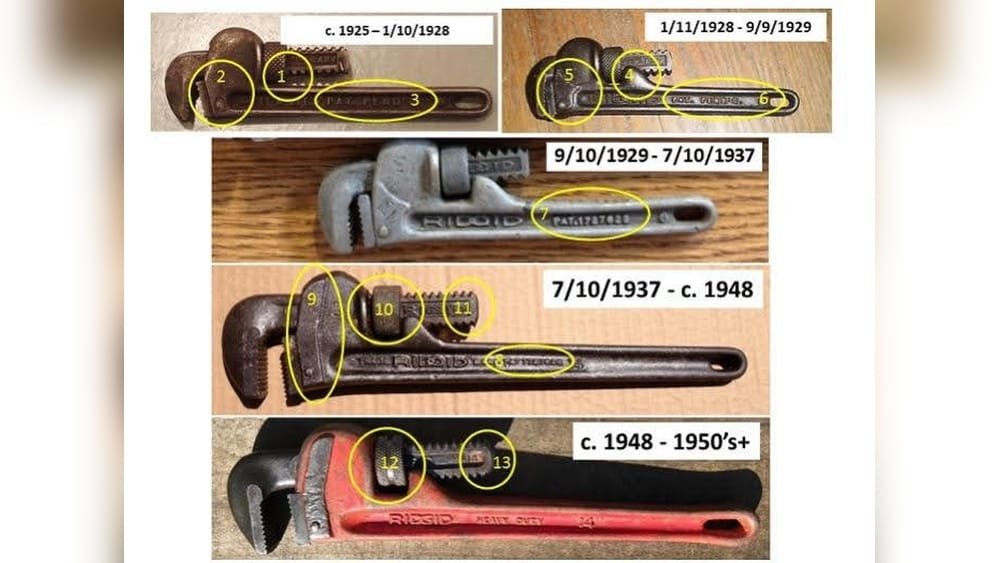
When I first started working with tools, I often saw a Ridgid pipe wrench in the toolbox but didn’t pay much attention to the numbers or markings on it. One day, a friend asked, “Can you tell how old your pipe wrench is?” I had no idea. That was the start of my journey into figuring out how to date a Ridgid pipe wrench. If you have a Ridgid pipe wrench and want to know its age, you’re not alone. I learned that dating these wrenches isn’t always easy, but it can be done if you know what to look for.
In this article, I’ll walk you through everything I’ve learned about identifying the age of a Ridgid pipe wrench. I’ll share the methods that actually worked for me, the common mistakes I made, and a few things I wish I’d known earlier.
Whether you’re a collector, a professional, or just curious, this guide will help you feel confident about dating your Ridgid pipe wrench.
Why Dating A Ridgid Pipe Wrench Matters
You might wonder, “Why does it matter how old my pipe wrench is?” I used to think the same. Over time, I found several reasons:
- Collectors want old tools for their history and value.
- Tradespeople like knowing the quality or changes in design.
- Repair or restoration sometimes needs matching parts.
Dating a tool can also be fun. I once found a wrench in my grandfather’s shed, and dating it helped me connect with his past. It’s a small way to hold onto a bit of history.
The Main Features To Check
Before you try to date your Ridgid pipe wrench, you’ll need to look at a few key features. Each gives clues about how old it is. Here’s what I always check first:
1. Manufacturer’s Markings
The first thing I look for is the brand name and location. Ridgid wrenches usually have “RIDGID” cast into the handle. Older ones might say “RIDGE TOOL CO.” and list the city and state, like “ELYRIA, OHIO, U.S.A.”
Sometimes, the style of the lettering changes over the years. For example, I noticed that the font on a 1950s wrench looked different from one made in the 1980s. These small details can narrow down the age.
2. Model Numbers
Most Ridgid wrenches have a model number stamped or cast into them. Popular models include the 10, 12, 14, 18, and 24. The model number alone doesn’t tell you the age, but it helps when you compare with Ridgid catalogs.
3. Patent Dates
Many older wrenches have a patent number or a patent date. I once found “PAT. NO. 1727623” on an old wrench. By searching online for that patent, I found it was granted in 1929. If your wrench has a patent date, you know it can’t be older than that.
4. Serial Numbers
Some Ridgid wrenches have a serial number. These are less common, but if you find one, write it down. Ridgid’s customer service can sometimes help you identify the year using this number.
5. Design Changes
Over the decades, Ridgid changed the shape of the handle, the teeth, and the adjustment nut. For example, older wrenches have a rounder handle, while newer ones are more squared. The jaw design also changed to improve grip.
Here’s a quick comparison that helped me date two wrenches:
| Feature | Older Wrench (1940s-50s) | Newer Wrench (1990s+) |
|---|---|---|
| Handle Shape | More rounded | Squared edges |
| Jaw Teeth | Fewer, deeper grooves | More, finer grooves |
| Adjustment Nut | Larger, heavier | Slimmer, lighter |
These differences are small, but when you compare two wrenches side by side, you’ll notice them.
Using Ridgid Catalogs And Guides
Another big help for me was searching for old Ridgid catalogs. Many are online, and they show pictures and descriptions of wrenches from different years. I once matched a wrench to a 1965 catalog just by the handle shape and model number.
Ridgid’s official website also has a history section. You can compare your wrench to pictures there. If you have a model that isn’t sold anymore, the catalog can give you a date range.
Here’s how I use catalogs:
- Find the model number on your wrench.
- Search for “Ridgid [model number] catalog year.”
- Compare the handle, jaw, and markings to the pictures.
- Check for special features, like the adjustment nut shape or color.
It’s not always exact, but you can often get within a decade.
Looking For Date Codes
Some Ridgid tools, especially newer ones, have a date code. Usually, it’s a small stamp with letters or numbers. I found one on a pipe wrench from the 2000s: “K12.” After some research, I learned that “K” stood for the month (November), and “12” for the year (2012).
Not all wrenches have this, but it’s worth checking near the hinge, jaw, or inside the handle. If you see a code you don’t understand, try searching for “Ridgid date code chart. ” The company sometimes changes their system, so it’s not always obvious.
Paint And Finish
The color and finish can give clues, too. Early Ridgid wrenches were often plain steel or had a black finish. Later, they used bright red paint. If your wrench is painted, see if the paint is original or added later.
Here’s a table with the paint changes I’ve noticed:
| Time Period | Paint/Finish |
|---|---|
| 1920s-1940s | Plain steel, dark or no paint |
| 1950s-1970s | Red paint, matte finish |
| 1980s-present | Glossy red paint |
Paint isn’t a perfect clue, but it helps you spot if a wrench is likely older or newer.
Real Examples From My Collection
I’ll share two cases from my own toolbox to show how I figured out the age.
Example 1: The Mystery Wrench
I found a battered Ridgid 14-inch wrench in my dad’s garage. It had “RIDGE TOOL CO. ELYRIA, OHIO U. S. A. ” on the handle, a model number 14, and a patent date of “PAT. NO. 1727623. ” The handle was thick and round, the paint mostly worn off.
Here’s what I did:
- Searched for the patent number online. Found it was from 1929.
- Checked old catalogs and saw the same handle shape in the 1940s and 1950s catalogs.
- Looked at the paint—very little was left, but it was dark, not bright red.
From this, I guessed the wrench was made in the late 1940s or early 1950s.
Example 2: The Modern Find
A new Ridgid wrench I bought last year had “RIDGID” on the handle, a shiny red finish, and a code “F21” near the hinge.
- I searched for “Ridgid date code F21” and found a chart on a tool forum.
- “F” is June, “21” is 2021.
- The wrench looked and felt more modern—lighter and smoother.
This one was easy to date to June 2021.

Common Mistakes To Avoid
When I first started, I made a few mistakes that wasted time:
- Assuming the model number is a year. Ridgid model 18 doesn’t mean 1918 or 2018. It’s just the size.
- Not checking both sides. Sometimes, markings or codes are only on one side of the wrench.
- Trusting only the paint. Paint can be changed, and old wrenches are sometimes repainted.
- Over-cleaning the tool. One time, I scrubbed too hard and removed a faint date code. Clean gently.
If you avoid these, you’ll have better luck figuring out your wrench’s age.
Getting Help From Ridgid And Online Forums
If you’re stuck, don’t be afraid to ask for help. I sent photos to Ridgid’s customer service once, and they replied with helpful info about the wrench’s age. Online forums like Garage Journal or Practical Machinist are full of people who know a lot about old tools.
Sometimes, all you need is a good photo and a question.
A great resource is the Ridgid Wikipedia page for background on the company’s history.
What If You Can’t Find An Exact Date?
Sometimes, you just can’t pin down the exact year. That’s okay. Even getting close—like “mid-1950s” or “early 2000s”—is helpful for most people. If you’re selling or collecting, say “circa 1950s” or “approximately 1980s. ” No one expects you to be perfect unless you’re a serious collector.
Two Insights I Wish I Knew Earlier
When I started, I missed two important things:
- Small design changes can be key. I ignored the adjustment nut shape at first, but later learned it changed in the 1970s. If you notice a small detail, it might be important.
- Patent dates are minimum ages. If a wrench has a 1940 patent, it can’t be older than that, but it might be newer. Use patent dates as a lower limit, not the exact year.

My Simple Step-by-step Process
Here’s the method I use now, after a lot of trial and error:
- Look for all markings: Brand, model, patent, serial.
- Check both sides of the wrench.
- Search for any patent numbers or codes online.
- Compare the wrench to catalog pictures.
- Note the paint and finish.
- Ask in forums or contact Ridgid if you need help.
This process works for almost every Ridgid wrench I’ve seen.
Frequently Asked Questions

What Is The Oldest Ridgid Pipe Wrench?
The oldest Ridgid pipe wrenches date back to the early 1920s, soon after the company was founded in 1923. These early wrenches often have plain steel handles and simple markings like “RIDGE TOOL CO. ” They’re rare and valuable to collectors.
Where Can I Find Ridgid Wrench Catalogs?
You can find old Ridgid catalogs online by searching for “Ridgid tool catalog year. ” Some websites and tool forums have scanned copies. Ridgid’s own website also has a history section with pictures.
What If My Wrench Has No Markings?
If your wrench has no markings, it may have worn off from use. Try comparing the shape, jaw style, and size to known Ridgid models in catalogs or online photos. Sometimes, you can still identify the age by the design.
Does The Color Of The Wrench Always Tell The Age?
No, the color is just a clue. Many old wrenches have been repainted, and paint colors changed over time. Use color together with other features like markings and shape.
Can Ridgid Customer Service Help Me Date My Wrench?
Yes, Ridgid’s customer service is helpful if you have a serial number or clear photos. Send them detailed pictures and any markings, and they might be able to tell you the approximate age.
If you have a Ridgid pipe wrench and want to know its story, I hope my experience helps you. Take your time, look closely, and enjoy connecting with the history of your tool. Every old wrench has a story to tell—sometimes, all you need is a sharp eye and a bit of patience to find it.
As an Amazon Associate, We earn from qualifying purchases