
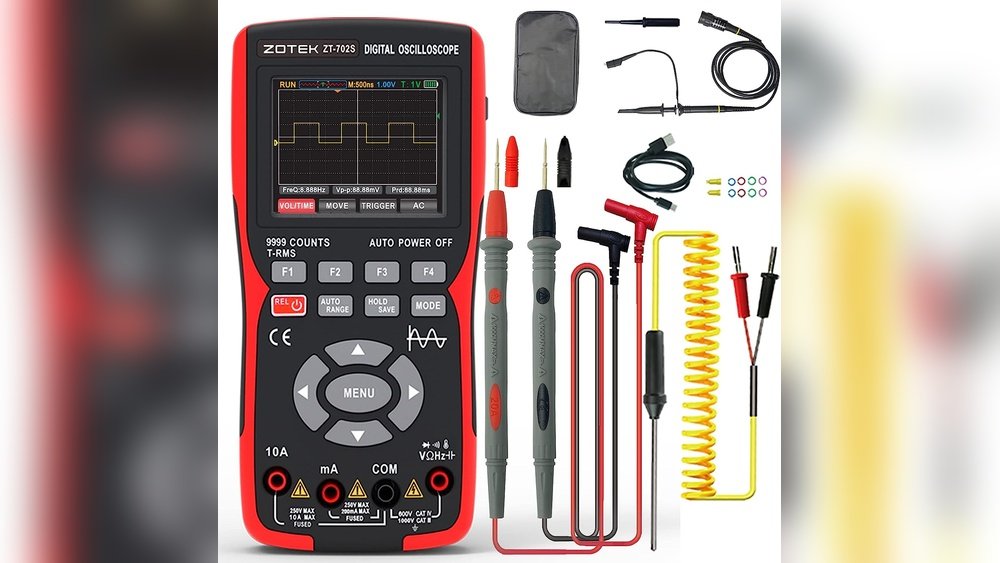
An oscilloscope and a multimeter are two of the most common tools in electronics, but many people—especially beginners—struggle to understand the real differences. Maybe you want to fix a broken device, study electronics, or choose the right tool for your workshop.
Picking between these two instruments isn’t just about price or appearance; it’s about what you actually need to measure. Understanding their differences, strengths, and limitations saves you time, money, and frustration. Let’s explore exactly how oscilloscopes and multimeters compare so you can confidently decide which fits your needs.
What Is An Oscilloscope?
An oscilloscope is a device that lets you see electrical signals as a moving graph on a screen. Instead of just showing one number, it displays how voltage changes over time. This makes it possible to see the shape, frequency, and timing of signals.
Oscilloscopes are essential for analyzing complex circuits, troubleshooting problems, and designing electronics. Professionals use them in laboratories, factories, and repair shops. Even hobbyists find them valuable for testing audio gear, microcontrollers, or radio equipment.
Some common features of oscilloscopes:
- Display: Shows real-time waveforms.
- Input Channels: Usually 2-4, letting you compare signals.
- Time Base: Lets you zoom in/out on fast or slow signals.
- Trigger: Helps stabilize repeating signals so you can study them.
Modern oscilloscopes often store data, let you export screenshots, and include math functions. They are sometimes called “scopes” for short.
What Is A Multimeter?
A multimeter is a handheld device that measures basic electrical quantities. The three main functions are:
- Voltage (V): Measures electrical potential difference.
- Current (A): Measures the flow of electric charge.
- Resistance (Ω): Measures how much a material resists current.
Many multimeters also test continuity, diodes, and sometimes temperature or frequency. There are two main types:
- Analog multimeters: Use a moving needle to show values.
- Digital multimeters (DMMs): Show values as numbers on a screen. These are more common today.
You’ll find multimeters in almost every toolbox, from car repair to home electricians. They are portable, easy to use, and affordable.

Key Differences Between Oscilloscope And Multimeter
While both tools measure electricity, their approach and results are very different. Here’s a comparison to clarify:
| Feature | Oscilloscope | Multimeter |
|---|---|---|
| Display | Shows graphs (waveforms) | Shows numbers only |
| Measures | Voltage vs. time, frequency, waveform shape | Voltage, current, resistance (sometimes more) |
| Best for | Seeing signal details, troubleshooting timing issues | Checking values, basic diagnostics |
| Speed | Captures fast, changing signals | Measures slow or steady values |
| Complexity | More complex, requires learning | Easy to use |
| Price | More expensive | Affordable |
Oscilloscopes show the “whole story” of a signal. Multimeters give you just a “snapshot” (a single value).
When To Use An Oscilloscope
Oscilloscopes shine when you need to:
- View signal waveforms: Check if a signal is a perfect sine wave, square wave, or has noise.
- Measure frequency or period: Useful for audio, radio, or clock signals.
- Analyze glitches: Spot short spikes or drops that happen too fast for a multimeter.
- Compare signals: With two channels, you can see input vs. output at the same time.
- Debug digital circuits: See if pulses are correct or if signals overlap.
A multimeter cannot show you if a signal is clean or noisy, or if it is changing shape. For example, if you’re troubleshooting a microcontroller, the oscilloscope reveals if the clock is running or if there are timing problems.
Example: In audio electronics, an oscilloscope shows whether an amplifier is distorting sound. The waveform on the screen tells you if the signal is clipped or noisy.
When To Use A Multimeter
A multimeter is the go-to tool for:
- Checking battery voltage: Is it charged or dead?
- Measuring current draw: Is a device using too much/too little power?
- Testing resistance: Are resistors in tolerance? Is a wire broken?
- Continuity tests: Is a connection open or closed?
- Simple diagnostics: Find faulty components in power supplies, appliances, or vehicles.
Multimeters are fast for “yes or no” answers. They’re perfect for repairs, installation, or quick checks.
Example: If a light doesn’t work, use a multimeter to check if voltage is present, if the bulb is blown (infinite resistance), or if a fuse is open.
How Oscilloscopes And Multimeters Measure Signals
Understanding how each device works helps you see their strengths and limits.
Oscilloscope Measurement Process
Oscilloscopes sample the voltage many times per second (thousands to millions). Each sample becomes a dot on the screen. These dots connect to form a waveform. You can adjust:
- Vertical scale: How much voltage each division shows.
- Horizontal scale: How much time each division shows.
- Trigger: Stabilizes the waveform for repeated signals.
Digital oscilloscopes can capture, freeze, and zoom in on rare events. This lets you analyze problems that happen only sometimes (like electrical “glitches”).
Multimeter Measurement Process
Multimeters measure by connecting to the circuit. They:
- Read voltage across two points.
- Pass a small current to measure resistance.
- Interrupt the circuit to measure current.
Digital multimeters sample slowly (usually 2–5 times per second). This is fine for steady signals, but too slow for fast-changing ones.
Key insight: If a signal is not steady—like a quick pulse or noisy voltage—a multimeter might just show “0” or the average value. An oscilloscope reveals the real shape.
Advantages And Disadvantages
Both tools have strengths and weaknesses. Here’s a clear breakdown:
Oscilloscope Advantages
- Visualizes signals: See timing, shape, and problems directly.
- Captures fast events: No missed glitches or spikes.
- Multiple channels: Compare two or more signals at once.
- Advanced features: Math functions, storage, analysis.
Oscilloscope Disadvantages
- Higher cost: Entry-level scopes start around $200; advanced models run thousands.
- Learning curve: Settings and controls take practice.
- Bulky: Less portable than a multimeter.
- Requires power: Most need AC; battery models are limited.
Multimeter Advantages
- Affordable: Good models cost $20–$100.
- Easy to use: Simple controls and clear numbers.
- Portable: Pocket-sized and battery powered.
- Versatile: Measures voltage, current, resistance, continuity.
Multimeter Disadvantages
- Shows only numbers: No way to see signal shape or timing.
- Slow: Misses fast events.
- Limited features: Can’t analyze or store data.
Real-world Examples: Scope Vs Multimeter
Let’s look at a few practical situations to see which tool fits best.
- Testing an audio amplifier: You want to know if there’s distortion at high volume. The multimeter shows voltage, but only the oscilloscope reveals if the output waveform is clipped.
- Checking a car battery: The multimeter instantly shows voltage and can help test charging current. The oscilloscope is overkill here.
- Troubleshooting a microcontroller circuit: You need to see the timing of digital pulses or clock signals. The oscilloscope is essential.
- Installing a new outlet at home: The multimeter checks voltage, continuity, and safety. Oscilloscope is not needed.
- Finding a noisy power supply: The oscilloscope can show ripple or switching noise that a multimeter cannot detect.
Non-obvious insight: Many beginners try to measure fast-changing signals with a multimeter and get confusing results. For any signal that is not steady, the oscilloscope is the right tool.
How To Choose: Which Tool Do You Need?
Deciding between an oscilloscope and a multimeter depends on your work.
- For basic electrical work: Choose a multimeter. It’s all you need for wiring, home repair, batteries, and automotive jobs.
- For advanced electronics: Choose an oscilloscope. It’s necessary for audio, radio, microcontrollers, and signal analysis.
- For education and learning: If you are studying electronics and want to “see” what’s happening, an oscilloscope helps you understand concepts deeply.
Many professionals own both. They use a multimeter for fast checks and an oscilloscope for deep analysis.
Common mistake: Some buyers pick a multimeter because it’s cheaper, but later discover they can’t troubleshoot complex circuits. Think ahead about your needs.
Key Specifications To Compare
Before buying, compare these important specs:
| Specification | Oscilloscope | Multimeter |
|---|---|---|
| Voltage Range | Up to 300V (typical) | Up to 1000V (typical) |
| Current Range | Not direct (needs probe) | 10A (typical) |
| Frequency Range | Up to 100 MHz+ (model dependent) | 1 kHz–100 kHz (if available) |
| Sampling Rate | 1–5 GS/s (Gigasamples/sec) | 2–5 samples/sec |
| Portability | Desktop or benchtop | Pocket-sized |
Pro tip: For high-voltage or high-current work, always check the safety category (CAT rating) of your instrument.
Digital Oscilloscope Vs Digital Multimeter
Both tools have evolved with technology. Modern digital versions offer more features:
- Digital oscilloscopes: Store and analyze data, connect to computers, and allow screenshots.
- Digital multimeters: Offer auto-ranging, data hold, and sometimes Bluetooth for logging.
Example: A digital oscilloscope can capture a one-time glitch, while an analog scope cannot. A digital multimeter can store max/min readings.
Safety Considerations
Both tools can be dangerous if used incorrectly. Here’s how to stay safe:
- Always check the input rating: Do not exceed voltage or current limits.
- Use proper probes: Only use leads rated for your voltage.
- CAT ratings: Higher numbers (CAT III, CAT IV) mean safer for tough environments.
- Disconnect power: Before measuring resistance or continuity.
- One hand rule: For high voltage, keep one hand in your pocket to reduce shock risk.
Non-obvious insight: Cheap or fake tools may not have real safety ratings. Always buy from trusted brands.

Cost And Value
Oscilloscopes and multimeters range widely in price.
- Entry-level multimeters: $20–$50. Good enough for most home and auto use.
- Professional multimeters: $100–$500. More accurate, safer, more durable.
- Entry-level oscilloscopes: $200–$400. Useful for education and hobby.
- Professional oscilloscopes: $1000–$10,000+. High bandwidth, advanced features.
Tip: For beginners, a good multimeter plus a basic USB oscilloscope (connects to your computer) may be more affordable than a full-size bench oscilloscope.
Common Mistakes When Using Each Tool
With Oscilloscopes
- Wrong probe setting: Probes often have “x1/x10” switches. Using the wrong setting gives wrong readings.
- Incorrect ground connection: Can create ground loops and noise.
- Too much signal: Exceeding voltage limits can destroy the oscilloscope.
- Ignoring bandwidth: Using a slow scope for fast signals leads to wrong results.
With Multimeters
- Wrong mode: Measuring voltage in current mode blows the fuse.
- No fuse check: If the current fuse is blown, readings are false.
- Measuring live circuits in resistance mode: Damages the meter.
- Using cheap probes: Leads can break or give unsafe readings.
Pro tip: Always double-check your settings before connecting to a circuit.
How Oscilloscope And Multimeter Work Together
In many situations, you use both tools:
- Step 1: Use a multimeter to check for power and basic faults.
- Step 2: If you find a problem, use the oscilloscope to analyze the signal in detail.
For example, if a circuit isn’t working, the multimeter shows if voltage is present. If yes, but the circuit still fails, the oscilloscope might reveal noise or missing pulses.
Insight: A multimeter is like a thermometer—it tells you the temperature. An oscilloscope is like a camera—it shows you the whole scene.
Advanced Features And Specializations
Some oscilloscopes and multimeters offer extra features:
- Oscilloscope features: FFT analysis (shows frequency content), serial protocol decoding, data logging, USB/PC connectivity, math functions.
- Multimeter features: Capacitance, frequency, temperature, data logging, Bluetooth.
Example: Modern oscilloscopes can decode signals like I2C or SPI directly, which is very helpful for digital electronics.

Who Needs Which Tool?
- Students: A simple multimeter for labs, an oscilloscope for advanced studies.
- Repair technicians: Both—multimeter for quick checks, oscilloscope for deep faults.
- Hobbyists: Start with a multimeter, add an oscilloscope as you build more.
- Engineers and designers: Both are essential for serious circuit design.
Learning Curve And Practical Tips
Oscilloscopes take more practice to master. Start with simple signals (like a battery and resistor) before moving to complex circuits. Read the manual and watch online tutorials.
Multimeters are easier. Learn to safely measure voltage, current, and resistance. Practice continuity checks on wires and fuses.
Tip: For oscilloscopes, always check probe calibration before use. For multimeters, keep spare fuses.
The Future: Smart Tools
New smart oscilloscopes and multimeters connect to smartphones or computers. They offer data logging, cloud storage, and remote monitoring. This trend makes both tools easier for beginners and more powerful for experts.
If you want to learn more about the history and evolution of these tools, visit the Oscilloscope Wikipedia page for in-depth information.
Frequently Asked Questions
What Is The Main Difference Between An Oscilloscope And A Multimeter?
The main difference is that an oscilloscope shows electrical signals as waveforms over time, letting you see their shape and timing. A multimeter displays only numbers, showing steady values like voltage, current, or resistance.
Can A Multimeter Replace An Oscilloscope?
No. A multimeter cannot show fast or changing signals, glitches, or waveform shapes. It’s only good for steady values. For analyzing complex signals, you need an oscilloscope.
Is An Oscilloscope Harder To Use Than A Multimeter?
Yes, oscilloscopes are more complex. They have more controls and require understanding of time base, voltage scale, and triggering. But with practice and tutorials, most people can learn the basics.
How Much Should I Spend On My First Oscilloscope Or Multimeter?
A good starter multimeter costs $30–$60. For oscilloscopes, USB models start around $100, while standalone bench models start at $300. Choose based on your projects and future needs.
Can I Use Both Tools Together?
Yes. Many professionals and hobbyists use a multimeter for basic checks and an oscilloscope for in-depth analysis. They complement each other and make troubleshooting easier.
Choosing between an oscilloscope and a multimeter is all about what you need to measure. For most beginners, a multimeter is the best first tool. As you advance, adding an oscilloscope opens up a new world of understanding and problem-solving.
With the right tool, you’ll find electronics easier, safer, and far more enjoyable.
As an Amazon Associate, We earn from qualifying purchases