
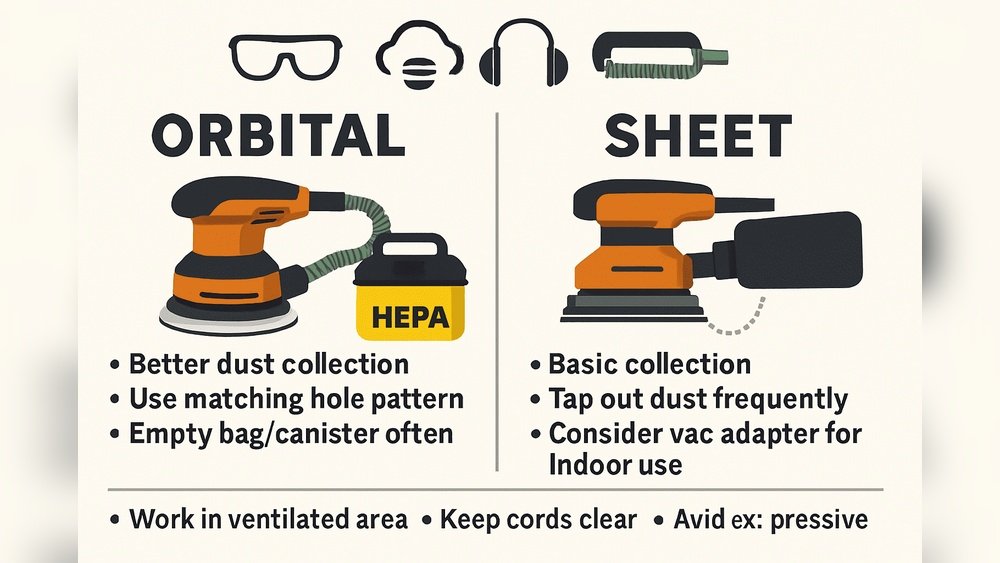
Many people who enjoy woodworking, home improvement, or DIY often face a common problem: choosing the right sanding tool. The orbital sander and the sheet sander are two of the most popular options. But which one is better for your needs? The answer isn’t always simple. Each tool has unique features, benefits, and limitations. If you want your wood projects to look professional, or if you want to save time sanding, it’s important to know the differences. This article will help you understand orbital sander vs sheet sander fully—covering how they work, where they shine, and what to watch out for. Along the way, you’ll find practical advice, real examples, and even mistakes to avoid.
What Is An Orbital Sander?
An orbital sander is a power tool that sands surfaces with a fast, circular motion. The sanding pad moves in small orbits—hence the name. When you turn it on, the pad spins quickly while vibrating in tiny circles. This action removes wood, paint, or varnish smoothly and evenly.
Most orbital sanders use hook-and-loop (Velcro-like) sanding discs, usually 5 or 6 inches in diameter. You can change grits quickly. The tool is comfortable to hold, and many models come with dust collection systems to keep your workspace cleaner.
Orbital sanders are sometimes called random orbit sanders. The “random” part means the pad moves in both a spin and an orbit, which helps prevent swirl marks. This tool is great for both beginners and professionals.
Key Features
- Motion: Circular and orbital (random)
- Pad Shape: Round
- Sandpaper Attachment: Hook-and-loop discs
- Speed: 6,000–12,000 orbits per minute (OPM)
- Common Sizes: 5-inch and 6-inch pads
- Uses: Smoothing wood, finishing between coats, removing paint
What Is A Sheet Sander?
A sheet sander is a finishing tool that uses a flat, square or rectangular pad. It moves the sandpaper in a simple back-and-forth (linear) motion. You attach a regular sheet of sandpaper—usually cut from a standard 9×11-inch piece—by clamping it to the pad.
Sheet sanders are also called palm sanders or finishing sanders. They are lighter and easier to control, making them good for fine, detail work. The square shape lets you reach into corners and along edges, where round sanders can’t go.
Unlike orbital sanders, sheet sanders are less aggressive. They remove less material, so they’re ideal for the last steps of sanding or for delicate surfaces.
Key Features
- Motion: Back-and-forth (linear)
- Pad Shape: Square or rectangular
- Sandpaper Attachment: Clamps (fits 1/4, 1/3, or 1/2 sheet)
- Speed: 10,000–14,000 strokes per minute (SPM)
- Common Sizes: 1/4 sheet, 1/3 sheet, 1/2 sheet
- Uses: Final sanding, getting into corners, prepping before painting
How They Work: Mechanism & Motion
Understanding how these sanders move can help you choose the right one.
Orbital Sander Motion
The pad spins and orbits at the same time. This “random” movement means no two areas of the wood are sanded in the same way. It reduces the risk of scratch patterns. You can move the tool in any direction—straight lines, circles, or even curves—without leaving marks.
Sheet Sander Motion
The pad vibrates back and forth in straight lines. You must move the sander along the wood grain for best results. If you move it across the grain, you may see fine lines or scratches. The square shape makes it perfect for corners and edges, but not as good on curves.
Performance Comparison
Let’s look at how these sanders perform in real tasks.
| Feature | Orbital Sander | Sheet Sander |
|---|---|---|
| Material Removal | Faster, more aggressive | Slower, gentle |
| Surface Finish | Smooth, swirl-free | Fine, but can leave lines |
| Detail Work | Not great for corners | Excellent for edges/corners |
| Dust Collection | Usually built-in | Sometimes built-in |
| Sandpaper Cost | Special discs, pricier | Uses regular sheets, cheaper |
| Ease of Use | Beginner-friendly | Very easy, lightweight |

Where Each Tool Shines
Choosing between orbital sander vs sheet sander depends on your project. Here are some examples to help you decide.
When To Use An Orbital Sander
- Removing old paint or varnish: The orbital sander’s fast action helps you strip surfaces quickly.
- Sanding large flat areas: Its speed saves time on tabletops, doors, or floors.
- Blending and smoothing: The random motion creates a very fine finish, great before staining or clear coating.
- Between coats: If you need to sand between layers of paint or polyurethane, orbital sanders make this easier.
When To Use A Sheet Sander
- Finishing touches: For the last pass before painting or staining, sheet sanders provide a gentle, even surface.
- Corners and edges: The square pad fits perfectly into tight spaces—something orbital sanders can’t do.
- Delicate veneers or thin wood: The gentle motion reduces the risk of sanding through the surface.
- Prepping for paint: Sheet sanders are excellent for lightly scuffing surfaces so paint will stick.
Pros And Cons
Both sanders have strengths and weaknesses. Here’s a quick breakdown.
Orbital Sander Pros
- Removes material quickly
- Leaves fewer swirl marks
- Works on curves and uneven surfaces
- Good for both rough and fine sanding
- Many models have variable speed
Orbital Sander Cons
- More expensive sandpaper
- Not ideal for tight corners
- Slightly heavier and louder
- May be overkill for delicate work
Sheet Sander Pros
- Simple and affordable sandpaper
- Gets into corners and edges
- Quiet and lightweight
- Great for fine finishing
Sheet Sander Cons
- Can leave straight scratch marks
- Not good for heavy material removal
- Struggles on curved surfaces
- Requires sanding with the grain

Cost & Maintenance
The price difference can affect your choice, especially if you do a lot of sanding.
| Aspect | Orbital Sander | Sheet Sander |
|---|---|---|
| Tool Cost (average) | $40–$150 | $25–$100 |
| Sandpaper Cost (per pack) | $8–$15 | $4–$8 |
| Maintenance | Clean pad and dust bag often | Check clamps and replace sheets |
| Durability | Long-lasting with care | Simple design, fewer issues |
Non-obvious insight: Many beginners forget that sandpaper cost adds up over time. While orbital sanders are faster, their discs are more expensive and not always available at every hardware store. Sheet sanders use regular paper, which is easier and cheaper to replace.
Common Mistakes To Avoid
Even experienced users sometimes make these errors:
- Using the wrong grit: Start with coarse grit for rough surfaces, then move to finer grits. Don’t jump from very rough (like 60) to very fine (like 220) too quickly.
- Pressing down too hard: Let the tool do the work. Pushing down can leave marks and wear out the motor.
- Not cleaning the dust bag/filter: Dust buildup can affect tool performance and make your workspace messy.
- Using the wrong tool for the job: Don’t try to use a sheet sander for heavy paint removal—it will take too long. Don’t use an orbital sander for tiny corners—you’ll miss spots.
- Skipping safety gear: Always use a dust mask and eye protection. Even with dust collection, fine particles can be harmful.
Another non-obvious tip: On delicate wood, always test the sander on a hidden spot. Some woods are soft and can dent or scratch easily, especially with aggressive sanding.
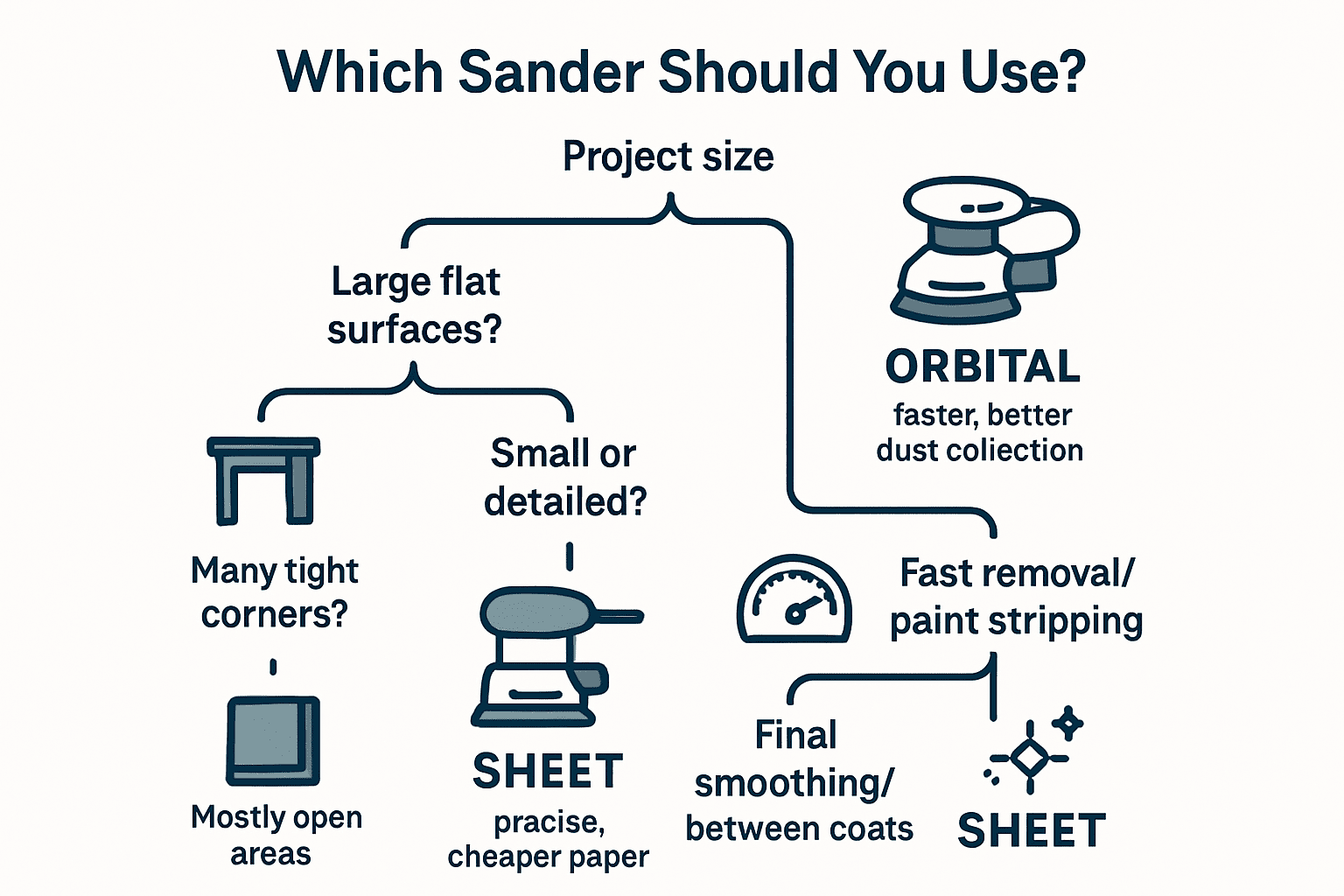
Which Sander Is Right For You?
Choosing between an orbital sander and a sheet sander depends on:
- Your project type: Are you removing lots of material, or just finishing?
- Surface shape: Large and flat, or small and detailed?
- Budget: Can you afford special discs or just basic sandpaper?
- Skill level: Are you a beginner or a pro?
Here’s a simple guide:
- Pick an orbital sander if you want speed, a smooth finish, and you work on larger surfaces.
- Pick a sheet sander if you do a lot of detail work, corners, or need a gentle touch.
If you often build furniture, both tools are useful to own. Many professionals start with an orbital sander, then switch to a sheet sander for the final finish.
Real-world Examples
Let’s look at two common scenarios.
Refinishing A Tabletop
You bought an old wooden table and want to refinish it. The surface is scratched and has old varnish.
- Step 1: Use an orbital sander with 80-grit disc to remove the finish quickly.
- Step 2: Switch to 120-grit, then 220-grit, for a smooth surface.
- Step 3: For the edges and corners, use a sheet sander with fine paper.
Painting A Door Frame
You want to repaint a door frame with lots of corners.
- Step 1: Use a sheet sander with medium-grit paper to scuff the old paint, focusing on corners.
- Step 2: Wipe clean, then paint.
Insight: Many people try to use just one sander for everything. But combining both tools gives the best results.
Safety And Health Tips
Sanding produces a lot of fine dust, which can be harmful if inhaled.
- Always use a dust mask or respirator.
- Wear eye protection to avoid dust in your eyes.
- Work in a well-ventilated area.
- Use the dust collection bag that comes with your sander, but don’t rely on it 100%.
- Vacuum your work area after sanding.
For more on safe sanding practices, see this official OSHA woodworking safety guide.
Environmental Impact
Most sanding tools use electricity. Using a more aggressive tool (like an orbital sander) can finish the job faster, saving energy. However, the disposable sanding discs for orbital sanders create more waste than regular sheets. If you’re environmentally conscious, consider this when choosing sandpaper.
Frequently Asked Questions
What’s The Main Difference Between An Orbital Sander And A Sheet Sander?
An orbital sander uses a round pad that spins and orbits, giving a fast, smooth finish. A sheet sander uses a square or rectangular pad that moves back and forth, which is better for corners and fine detail.
Can I Use Regular Sandpaper With An Orbital Sander?
No. Orbital sanders need special hook-and-loop sanding discs. Regular sheets won’t fit or stay attached.
Which Sander Is Better For Beginners?
Both are easy to use, but orbital sanders are more beginner-friendly for large surfaces because they work faster and hide mistakes better.
Can I Sand Metal Or Plastic With These Tools?
Yes, but use the correct sandpaper type for metal or plastic. Don’t press too hard, and clean the pad often to avoid clogging.
How Do I Avoid Swirl Marks Or Scratches?
With an orbital sander, use finer grits and don’t push down. With a sheet sander, always move along the wood grain and use gentle pressure.
Choosing between an orbital sander and a sheet sander doesn’t have to be confusing. Think about your project, budget, and skill level. Both tools can make your sanding jobs faster and give professional results. With the right tool and technique, you’ll be proud of your finished work.
As an Amazon Associate, We earn from qualifying purchases