
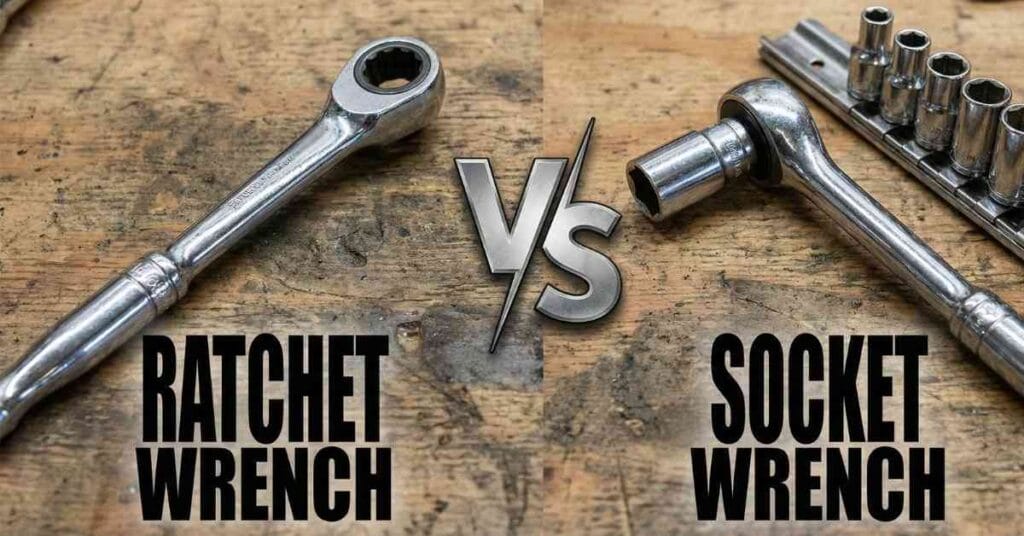
Ratchet Wrench vs Socket Wrench—I learned the hard way which one works best.
I still recall the day I learned the real difference between these two tools.
It was a sticky, hot Saturday. I was in my garage, trying to change the alternator on my old truck. Sweat was dripping down my nose. My hands were covered in grease.
I grabbed my standard socket wrench. I tried to jam it into the tight gap between the engine and the fan. Clunk. Clunk. No luck. The handle was too fat. It hit the fan blades every time I tried to turn it.
That moment of frustration taught me a valuable lesson. A ratchet wrench and a socket wrench might sound the same, but they are very different tools.
If you are building your DIY kit, you need to know which one does what. Here is my honest breakdown, feature by feature.
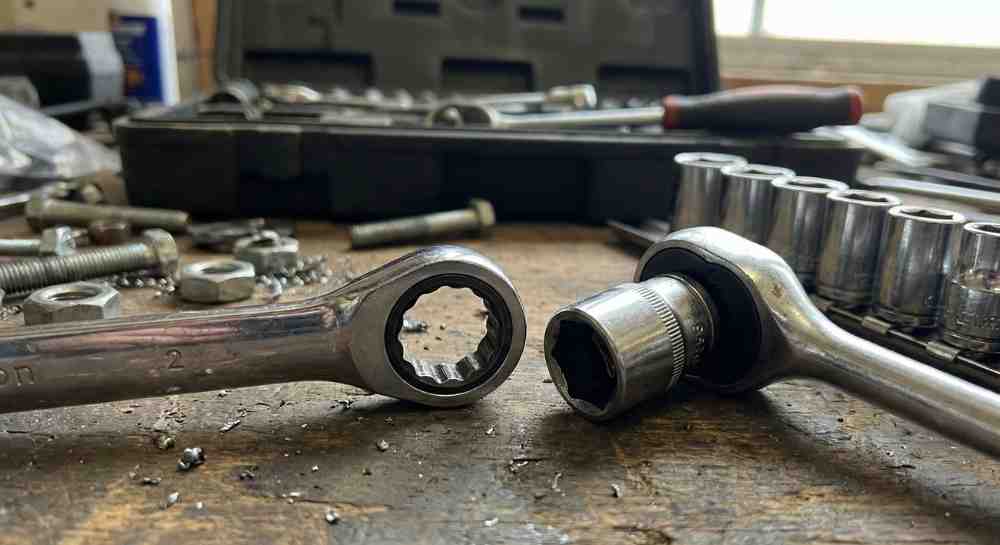
Table of Contents
The Socket Wrench
Most of us start here. My first tool kit was just a box of shiny chrome tubes.
The main tool is the socket wrench. It has a square nub. You snap the metal tubes, called sockets, onto it.
My Experience: I use this for almost all my jobs. It is strong. It fits my hand well.
- The Reach: Sometimes a nut is deep inside a machine. I add an “extension bar” to the handle. It reaches down like a long arm.
- The Power: The handle is thick and round. I can grip it hard. It helps me break loose rusty bolts on my outdoor gear.
Downside: It is tall. The handle and socket stack up high. It is about two or three inches. I found this out with my mower. Sometimes, you just lack the room.
The Ratcheting Wrench
This tool changed the game for me.
It looks like a normal flat wrench. But the ring end has a secret. There is a small gear inside it.
My Experience: I bought a set after a bad day with my mower. I slid the thin wrench behind a plastic guard. It fit right in.
- The Speed: The ring has a ratchet. I do not lift the tool off the bolt to turn it. I just move my hand back and forth. Click-click-click. The job is done fast.
- The Profile: These tools are skinny. If your finger fits in the gap, this wrench fits too.
Downside: The sizes are fixed. Do you need a 10mm and a 12mm? You need two different wrenches. With a socket set, you just swap the cup.
Design: How They Are Built
The first thing you notice is how they look and feel. One is like a Transformer toy; the other is a solid piece of steel.
| Feature | Socket Wrench System | Ratchet Wrench (Fixed) |
| The Grip | It uses a detachable metal cup (socket) to grab the bolt. | The “socket” part is built right into the metal handle. |
| The Drive | You snap the cup onto a square nub on the handle. | There is no nub. The gear is inside the ring at the end. |
| Moving Parts | The clicking gear is hidden inside the handle grip. | The gear is exposed inside the round head of the wrench. |
Versatility: One Tool or Many?
When I started out, I was on a tight budget. I quickly found out that one of these systems gives you way more options for your money.
| Feature | Socket Wrench System | Ratchet Wrench (Fixed) |
| Changing Sizes | High. I can swap a tiny 10mm cup for a huge 24mm cup in seconds. | Low. It is fixed. A 10mm wrench only fits a 10mm bolt. |
| Reach | I can add a long metal bar (extension) to reach deep holes. | What you see is what you get. You cannot make it longer. |
| Bolt Types | I can use tall cups for long bolts or short ones for tight spots. | It only fits standard bolts. It cannot reach into deep wells. |
Durability: Taking the Abuse
I have had days where a bolt is rusted solid. I have had to lean my entire body weight onto a tool to break it loose. This is where strength matters.
| Feature | Socket Wrench System | Ratchet Wrench (Fixed) |
| Strength | Very Strong. The square drive is thick and tough. | Moderate. The small gear ring can break if you pull too hard. |
| Wear & Tear | If a socket wears out, I just buy a new cup for a few dollars. | If the gear breaks, the whole wrench is trash. |
| Heavy Duty | I use this to break loose rusty, stuck, or frozen bolts. | I only use this to spin loose bolts that are already free. |
Application: Where Do They Fit?
This is the big one. This is why I was stuck on that hot Saturday afternoon. Sometimes, the “best” tool is just the one that fits in the hole.
| Feature | Socket Wrench System | Ratchet Wrench (Fixed) |
| Clearance | Tall. The handle plus the cup is bulky. It needs headroom. | Slim. It is flat. It slides into gaps where my fingers barely fit. |
| Speed | Fast. The handle is easy to spin back and forth. | Fast, but you have to be careful not to bump your knuckles. |
| Comfort | The handle is usually round and thick. It feels good to hold. | The handle is flat and thin. It can dig into your hand. |
My Personal Verdict
So, which one do I actually use?
I use the Socket Wrench 90% of the time.
It is my workhorse. Whether I am fixing the lawnmower or assembling furniture, I grab the socket set first. It is strong, comfortable, and adapts to almost any bolt I find.
I use the Ratchet Wrench for the “Impossible” spots.
I save these for when I am stuck. When a bolt is trapped behind a pipe or tucked near a car battery, the flat ratchet wrench is a lifesaver. It slips in, does the job, and saves me hours of taking other parts off.
FAQs – Ratchet Wrench vs Socket Wrench
What is the main difference between Ratchet Wrench and Socket Wrench?
A socket wrench uses a handle and many cups. You swap them to fit any bolt. A ratchet wrench is one solid piece. It fits one size. It has a gear to turn fast.
Can a socket wrench fit in tight spots?
A socket wrench is often too tall for tight spots. The handle and cup stack up high. It hits nearby parts. A flat ratchet wrench fits much better in small gaps.
Are ratcheting wrenches worth the cost?
Yes, they are worth the cost. They save you time and effort. They fit where sockets cannot go. The gear lets you turn bolts fast. They are great for tricky repairs.
Which tool should I buy first?
Buy a socket wrench set first. It is the best tool for most jobs. You can fix cars or home items. It handles many bolt sizes. It is a great start for your kit.