
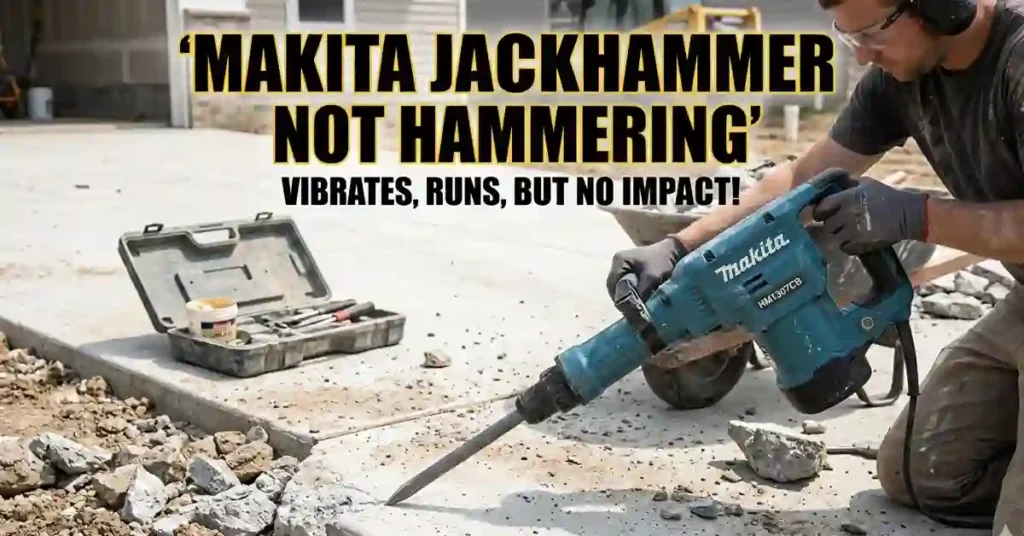
Last Tuesday, I was out in the sun. I had a big slab of rock to break before lunch. I grabbed my Makita, plugged it in, and pulled the trigger. The motor made a loud noise. The tool shook in my hands. But the bit just sat there. It did not hit the rock at all. It felt like I was poking the ground with a stick.
When a Makita jackhammer is not hammering, it feels like a total loss. These tools cost a lot of money. You might think the gears are gone or the motor is dead. But I have fixed my own gear for years. I know the truth. Usually, it is just a tiny seal or old grease.
I want to show you how I got my tool back to work. We will look at the air seals and the grease. I will also share my cold weather tricks. This is what I do when my own job is on the line.
Understanding the Air Punch
Before you take out a screw, you must know how these hit. A metal arm does not hit the bit. That is not how it works. Makita uses an electro-pneumatic system to make the power.
Inside the tool, a piston moves fast. It does not touch the bit. It pushes a striker using a cushion of air. The air is like a spring. If the air leaks out, the striker stays still. Then the tool stops hitting.
Why Your Makita Jackhammer Won’t Hit
There are three main reasons for a Makita jackhammer not hammering. I see these issues every single week in the shop. They are easy to spot once you know where to look.
The Piston O-Ring is Done
This is the most common fix I find. The piston has a small rubber ring. This ring keeps the air tight. Heat and use make the rubber hard. It cracks over time. Once it cracks, the air leaks out. The punch is gone.
The Grease is Too Thick
I once made a big mistake. I put cheap, thick grease in my hammer. It was a cold day in the winter. The grease turned into glue. The striker could not move through it. If your tool feels slow, your grease is likely the problem.
The No-Load Feature
Some Makita models have a “no-load” feature. The hammer only starts when you push hard. You must press the bit against the ground. If your bit is stuck or the chuck is dirty, the tool thinks it is just idling.
Comparing Makita Hammer Failures
| Symptom | My Diagnosis | Repair Difficulty |
| Motor runs, no impact | Piston O-ring is worn | Medium |
| Weak or light hitting | Low or dirty grease | Easy |
| Hits only when hot | Grease is too thick | Easy |
| Oil leaking from nose | Front seal failure | Medium |
My Step by Step Repair Guide
When my hammer failed last week, I did not panic. I took it to my bench. I could smell hot oil in the air. That was my first clue. Here is the path I took to fix it and get back to work.
Step 1: The Warm Up Test
Sometimes the fix is free. If it is a cold day, the grease is stiff. I let the tool run for three minutes. I do not try to hit anything. I just let the motor spin. This thins the grease. If it hits after three minutes, you just need better oil.
Step 2: Checking the Bit Shank
I pulled the bit out of the chuck. I saw that the end was dry. A dry bit can get stuck in the wrong spot. I wiped it clean. I added a small dab of grease. I pushed it back in until it clicked. This is a simple step many people skip.
Step 3: Checking the Grease Level
Most Makita hammers have a cap on top. I used a wrench to open mine. The grease inside was black. It looked like old coffee. This is a sign of high heat. I cleaned out the old gunk. I added a little bit of fresh grease to the tank.
Advanced Fix: Replacing the Piston Ring
If the grease and the bit are fine, you have to go deeper. This is where most people get nervous. Do not worry. It is just a few bolts. Take your time and keep the parts in a line on your bench.
Opening the Barrel
I removed the bolts on the front part. I pulled the cylinder out. I saw the striker at the bottom. I used a magnet to pull it out. Everything was covered in black oil. I cleaned it all with a clean cloth so I could see the parts.
Inspecting the Seals
I looked at the ring on the striker. It was flat and hard. It should be round and soft. When I touched it, it snapped in half. That was my air leak. I put on a new ring. I felt the difference right away. The seal was tight and strong again.
Parts You Might Need for Your Makita
| Part Name | Function | When to Replace |
| Piston O-Ring | Keeps air pressure | Every 100 hours |
| Striker Seal | Seals the hit | If impact is weak |
| Carbon Brushes | Powers the motor | If motor sparks |
| Front Oil Seal | Prevents leaks | If oil drips out |
How to Prevent Future Failures
I hate fixing the same tool twice. To keep my Makita running, I changed my habits. I only use the right grease now. I know it costs more. But cheap grease kills the seals. It is not worth the risk to save a few cents.
I never store my hammer in a cold shed. I keep it in my house where it stays warm. This stops the grease from getting thick. It also stops rust from growing on the gears. A warm tool is a happy tool.
Lastly, I listen to the sound. A good Makita has a deep thump. If the sound gets thin or fast, I stop. I check the grease right then. Usually, the tool is trying to tell me it needs help. Listening saves me a lot of money.
Final Thoughts on the Fix
Fixing a Makita jackhammer not hammering is a fun job. It took me less than an hour. I spent very little money on a new seal. By lunch time, I was back on the slab. The concrete was easy to break after that.
If your tool acts up, do not throw it away. Take it apart. Look at the seals. Feel the grease with your fingers. These tools are built to be fixed. You can do it yourself and save a lot of cash.