
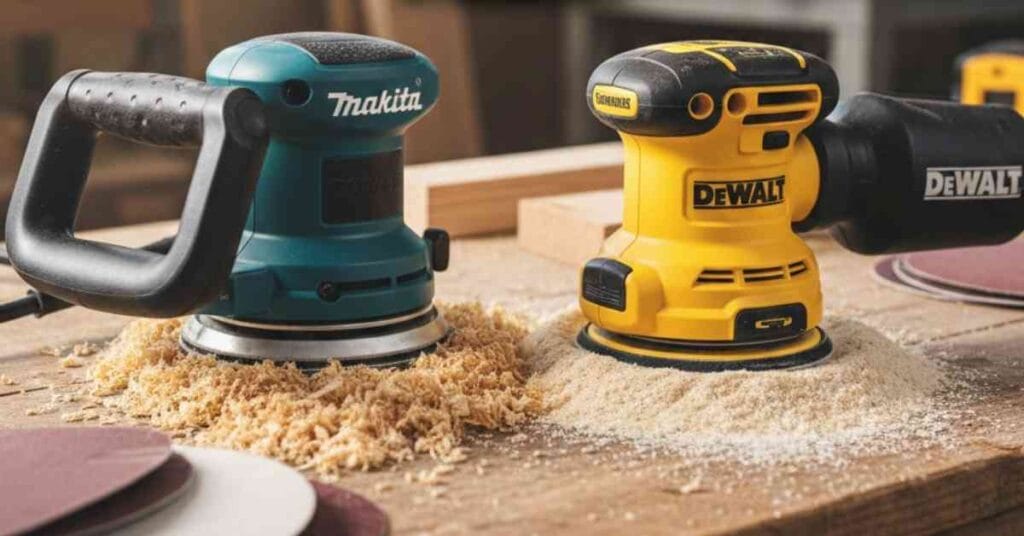
I spent two weeks using both the Makita BO5041 and the DeWalt DWE6423 in my shop. If you need a new 5-inch sander, my hands-on test will help you pick the right one. Both tools are great, but they feel very different when you turn them on and start working.
Makita BO5041 Review
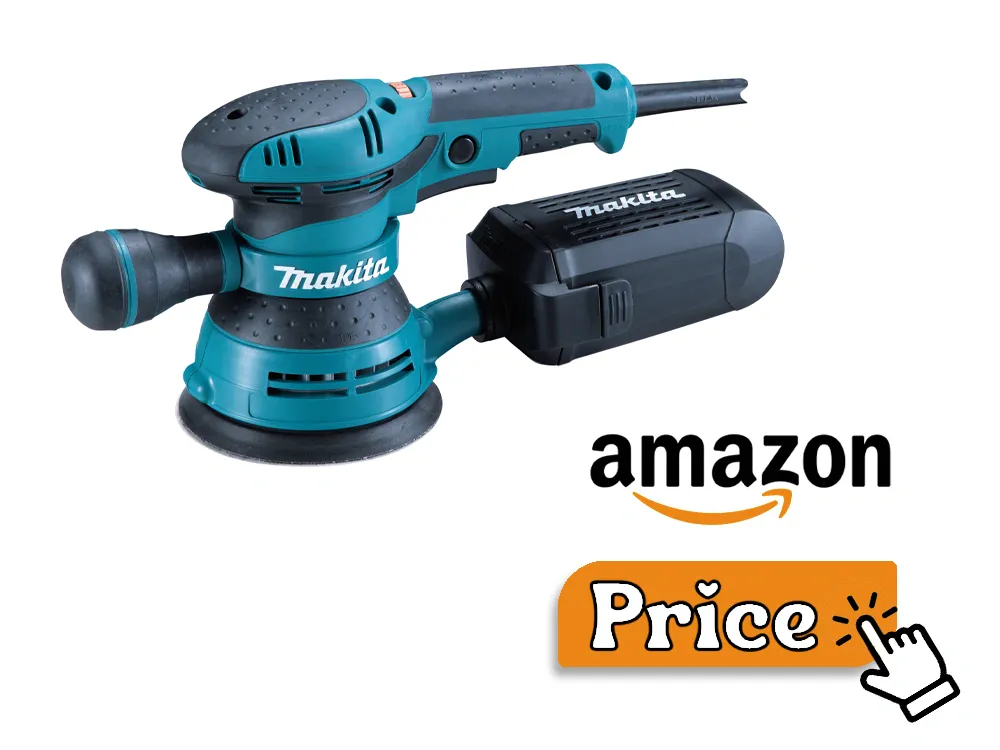
I first used the Makita BO5041 to fix an old oak table. It had thick layers of old paint. The big front handle caught my eye right away. Most sanders only have a top grip. This extra handle let me use two hands to keep the tool flat on the wood. It stopped the sander from tipping or making deep marks.
The motor stayed cool during my test. I sanded for thirty minutes without a break. The 3-amp motor did not slow down once. I pressed hard on rough pine boards, and it kept its speed. The speed dial is near the trigger. This makes it easy to slow down for edges.
| Pros | Cons |
| Great two-hand control | Hard to fit in tight gaps |
| Very low shaking | Dust bag is quite small |
| High power for old paint | Heavier than palm tools |
| Soft rubber grips | Plastic case feels thin |
I loved the lock button on the trigger. On long jobs, my fingers usually get tired. This button let me relax my hand. I could focus just on moving the tool. The dust bag is a bit small for big jobs. I hooked it to my shop vacuum instead. This worked much better to keep my air clean.
The tool feels very balanced. I used it on walls and flat desks. It feels like a tool made for pros. The build is solid. The pad brake stops the spin fast when you let go. This is a great safety feature that I really appreciate.
DeWalt DWE6423 Review
The DeWalt DWE6423 felt different as soon as I turned it on. I used it to finish a walnut coffee table. This is a low-profile palm sander. Your hand sits very close to the wood. This gives you a great feel for the surface. It is much better for fine work than the taller Makita.

The vibration control is the best I have felt. I sanded chair parts for two hours. My hand did not feel numb or tingly at all. It is shorter and lighter than the Makita. This made it my top choice for sanding trim high up on a wall.
| Pros | Cons |
| Very low vibration | Only one hand spot |
| Short and easy to guide | Needs a special hose part |
| Dust-proof power switch | Speed dial is a bit stiff |
| Perfect for fine finish | Slower than the Makita |
The dust port was a small problem. It has a special lock that did not fit my vacuum hose. I had to buy a separate part to make it fit. The dust bag does a good job, though. The power switch has a rubber cover. This keeps dust out. Dust is what kills most sander switches over time.
This tool is very tough. I knocked it off my bench onto the floor. It hit the hard concrete. It did not crack or break. The motor still sounds smooth. It is not as strong as the Makita for stripping paint. But for making wood feel like glass, it is hard to beat.
Details Comparison for Makita BO5041 vs DeWalt DWE6423
These two tools are for different users. One is for big, rough jobs. The other is for smooth, fine finishes. They both use 5-inch pads, but they work in their own way.
Core Capability Comparison
The Makita lets you use two hands. This is best for removing a lot of wood fast. The DeWalt is a precision tool. It sits low to the ground. This gives you better control for final sanding steps.
| Feature | Makita BO5041 | DeWalt DWE6423 |
| Motor Power | 3.0 Amp | 3.0 Amp |
| Top Speed | 12,000 OPM | 12,000 OPM |
| Best Use | Rough Stripping | Fine Finishing |
Accuracy and Stability
In my tests, the DeWalt was more stable. It did not jump or move across the wood. The Makita is strong, but it is tall. You have to focus more to keep it flat. If you are new to sanding, the DeWalt is easier to use without making mistakes.
| Metric | Makita BO5041 | DeWalt DWE6423 |
| Balance | Good | Excellent |
| Swirl Mark Risk | Medium | Very Low |
| Pad Braking | Very Fast | Fast |
Design and Practical Use
The Makita is better for work on walls. You can hold it with two hands to stay steady. The DeWalt is the winner for tight spots. A front handle would just get in the way there. The DeWalt also fits better in small hands because it is slim.
| User Insight | Makita BO5041 | DeWalt DWE6423 |
| Hand Fatigue | Medium | Very Low |
| Two-Hand Use | Yes | No |
| Tool Weight | 3.1 lbs | 2.9 lbs |
Build Quality and Durability
Both tools use good rubber grips. They stay in your hand even if you sweat. The Makita feels more like a shop tool. It has a thick cord and a heavy trigger. The DeWalt has a sealed switch. This is a big win for long-term use in a dusty shop.
| Component | Makita BO5041 | DeWalt DWE6423 |
| Switch Seal | Standard | Dust Sealed |
| Cord Quality | Very Heavy | Standard |
| Tool Body | Tough Plastic | Tough Plastic |
Dust Collection Efficiency
The Makita bag is easy to use. It fits most standard vacuum hoses. I loved that. The DeWalt bag is built better. It has a spring to keep it shut. But the port needs a special part to fit a vacuum. If you do not use a vacuum, the DeWalt bag catches more fine dust.
| Performance | Makita BO5041 | DeWalt DWE6423 |
| Vacuum Hookup | Easy | Hard |
| Bag Size | Small | Medium |
| Dust Seal | Good | Great |
Final Comparison Table
| Feature | Makita BO5041 | DeWalt DWE6423 |
| Accuracy | High | Very High |
| Performance | Best for Paint | Best for Finish |
| Tool Size | Large and Tall | Small and Low |
| Ease of Use | Two Hands | One Hand |
| Best For | Big Projects | Fine Furniture |
The Makita BO5041 is best if you want one tool for all jobs. It can strip paint and sand wood. But I reach for the DeWalt DWE6423 most of the time. it is more comfortable and leaves a perfect finish. Both will last a long time if you keep them clean.