
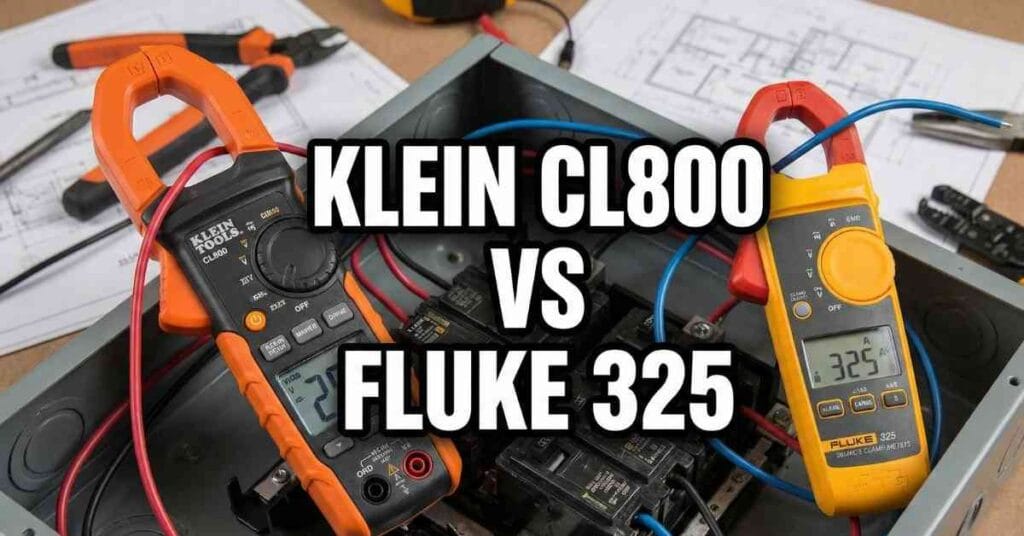
I used both of these tools for a long time. I took them to work with me. I tested them hard on real jobs. I want to share what I found. One is cheap and does a lot. The other is small and works fast. Here is my true review.
My Time With The Klein Tools CL800
I bought the Klein CL800 for a good price. The numbers on the box looked great. I wanted a backup tool. It claims to read 600 amps. It can also handle 1000 volts.
When I first held it, I felt the weight. It is big. It is thick. It feels like a brick in your hand. I felt like I could drop it and it would be fine. I actually did drop it once. It fell off a ladder. It hit the floor. It did not break. It barely had a scratch.
I used this tool on a garage job. I had to put in a new panel. The built-in light was a big help. It is not a huge light. But it points right at the wires. This helps in dark spots.
I really liked the “Low Z” mode. I had a wire that showed 40 volts. I thought it was live. I used the Low Z mode. The number dropped to zero. It was just ghost voltage. That saved me a lot of time. I did not have to guess.
The meter can do a lot of things. It can check heat. It can check capacitors. It offers a lot for the price.
Pros and Cons of Klein CL800
| Pros | Cons |
| It has a huge range (1000V / 600A) | The auto mode is a bit slow |
| It has “Low Z” to find ghost volts | It is very big and heavy |
| It has a light built right in | The NCV beeps too much |
| The price is very low | You must press a button for DC |
| It is tough and can take a drop | The leads are stiff in the cold |
But, I did not like some things. The speed is a bit slow. When I turn the dial, I have to wait. If I want to check DC amps, I must press a button. I do this a lot. It gets annoying.
The auto range takes time too. I touch the wires. The numbers jump around. It takes a second to stop. It is right, but it is slow.
The sensor for live wires is also too sensitive. It beeps when I am far away. It is hard to know which wire is hot. It beeps at everything.
But it is still a good tool. It offers a lot of value. If you need one tool to do it all, this is it. It is cheap and tough.
My Time With The Fluke 325
I have used the Fluke 325 for years. I love this tool. When I pick it up, it feels right. It is small. It is light. It fits in my pocket. It fits in my belt pouch. It does not pull my pants down.
I used it for a week on HVAC calls. I had to crawl in attics. I had to squeeze into tight spots. The small size was great. It was easy to move around. It did not get in the way.
The tool just works. It is fast. I checked a fuse to see if it was good. The beep was instant. There was no lag. The dial is stiff but good. It clicks into place. You know what mode you are in.
I checked some start parts on AC units. The Fluke was fast. It gave me the number right away. I trust what it says. I feel sure the number is true.
Pros and Cons of Fluke 325
| Pros | Cons |
| It works every time | It costs a lot of money |
| It is small and light | The specs are lower |
| The beep is instant | No “Low Z” mode |
| The battery lasts a long time | The screen looks old |
| It finds the range fast | No light or magnet |
The bad parts are mostly what is missing. It costs a lot more. It does not have the “Low Z” mode. If a wire has ghost volts, the Fluke might fool you.
It also has no magnet. I hate that. I had to buy a strap to hang it up. I wish it came with one.
The numbers are lower too. It only goes to 400 amps. It only goes to 600 volts. For most house work, this is fine. I rarely need more. But the cheaper Klein goes higher. That makes you think.
The screen is also old. It is plain. It is not fancy. But it is clear. You pay for the build quality. You pay for safety. It feels like it will last for twenty years. And it likely will.
Detailed Comparison for Klein CL800 vs Fluke 325
I want to compare these two tools. I will look at how they work on real jobs. I will not just look at the box.
Core Capability and Performance
The Klein has bigger numbers. It can read up to 1000 volts. It can read up to 600 amps. The Fluke stops at 600 volts and 400 amps.
I tested both. I rarely needed the high range on the Klein. But it is nice to have. If you work on big motors, you need the Klein. It can also test more ohms. It is better for bench work. The Fluke is fine for regular work.
| Feature | Klein CL800 | Fluke 325 |
| Max Amps | 600 A | 400 A |
| Max Volts | 1000 V | 600 V |
| Resistance | High | Low |
| Winner | Klein | – |
Accuracy and Speed
The Fluke wins on speed. It is very fast. The beep for continuity is instant. The Klein has a small delay. It is a tiny lag. But you notice it.
When I touch the leads to a wire, the Fluke shows the number fast. The Klein hunts for a bit. The numbers move. Then they stop. Both are right. But the Fluke feels steady. I like that. It saves me time.
| Feature | Klein CL800 | Fluke 325 |
| Beep Speed | Good | Instant |
| Range Speed | Average | Fast |
| Stable Read | Good | Great |
| Winner | – | Fluke |
Design and Ergonomics
The size difference is huge. The Klein is a beast. It is wide. It is heavy. It fills my hand. It takes up a lot of space in my bag.
The Fluke is sleek. It is thin at the bottom. It is easy to hold. I can use the clamp trigger with one hand. It is easy. If you climb ladders, you want the Fluke. The weight matters.
| Feature | Klein CL800 | Fluke 325 |
| Weight | Heavy | Light |
| Grip | Big | Easy |
| One Hand | Hard | Easy |
| Winner | – | Fluke |
Display and Interface
The Klein screen is busy. It shows a lot. It is bright orange. But you have to use buttons. To check DC amps, you turn the dial. Then you press “Select.”
The Fluke is simple. The dial does the work. If you want DC amps, turn to DC amps. There are no menus. I like that. It is faster. But the Fluke screen is small. The Klein has a holder for the probes. That is handy.
| Feature | Klein CL800 | Fluke 325 |
| Screen Size | Big | Medium |
| Light | Orange | White |
| Mode Switch | Button | Dial |
| Winner | Klein (Looks) | Fluke (Use) |
Value for Money
This is the big one. The Klein is cheap. You can buy two for the price of one Fluke. The Klein gives you more. You get a light. You get Low Z. You get NCV.
If you lose the Klein, it is okay. It is cheap to replace. The Fluke costs a lot. You pay for the brand. You pay for safety. You pay for a tool that lasts. But for features per dollar, the Klein wins.
| Feature | Klein CL800 | Fluke 325 |
| Price | Low | High |
| Warranty | 2 Years | 2 Years |
| Features | Many | Few |
| Winner | Klein | – |
Conclusion
If you want to save money, buy the Klein CL800. It does more things. It has better specs. It is a great deal.
If you use a meter all day, buy the Fluke 325. It is faster. It is smaller. It is easier to carry. It will last a long time. It is worth the extra cost for a pro.