
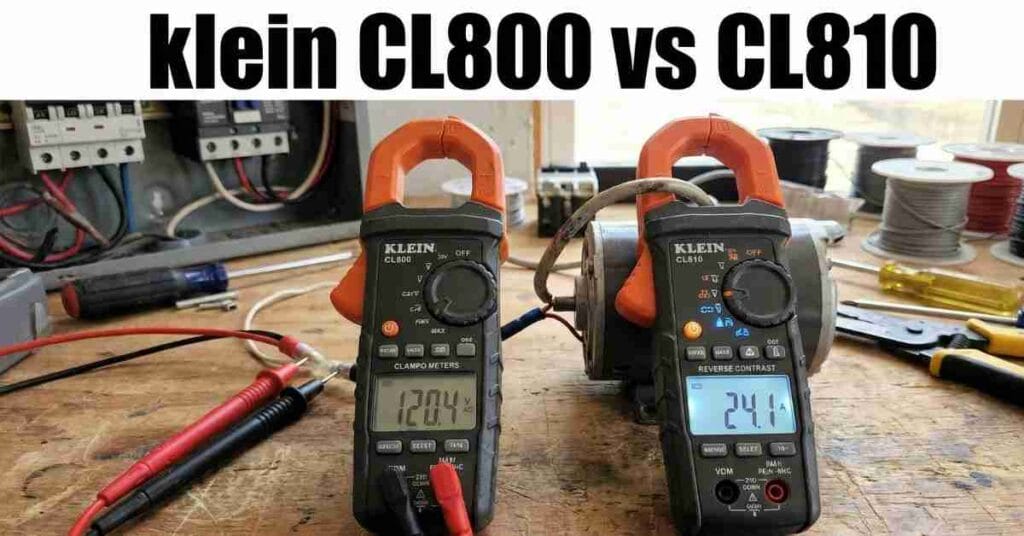
I have used Klein tools for a long time. I like to know if new tools are worth the cash. I bought the new CL810 to test it. I put it next to my old CL800. I took both to real jobs. I used them on panels and AC units. I wanted to see which one works best.
Klein CL800 Review
I have kept the CL800 in my bag for years. It is a strong tool. It feels heavy and tough. I use this for most wire work. I used it last week in a kitchen. I had to map out plugs. I like the “Low Z” mode a lot. It helps me find ghost voltage. This is false voltage that tricks other meters. My cheap stick tester beeped at a wire. But the CL800 showed zero volts. That was right.
The dial is stiff. This is good. You will not bump it by mistake. I shove it into tight panels often. The dial stays put. I also like the lead holders on the back. They grip the probes well. This lets me use the meter with two hands. It is safe and easy.
Testing the CL800
I tested this on a dimmer switch. The voltage was weird. The CL800 read it fast. I also dropped it from a ladder. It fell six feet onto concrete. It still works fine. The rubber case saved it. The screen can be hard to see though. If it is dark, you need the light. The grey screen is hard to read from the side.
| Pros | Cons |
| Very tough build | No inrush mode |
| Low Z mode works well | Screen is hard to read |
| Loud beeper | Sensor is only at the tip |
| Good battery life | No mode for flame sensors |
The battery life is great. I use it every day. I only swap the batteries twice a year. It uses two AAA cells. This is cheap and easy. The beeper is loud too. I can hear it over a drill. That helps a lot on a loud job site.
Klein CL810 Review
I bought the CL810 for HVAC work. The CL800 could not do it all. I needed to test flame sensors. The CL810 has a mode for that. It reads DC microamps. This is key for heaters. I tested this on a broken furnace. It kept shutting off. I hooked the leads to the sensor. The meter showed 3.2 microamps. It was fast and clear.
The screen is the big change. It uses a “reverse” look. The background is black. The numbers are bright. I took this into a dark attic. I was checking an air handler. It was pitch black. I did not need the backlight. The numbers glowed. It was very easy to see.
Testing the CL810
I also tested the “Inrush” mode. This checks motor start power. Standard meters miss this. I tested a pool pump. I hit the Inrush button. I started the pump. The meter caught the spike. It showed 45 amps fast. Then it dropped to 12 amps. The CL800 cannot do this. But the battery dies faster. I lost a bar of power in two weeks. The bright screen uses more juice.
| Pros | Cons |
| Catches motor start spikes | Eats batteries fast |
| Screen glows in the dark | Hard to read in sun |
| Great for furnace work | Costs a bit more |
| Sensor is in the clamp | Dial is hard to see in sun |
The dial icons light up too. This is cool. It helps in the dark. But in the sun, it is hard to see. The glare on the black screen is bad. You have to shade it with your hand. But inside, it is the best screen I have used.
Detailed Comparison for Klein CL800 vs CL810
Here is the real test. Ads say they are the same. They are not. I used them side by side. They feel different. I looked at five key things. These matter when you hold the tool all day.
Display and Visibility
The screen is the first thing you see. The CL800 has a grey screen. It has black numbers. It is fine in a lit room. It is great outside. The sun makes it easy to read. The CL810 is the opposite. It has a black screen. The numbers are white.
I found the CL810 is much better in the dark. If you work in attics, get this one. You can read it from five feet away. But in the sun, the CL800 wins. The CL810 has glare. The sun washes out the white numbers. You have to tilt it to see. The CL810 dial lights up. The CL800 dial does not.
| Feature | CL800 | CL810 |
| Screen Type | Grey | Black (Reverse) |
| Dark Use | Needs Light | Great |
| Sun Use | Great | Has Glare |
| Dial Light | No | Yes |
HVAC Capabilities
If you fix AC units, read this. The CL800 is for wire work. The CL810 is for motors and heat. This is a big deal.
I tried to check a flame sensor with the CL800. I could not do it. It lacks the mode. I had to use a different tool. The CL810 has the mode built in. It worked perfectly. Also, the Inrush mode is vital. I used the CL810 on a bad compressor. It showed a high spike. The CL800 missed it. It just showed the run amps. If you do HVAC, you need the CL810.
| Feature | CL800 | CL810 |
| Inrush Mode | No | Yes |
| Flame Sensor Mode | No | Yes |
| Temp Probe | Yes | Yes |
| Motor Caps | Yes | Yes |
Non-Contact Voltage (NCV) Design
Both meters can sense voltage. But they do it in different ways. The CL800 has a sensor at the tip. It is like a nose. You point it at the wire. It works, but you have to be close.
The CL810 puts the sensor in the clamp. This is much better. I just hook the clamp on a wire. It beeps if the wire is hot. The CL810 also beeps faster as you get close. It changes tone. This helps you find the right wire. It felt more natural to use. I liked it more.
| Feature | CL800 | CL810 |
| Sensor Spot | Tip | Clamp Jaw |
| Beep Style | One Tone | Fast Beep |
| Ease of Use | Good | Best |
Battery Life and Power
I put new batteries in both. The CL800 takes two AAA batteries. The CL810 takes three. This matters if you buy packs of four. You will have one left over.
After three weeks, the CL800 was full. It still had all its bars. The CL810 lost one bar. The black screen stays on. The lighted dial uses power too. If you forget to turn it off, it dies faster. The CL800 lasts a long time. If you hate changing batteries, pick the CL800. It is a workhorse.
| Feature | CL800 | CL810 |
| Battery Type | 2x AAA | 3x AAA |
| Life Span | Months | Weeks |
| Auto Off | Yes | Yes |
Price and Value
The CL810 costs more. It is usually about 30 or 40 bucks more. Is it worth it? That depends on your job.
If you fix plugs in houses, buy the CL800. It is cheaper. You do not need the fancy modes. It saves you money. But if you touch motors, buy the CL810. It will save you time. One bad diagnosis costs more than the meter. The Inrush mode pays for itself. It helps you find bad parts fast.
| Feature | CL800 | CL810 |
| Cost | Low | High |
| Best For | Wire Work | HVAC / Motors |
| Value | Good | Good |
Conclusion
If you wire houses, get the CL800. It is tough and cheap. The battery lasts forever. But if you fix AC units, get the CL810. You need the extra modes. The screen is great in the dark. It is the better tool for tech work.