
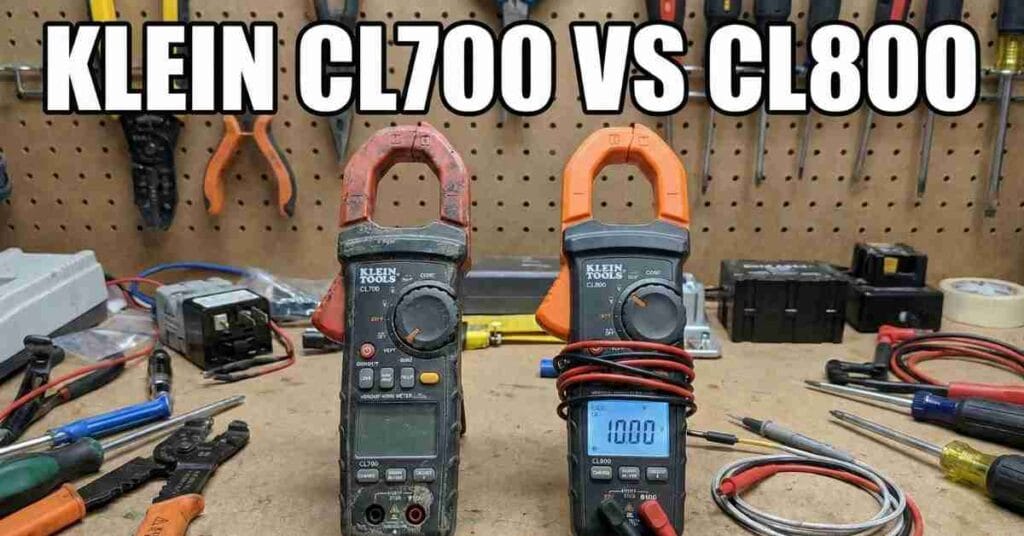
I used both of these tools for a long time. I took them to many jobs. You need to know which one is right for you. It comes down to one big thing. Do you need to test car batteries? Or just house wires? Here is what I found.
Klein Tools CL700 Review
I bought the CL700 for basic work. I work on homes a lot. I needed a tool that was strong. I did not want to pay too much. I put it in my van right away. I used it on a garage job first.
I picked it up. It felt good. It is heavy in a good way. It is not cheap plastic. The grip has rubber on it. It stays in my hand. Even when my hands are wet, it stays put.
I tested a wall plug. It read 120 volts. That is spot on. I checked it with my expensive meter. The numbers were the same. I trust this tool. It tells me the truth.
I also used a special mode. It is called LoZ. This helps with ghost voltage. Sometimes a wire looks live but is not. This mode fixes that. It saved me time. I did not have to guess.
| Pros | Cons |
| Great for house walls | No DC amps |
| Stops ghost voltage | No light on the jaw |
| Screen is bright | Beep is soft |
| Tough case | Stiff wires in cold |
| Good battery life | Tight bag |
The clamp is big. It fits round big wires. I put it on a thick main cable. It fit with ease. But I had one issue. I tried to test a gate motor. The motor used DC power. The clamp did not work. This tool only does AC power on the clamp.
The screen is nice. It lights up bright. I used it in a dark cellar. I could see the numbers well. The wires are okay. They get stiff in the cold. That is a small pain. But the tool is tough. I dropped it once. It fell six feet. It hit the concrete. It was fine. It turned right back on.
Klein Tools CL800 Review
I got the CL800 for a different reason. I work on cars and solar power too. I needed to test batteries. The CL700 could not do that. The CL800 can.
I used it on a solar setup. I clamped it on a battery wire. I could see the power flow. I did not have to cut the wire. That is a huge help. It makes the job fast.
I also used the heat probe. I checked an AC unit. I put the probe in the vent. The number came up fast. It took ten seconds. It was close to my heat gun. It is nice to have this in one tool. It does a lot of jobs.
| Pros | Cons |
| Does AC and DC | Costs more |
| Has a jaw light | A bit heavy |
| Checks heat too | Dial is stiff |
| Very safe rating | Touchy sensor |
| Easy to read | Small screw |
It has a light on the jaw. I love this feature. I was in a dark attic. I could not see the wires. I turned on the jaw light. I saw the wire colors. It helped me a lot. The other meter does not have this.
The battery life is good. I have used it for two months. I have not changed them yet. It turns off if you forget it. That saves power. The voltage sensor is touchy. It beeps when I am just near a wire. That can be annoying. But it keeps me safe. It is a beast of a tool.
Detailed Comparison for Klein CL700 vs CL800
Both tools are good. But they are for different jobs. I used them side by side. I saw some clear differences.
Core Capability (AC vs DC)
This is the main thing. The CL700 acts one way. It only reads AC current. That is the power in your walls. I tried it on my truck. It read zero. It cannot read DC current.
The CL800 can do both. It has a special sensor. If you work on cars, you need this. If you work on solar, you need this. If you just do house wires, you do not.
| Feature | CL700 | CL800 |
| AC Amps | Good | Good |
| DC Amps | None | Good |
| Best For | Homes | Cars |
Worklight and Visibility
Dark rooms are hard to work in. You need to see the wire. The CL700 has a bright screen. But the jaw is dark. I had to hold a flashlight in my mouth. That is not fun.
The CL800 has a light on the jaw. It shines on the wire. It is not huge. But it helps. You can see the colors. It makes the job safer. Both screens are bright. You can read them easily.
| Feature | CL700 | CL800 |
| Screen Light | Yes | Yes |
| Jaw Light | No | Yes |
| Dark Use | Hard | Easy |
Durability and Build Quality
I am hard on tools. I drop them a lot. I dropped both of these. They fell from my ladder. They both lived. The rubber is thick. They feel the same in my hand.
The dial on the CL800 was stiff. It got loose after a week. Now it is fine. The battery door has a screw. Do not lose it. It is small. But it keeps the door shut when you drop it.
| Feature | CL700 | CL800 |
| Drop Test | Passed | Passed |
| Feel | Strong | Strong |
| Case | Rubber | Rubber |
Accuracy and Response Time
I put both on the same plug. I wanted to see if they match. The plug was 120 volts. The CL700 read 120.1. The CL800 read 120.2. They are the same.
The beeper is fast on both. The CL800 felt a tiny bit faster. When I test fuses, speed is good. Both gave me the number fast. It took two seconds. The numbers did not jump around. They stayed still.
| Feature | CL700 | CL800 |
| Accuracy | High | High |
| Beeper | Fast | Faster |
| Speed | Good | Good |
Price and Value
The CL700 costs less. It is a good deal. If you just fix homes, buy it. You save money. You can buy other tools.
You pay more for the CL800. You pay for the DC part. If you do not need DC, do not pay for it. The CL700 is a great value. But if you need to check a car, get the CL800. It is worth the extra cost.
| Feature | CL700 | CL800 |
| Cost | Low | High |
| Value | Good | Good |
| Best Buy | Electrician | Mechanic |
Conclusion
If you only work on houses, get the CL700. It saves you money. It works great. If you work on cars or solar, get the CL800. You need the DC feature. It is safer for those jobs. Both are tough tools. You will like them.