
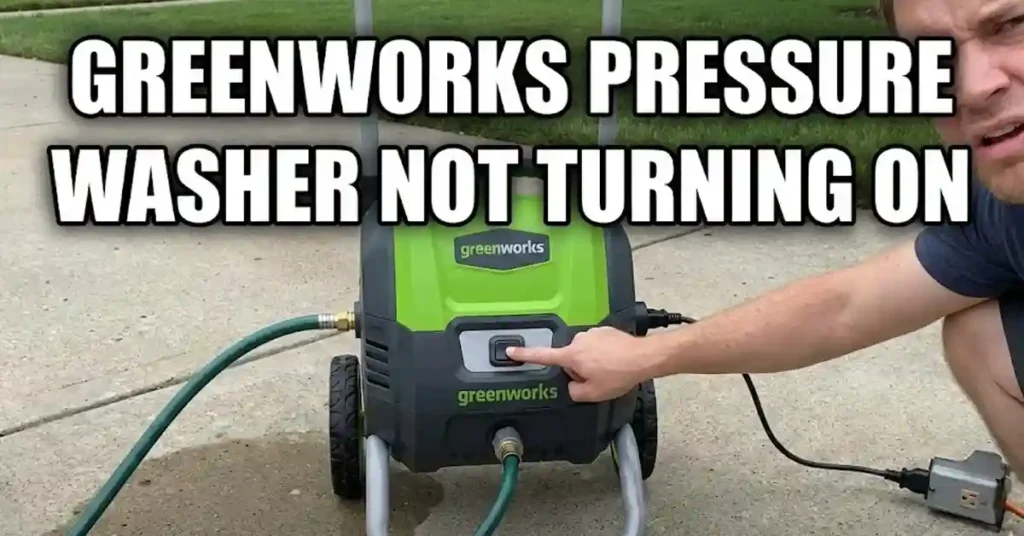
It was a bright Saturday morning when I decided to clean my driveway. The sun was out, and I had my coffee in hand. I dragged my Greenworks pressure washer out of the shed and hooked up the hose. I was ready to blast away the winter grime, but when I flipped the switch, nothing happened.
The silence was frustrating. I just wanted to clean the concrete, not spend my day fixing a broken tool. If you are here reading this, you are likely in the exact same spot. You want to wash your car or your deck, but your machine is dead.
I have been there many times. I have learned that most of the time, the machine is not actually broken. It is often just confused or needs a simple reset. Here is what I learned from my own experience to get it running again.
It Might Not Be Broken at All
The first time my washer refused to start, I felt a bit silly. I am used to gas engines that roar to life as soon as you pull the cord. Electric tools are different and can be very quiet. They do not always make noise when they are on.
I flipped the switch to “ON” and waited for a hum, but I heard nothing. I thought the motor was blown, but I was wrong. These units have a feature called the “Total Stop System” that saves the pump from wear.
The motor only runs when you actually pull the trigger on the wand. If the system has pressure in the hose, the motor sits still and waits for you. It is a smart feature, but it can trick you into thinking the unit is dead.
So, do this simple test first. Squeeze the trigger on the gun firmly. Does water shoot out? Does the motor kick on for a second? If yes, your machine is fine and was just waiting for you to work.
Check The Power Plug First
We need to look at the power cord before we do anything else. You know that big, brick-like plug at the end of the cord? That is the GFCI plug, and it is there to save your life.
Water and electricity do not mix well, so this plug stops the power if water gets in the wrong place. I have tripped this plug just by dragging it through wet grass. It happens often and is very easy to fix.
Look closely at the plug to see the two buttons. One says “TEST” and the other says “RESET.” There should also be a small light on the plug, which is usually green. If the light is dark, you have no power.
Common Plug Status Codes
| What You See | What It Means | What I Do |
| Green Light On | Power is good | Check the machine switch |
| No Light | Power is cut | Press the RESET button firmly |
| Button Pops Out | Safety trip | Try a dry outlet indoors |
| Light Flickers | Bad contact | Check the wall socket |
Press the RESET button firmly until you feel a solid click. The green light should glow steadily. If it clicks and the light stays on, try the machine again.
If the button pops back out right away, stop and do not force it. Unplug the unit and take it to a different outlet. Try an outlet in the kitchen or a dry spot in the garage to rule out a bad wall socket.
The Air Lock Problem
This is the most annoying issue I run into, and it happens to me at least once a season. Inside the pump, you need water to create pressure. You cannot have air inside the system because air compresses and water does not.
If there is a big bubble of air in your pump, the sensors get confused. The pump thinks it is full of high-pressure water and tells the motor to stop. It is lying to the motor, but the machine does not know that.
I call this the “Air Lock,” and here is how I clear it. Turn the power switch off and unplug the cord from the wall. Turn your garden hose water spigot on full blast.
Important: Take the nozzle tip off the wand so you just have the open metal tube. Point the gun at the grass and squeeze the trigger. Water will spit and sputter, and it will look foamy as the air escapes.
Keep holding the trigger and do not let go until the water flows smooth. It should look like a solid clear stream, which can take up to a full minute. Once the water is smooth, keep holding the trigger and flip the power switch to on.
Watch Out For Extension Cords
I have a big yard, and the outlet is by the back door. My driveway is 50 feet away, so I often need an extension cord. My first instinct is to grab the orange cord from my garage because it is long and handy.
However, using the wrong cord is a motor killer. I learned this the hard way with my table saw. Electric motors need a lot of power to start, and they need that energy instantly.
Long, thin extension cords act like a thin straw. You cannot get enough juice through them fast enough, which causes a “voltage drop.” If your cord is too long or too thin, the power drops and the motor starves.
My Rule for Extension Cords
| Cord Length | Gauge You Need (AWG) | My Advice |
| 0 to 25 Feet | 14 Gauge | Okay for light duty |
| 25 to 50 Feet | 12 Gauge | This is the minimum I use |
| 50+ Feet | 10 Gauge | Heavy and expensive, but needed |
| Any Length | 16 Gauge (Standard) | Do not use. It will kill the motor |
Look at your cord and find the gauge number printed on the side. The lower the number, the thicker the wire. If you are using a thin white household cord, stop immediately.
Plug the washer directly into the wall to test it. If it turns on, toss that thin cord aside. You have found your problem and saved your motor.
Did It Get Too Hot?
Last summer, I was cleaning my deck on a very hot day. I was sweating, and the sun was beating down on the black plastic case of the washer. I had been running the machine for an hour straight without a break.
Suddenly, it just quit. There was no noise and no sputter. It was just dead. I thought I had killed it for sure.
I touched the case, and it was hot. It was not just warm from the sun, but hot from the motor working hard. These machines have a thermal switch that acts like a fever thermometer.
If the motor gets too hot, the switch cuts the wire to save the motor from melting. There is no reset button for this, so you just have to wait. I unplugged it and moved it to the shade under a tree.
I went inside and drank some iced tea to cool off. I gave the machine 45 minutes to cool down as well. When I came back, the case was cool to the touch.
I plugged it in, and it started right up. If you have been working hard, give the tool a break. It needs to cool down just like you do.
My Final “Is It Dead?” Checklist
Sometimes, things just break. It is sad, but it is true. I have fixed many tools, but I can’t fix everything. There comes a point where I stop fighting and start looking for the warranty card.
If you have tried all the steps above, go through this final list. First, check the outlet again by plugging in a lamp. Does it work? If yes, the power is fine.
Second, check the water flow. Is the hose kinked? Is the little screen filter where the hose connects clogged with dirt? I pulled a tiny pebble out of mine once, and that pebble stopped the whole show.
Third, listen closely when you flip the switch. Do you hear a hum or a loud buzz? If it hums but won’t spin, the capacitor might be bad. That is an internal part, and unless you love soldering, that is a shop repair.
If there is absolutely no sound and the plug light is on, the switch itself might be broken. At that point, I check the warranty. Greenworks usually has a decent warranty and might just send you a new one.
FAQs: Greenworks Pressure Washer Not Turning On
Where is the reset button on my Greenworks pressure washer?
The reset button is on the large GFCI plug at the end of the power cord. Press it firmly until you hear a click and see a green light. This restores power after a trip.
Why does my electric pressure washer hum but not start?
You likely have an air lock trapped inside the pump. Remove the nozzle tip and run water through the gun with the power off. This clears air so the motor can spin freely.
Can I use an extension cord with my Greenworks washer?
Avoid standard cords as they reduce power to the motor. If you must use one, grab a thick 12-gauge cord under 50 feet. This keeps the voltage steady and safe for the tool.
Why does the motor stop when I let go of the trigger?
This is the Total Stop System working exactly as it should. The motor shuts off to save the pump when you are not spraying. Just squeeze the trigger to run it again.