
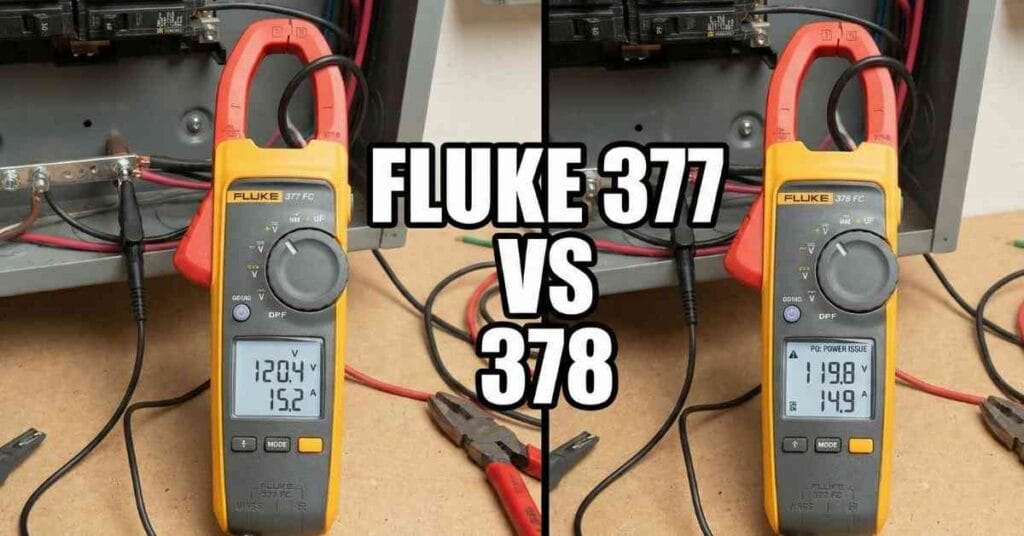
I spent the last two weeks carrying both the Fluke 377 FC and the 378 FC in my truck. I used them on messy breaker panels, old HVAC motors, and even a car battery to see which one earned a permanent spot in my bag. Here is the honest truth about how they compare when the work gets dirty.
My Experience with the Fluke 377 FC
I started testing the 377 FC on a Monday morning service call. I had a crowded sub-panel where I couldn’t easily stick test probes. This is where the “FieldSense” feature shines. I clipped the black lead to the panel ground and just clamped the jaw over a wire. It showed me voltage and current at the same time on the split screen. That saved me a solid ten minutes of fiddling around.
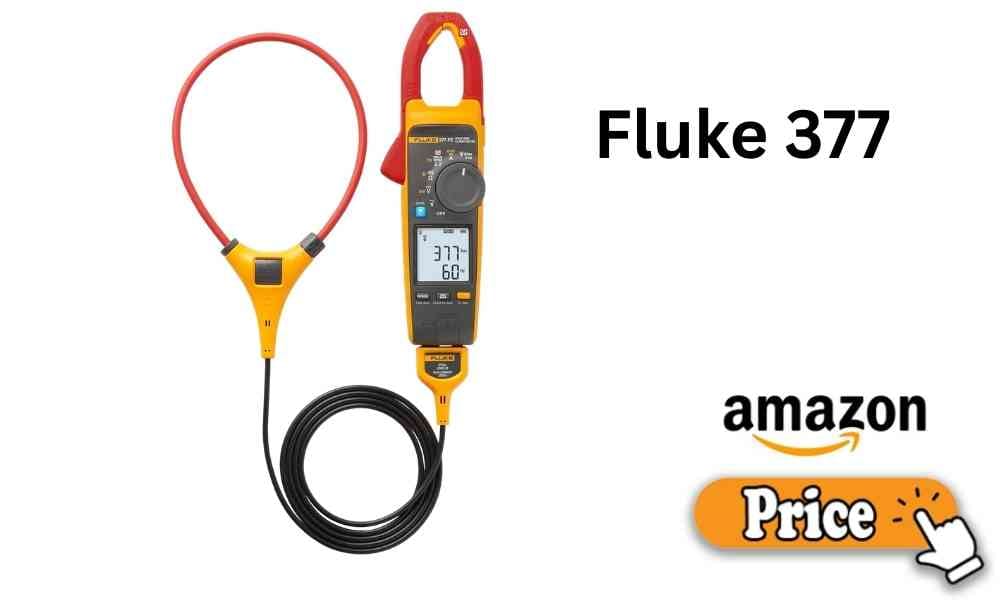
I also tested the continuity on a long run of thermostat wire. The beeper is loud enough to hear over a running compressor, which is a small detail that matters. I compared the amperage readings against my old trusty Fluke 325. The 377 FC was dead on, but it reacted faster to load changes. The build feels like a tank. I accidentally knocked it off a six-foot ladder onto concrete, and it didn’t even care.
| Pros | Cons |
| FieldSense makes voltage checks safe and fast | The jaw is a bit bulky for very tight bundles |
| Screen turns green when FieldSense works | It does not show power quality issues |
| Bluetooth sync to phone is reliable | Price is high for a clamp meter |
| Feels very durable in the hand |
My Experience with the Fluke 378 FC
The 378 FC looks and feels exactly like the 377 FC until you have a problem. I went to a site where a three-phase pump kept tripping. I clamped the 378 FC on the lines. Immediately, the screen showed a little symbol indicating a “Power” issue, not an equipment issue. It turns out the incoming voltage had some nasty harmonics.
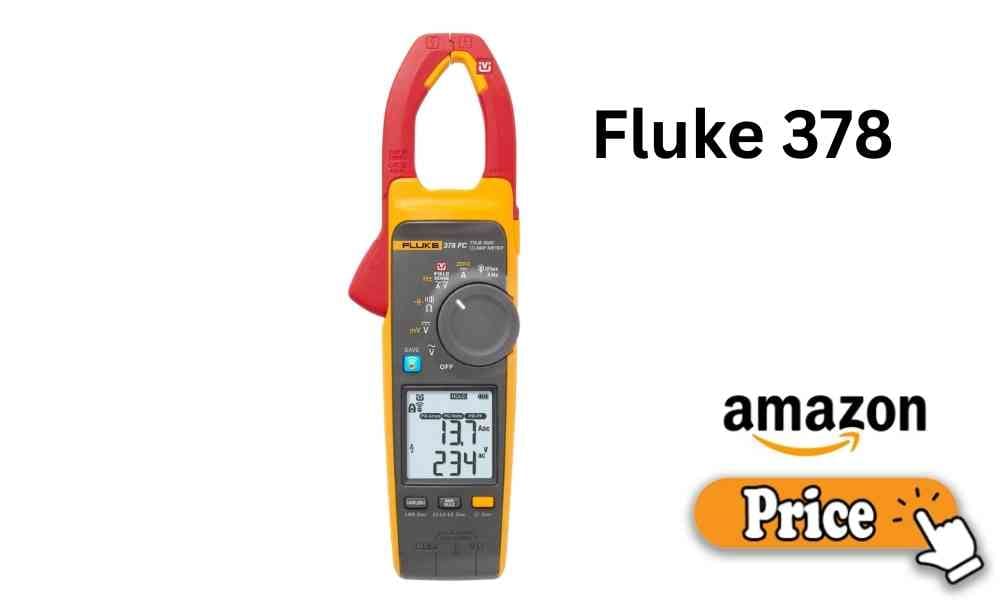
If I had used the 377 FC, I might have wasted an hour taking the pump apart. The 378 FC told me the problem was upstream instantly. I also love the phase rotation feature on this. You clamp L1, L2, and L3 in order, and it does the math for you. It takes the guesswork out of hooking up motors. The battery life seems identical to the 377; I am still on the first set of AAs after heavy use.
| Pros | Cons |
| Spots power quality issues automatically | Most expensive option in the lineup |
| Tells you if the fault is utility or load | PQ indicator is basic, not a full analyzer |
| Phase rotation is easy to use | Same bulky jaw size as the 377 |
| Includes all standard FieldSense features |
Details Comparison for Fluke 377 vs 378
Here is a breakdown of the specific differences I found during my testing to help you pick the right tool.
Power Quality Diagnostics
This is the only real difference that changes how you work. The 378 FC has a mode that listens to the line quality. It checks for weird ripples or dips (THD) that can hurt motors. The 377 FC just measures the raw numbers.
| Feature | Fluke 377 FC | Fluke 378 FC |
| Power Quality Indicator | No | Yes |
| THD Sensitivity | None | Detects Harmonics |
| Fault Source Logic | You guess | Meter tells you |
FieldSense Technology
Both meters use the same tech here. You do not need metal-to-metal contact for voltage. I found both worked reliably on standard 14-gauge and 10-gauge wire. They both struggled a bit if the wire was shoved deep in the corner of the jaw, so placement matters.
| Feature | Fluke 377 FC | Fluke 378 FC |
| Non-contact Voltage | Yes | Yes |
| Ground Clip Need | Yes | Yes |
| Visual Confirmation | Green Screen | Green Screen |
Comparison Accuracy
I checked both meters against a calibrated bench multimeter. I measured a steady 120.5V source. The 377 read 120.4V and the 378 read 120.5V. For real work, they are effectively the same. They both hold zero well and do not drift when the temperature changes.
| Metric | Fluke 377 FC | Fluke 378 FC |
| Voltage Accuracy | ± 3 % | ± 3 % |
| Current Accuracy | 2% ± 5 digits | 2% ± 5 digits |
| Stability | High | High |
Jaw Design and Ergonomics
These are big meters. The jaw opening is huge (34 mm), which is great for thick feeder cables. But it is tough to use inside a small residential box. The clamp spring is stiff, which feels high quality but might tire your hand out if you squeeze it all day.
| Spec | Fluke 377 FC | Fluke 378 FC |
| Jaw Opening | 34 mm | 34 mm |
| Weight | 463 g | 463 g |
| One-hand use | Good | Good |
App Connectivity
I used the Fluke Connect app with both. They pair fast. I could see the readings on my phone while the meter was shut inside a cabinet. This is a huge safety win. The data logging speed was the same for both.
| Feature | Fluke 377 FC | Fluke 378 FC |
| Bluetooth | Yes | Yes |
| Phase Rotation App | Yes | Yes |
| Data Logging | Yes | Yes |
Conclusion
If you work on sensitive industrial gear or motors, buy the Fluke 378 FC. That power quality indicator pays for itself in one job. If you just do standard electrical installs or residential work, the Fluke 377 FC is all you need. It has the same safety features and speed without the extra cost.