
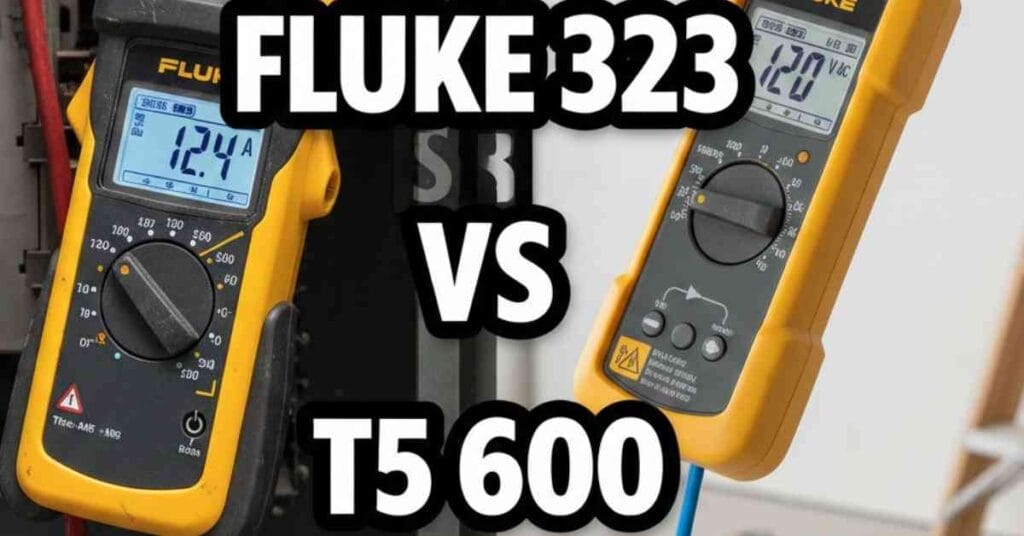
I spent weeks testing the Fluke 323 and the T5-600 on real jobs. After using them in dusty panels and tight engine bays, I finally know which one wins for daily use.

My Experience With the Fluke 323
I took the Fluke 323 to a local workshop to fix an old air compressor motor. The first thing I noticed was the True RMS feature. It gave me a rock-solid reading of 12.4 amps, while my cheaper backup meter kept jumping around. The clamp is smooth and snaps shut with a firm click. I used it to check household AC current on a fridge circuit, and the numbers were very consistent. It feels like a tool that will last ten years. The only downside was the lack of a backlight, which made it hard to see inside dark electrical cabinets.

| Pros | Cons |
| Very accurate True RMS readings | No backlight on the screen |
| Feels rugged and professional | Jaw can be tight in crowded wires |
| Great for motor troubleshooting | Higher price than basic testers |
My Experience With the Fluke T5-600
The T5-600 has been in my pocket for almost a month. I used it mostly for quick checks on a DIY home renovation. The “OpenJaw” design is a lifesaver. I didn’t have to unclip wires to get a reading; I just slid the fork over the wire. I tested it on a car battery draw, but keep in mind this is for AC current only. For continuity tests on old wiring, the beeper is loud and fast. It doesn’t feel as precise as the 323, but for roughing-in work, it is much faster to use.
| Pros | Cons |
| Fits perfectly in a tool pouch | Not a True RMS meter |
| Very fast to use with the fork | Harder to use on very thick cables |
| Leads store safely on the back | 100A limit is lower than the 323 |
Detailed Comparison for Fluke 323 vs T5 600
Both of these tools are built well, but they serve different goals. Here is how they stack up when you actually put them to work.
Core Measurement Capabilities
The 323 is a full clamp meter, while the T5 is a tester. I noticed the 323 handled higher loads without breaking a sweat.
| Feature | Fluke 323 | Fluke T5-600 |
| Max AC Amps | 400A | 100A |
| Measurement Type | True RMS | Averaging |
Accuracy and Stability
In my shop tests, the 323 gave me more stable readings. When testing a motor start-up, the 323 held the number well, whereas the T5 fluctuated a bit more.
| Metric | Fluke 323 | Fluke T5-600 |
| AC Accuracy | 2% + 5 counts | 3% + 3 counts |
| Stability | High | Moderate |
Jaw Size and Design
The 323 has a 30mm jaw that closes fully. The T5 has an open fork. I found the 323 better for hanging off a wire so I could keep my hands free.
| Design | Fluke 323 | Fluke T5-600 |
| Jaw Type | Closed Clamp | Open Fork |
| Max Wire Size | 30mm | 12.9mm |
Display and Usability
Neither of these has a backlight, which is a shame. However, the T5 is much slimmer and easier to hold if you have smaller hands or are wearing thick gloves.
| User Factor | Fluke 323 | Fluke T5-600 |
| Weight | 310g | 280g |
| One-Hand Use | Good | Excellent |
Build Quality and Durability
Fluke is known for toughness. I dropped the T5 off a ladder once, and it didn’t even scratch. The 323 feels a bit more like a “sensitive” instrument, but the plastic is very thick.
| Build | Fluke 323 | Fluke T5-600 |
| Drop Rating | Standard Fluke | 10-foot drop |
| Lead Quality | Detachable | Fixed/Storable |
Conclusion
If you need to fix motors or do precise HVAC work, buy the Fluke 323. It is more accurate and handles more power. If you are just doing basic home electrical or “rough” work, the T5-600 is faster and easier to carry. I keep the 323 in my main bag and the T5 in my pocket.