
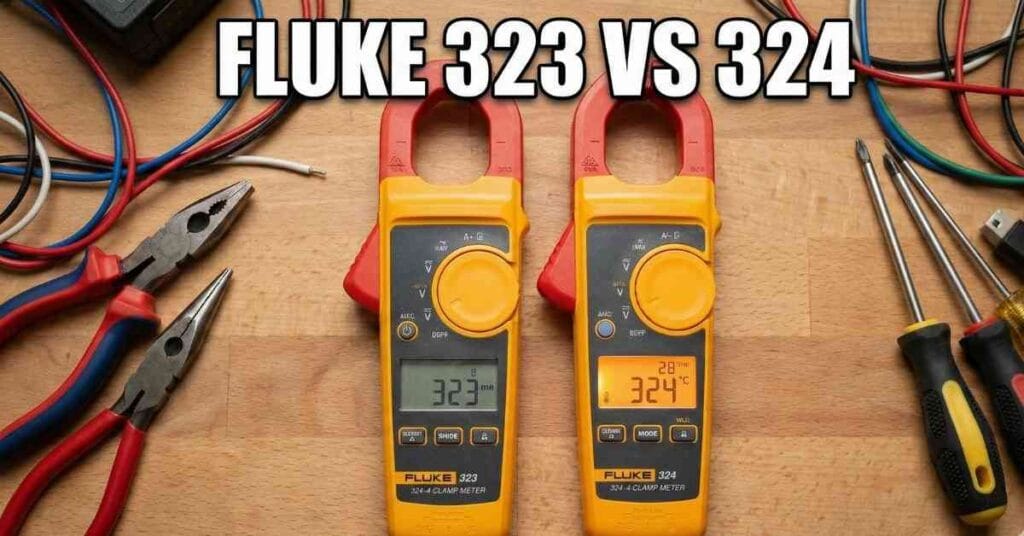
I spent the last two weeks with both the Fluke 323 and the 324 in my tool bag. I wanted to see if the price jump for the 324 was actually worth it for day-to-day tasks. Here is exactly how they handled my real-world electrical and HVAC jobs.

My Experience With the Fluke 323
I started by using the Fluke 323 for a basic subpanel installation in a garage. It feels solid in the hand, just like you expect from Fluke. I love that it is simple. You just turn the dial and it works. I clamped it around a thick service wire to check the load. The reading came up fast. It did not jump around.
I also used it to check continuity on some old outlets. The beep is loud and instant. That is great when you are trying to work fast. But I did run into one issue. I was in a dark corner of the garage, and I could not read the screen. I had to use my phone light to see the numbers. It was a bit annoying.
| Pros | Cons |
| Very easy to use | No screen backlight |
| Fast continuity beep | Cannot measure capacitance |
| Slim and fits in pockets | Hard to read in dim light |
| Great battery life | No temperature settings |
My Experience With the Fluke 324
Next, I took the Fluke 324 up to an attic to look at a faulty AC unit. This is where the differences hit me right away. The attic was dark, but the 324 has a backlight. I hit the button and could see my readings clearly. That one feature saved me so much frustration.
I needed to check the run capacitor on the blower motor. The 323 cannot do this, but the 324 can. I set it to capacitance mode and tested the cap. It showed 5 microfarads, which was spot on. I also used the temperature probe to check the air vent output. It is nice to have fewer tools to carry up a ladder.
| Pros | Cons |
| Bright backlight is a lifesaver | Costs more than the 323 |
| Measures capacitors | Slower on auto-range |
| Includes temperature probe | Beep is a bit quieter |
| Great for HVAC work | Same basic accuracy as 323 |
Details Comparison for Fluke 323 vs 324
Here is the deep dive. I looked closely at the specific features that matter when you are actually on the job site.
Core Measurement Capabilities
This is the main reason to pick one over the other. The 323 is for pure electrical work. The 324 is built for HVAC. I missed the capacitance setting on the 323 when I tried to fix a pool pump.
| Feature | Fluke 323 | Fluke 324 |
| AC Current | 400 A | 400 A |
| Capacitance | None | 100 to 1000 μF |
| Temperature | None | -10°C to 400°C |
Display and Usability
The screen size is the same, but the light changes everything. I work in basements a lot. The 323 forced me to squint or use a flashlight. The 324 let me work with one hand free.
| Feature | Fluke 323 | Fluke 324 |
| Backlight | No | Yes |
| Screen Contrast | Good | Excellent |
| Readability in Dark | Poor | Perfect |
Accuracy and Stability
I compared both meters against a high-end bench meter. They were both very close. The True RMS feature on both kept readings stable even when I tested them on a variable speed drive. They did not drift.
| Feature | Fluke 323 | Fluke 324 |
| True RMS | Yes | Yes |
| AC Accuracy | 2% ± 5 counts | 1.5% ± 5 counts |
| Reading Stability | Very Stable | Very Stable |
Jaw Size and Design
The clamps are identical. They are slim and tapered. This shape helps a lot in tight breaker boxes. I had no trouble hooking either one around a 4/0 wire inside a crowded panel.
| Feature | Fluke 323 | Fluke 324 |
| Jaw Opening | 30 mm | 30 mm |
| Shape | Tapered | Tapered |
| Wire Access | Easy | Easy |
Safety Ratings
Safety is key for me. Both tools are rated for serious work. I felt safe using them on the main feeds of a house. The build quality gives you confidence that they will not fail if you drop them.
| Feature | Fluke 323 | Fluke 324 |
| Safety Rating | CAT IV 300V | CAT IV 300V |
| Secondary Rating | CAT III 600V | CAT III 600V |
| Build Feel | Rugged | Rugged |
Conclusion
If you only do basic wiring, save your cash and get the 323. It is tough and accurate. But if you touch AC units or work in the dark, buy the 324. The backlight and capacitor test are worth every extra penny.