
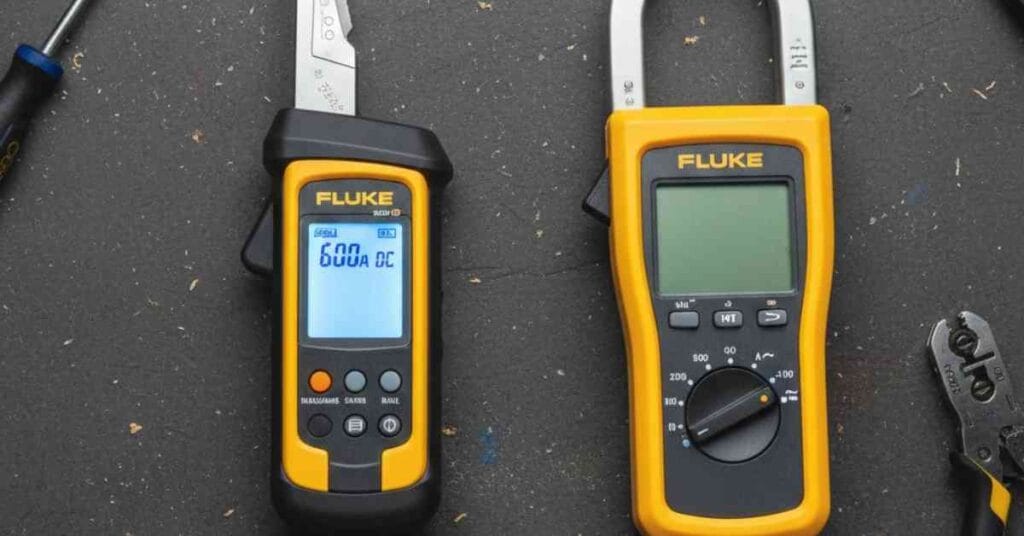
I spent the last few weeks testing the Fluke 301D and the Fluke 323 on real jobs. One is a tiny powerhouse while the other is a rugged classic. Here is what I learned from using them every day.

My Experience With the Fluke 301D
I took the 301D to a solar site last Tuesday. The first thing I noticed was the size. It is thin and light. It fit right into my pocket without weighing me down. The “blade” jaw design is a lifesaver. I had to measure current in a very crowded junction box. Most clamps are too fat to slide between wires, but this one slipped right in.
I used it to check the DC draw on a car battery and a few solar strings. The readings were fast. It also has a backlight, which helped a lot when the sun started to go down. I did notice it felt a bit like a toy because it is so light. However, it survived a small drop onto gravel without a scratch. The screen is clear, and the buttons click firmly.
| Pros | Cons |
| Very slim jaw for tight spaces | Only CAT III 300V safety rating |
| Measures both AC and DC current | Not a True-RMS meter |
| Includes frequency and capacitance | Feels less rugged than larger models |
My Experience With the Fluke 323
The Fluke 323 is a tool I have trusted for a long time. It feels solid in the hand. I used it to test a large AC motor start-up current at a workshop. Since this meter is True-RMS, the readings were very stable even with the electrical noise from the motor. It gave me a solid 12.4 amps every time I checked the line.
I also performed continuity tests on an old wiring harness. The beeper is loud and instant. There is no lag. The jaw is much larger than the 301D. While it was harder to use in small boxes, it felt much safer when I was checking 480V circuits. It does not have a backlight, which is my only real gripe. It is a simple tool that just works.
| Pros | Cons |
| True-RMS for accurate AC readings | No DC current measurement |
| Higher CAT IV safety rating | No backlight on the screen |
| Very durable build quality | Fewer extra features (no Hz or Cap) |
Details Comparison for Fluke 301D vs 323
Both meters come from a great brand, but they do very different things. Here is how they stack up in the field after my hands-on testing.
Core Measurement Power
The 301D is the winner for versatility. It handles DC current, which the 323 cannot do. If you work on cars or solar, you need the 301D. But for pure AC work, the 323 is more precise due to True-RMS.
| Feature | Fluke 301D | Fluke 323 |
| Current Type | AC and DC | AC Only |
| True-RMS | No | Yes |
| Frequency | Yes | No |
Accuracy and Stability
In my tests, the 323 was more stable. When I measured a steady AC load, the numbers on the 323 stayed still. The 301D jumped around by about 0.2 amps. The 323 is built for precision in tough spots.
| Metric | Fluke 301D | Fluke 323 |
| AC Accuracy | 2% + 5 counts | 2% + 5 counts |
| Reading Feel | Fast but drifts | Very stable |
| Counts | 6000 | 4000 |
Jaw Design and Use
The 301D has a 10mm jaw. That is tiny. I could clamp one wire in a bundle easily. The 323 has a 30mm jaw. It is better for thick cables like those on a generator.
| Feature | Fluke 301D | Fluke 323 |
| Jaw Width | 10mm (Slim) | 30mm (Standard) |
| Max Wire Size | 600 MCM | 750 MCM |
| Hand Feel | Pocket-sized | Full-sized |
Display and Visibility
The 301D has a great backlight. I could see it in a dark basement. The 323 has no light. If you work in dark areas, you will need a flashlight to see the 323 screen.
| Feature | Fluke 301D | Fluke 323 |
| Backlight | Yes | No |
| Screen Size | Large for its size | Standard |
| Sunlight View | Good | Good |
Safety and Build
The 323 is a tank. It has a CAT IV 300V rating. The 301D is only CAT III 300V. This means I trust the 323 more when I am working near a main service panel.
| Feature | Fluke 301D | Fluke 323 |
| Safety Rating | CAT III 300V | CAT IV 300V |
| Case Material | Hard Plastic | Rubber Overmold |
| Drop Test | Not specified | 1 Meter |
Conclusion
If you need to check DC current on a car or solar panel, get the Fluke 301D. It is small and full of features. But if you want a rugged tool for standard AC electrical work, the Fluke 323 is the better choice. It is safer, more stable, and built to last a lifetime.