
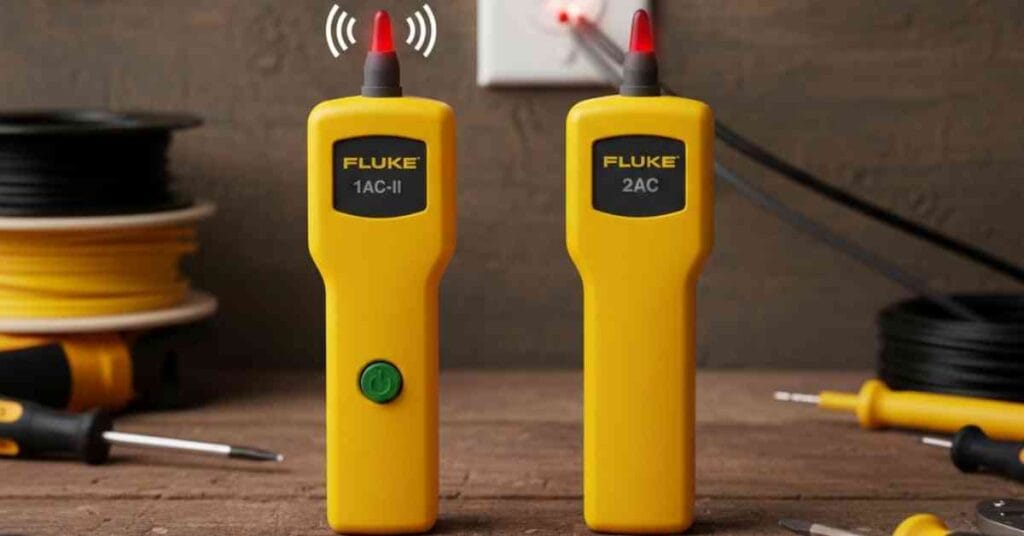
I spent the last few weeks testing these two little red sticks on everything in my shop. If you want a tool that keeps you safe without a complex manual, here is what I found during my hands-on testing.
My Experience With the Fluke 1AC-II
I took the 1AC-II into a dark basement to trace a dead outlet. What I love about this model is the feedback. When it detects voltage, it glows red and lets out a loud beep. I didn’t have to look directly at the tip while reaching behind a heavy workbench.
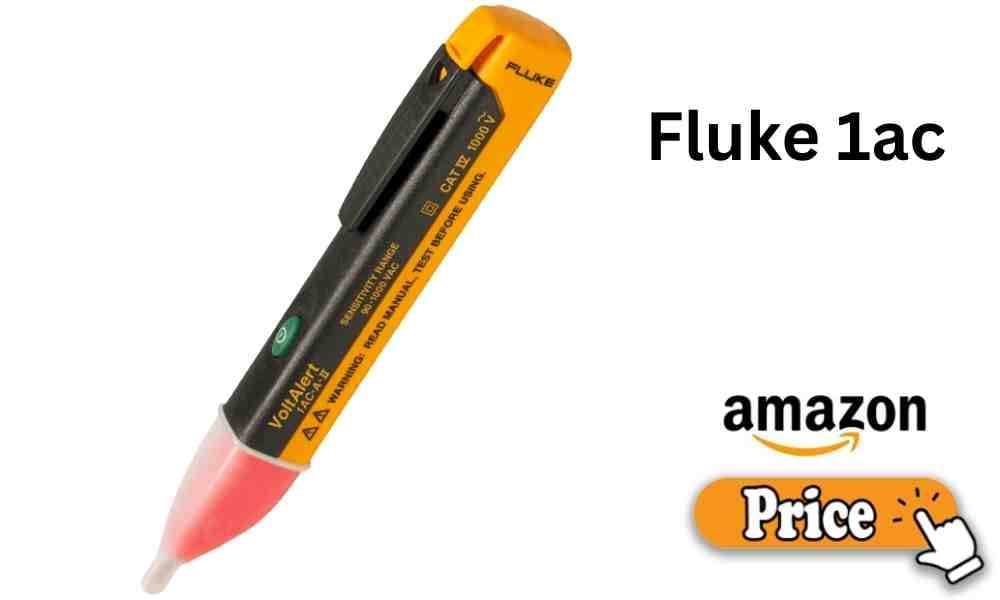
I used it to check for household AC current on a frayed lamp cord. The sensitivity is spot on. It didn’t give me any “ghost” readings from nearby wires. One morning, I dropped it onto a concrete floor. It didn’t even scratch. The manual power button feels firm, and I like knowing exactly when the tool is on or off.
| Pros | Cons |
| Loud audible beeper for noisy spots | Can accidentally leave it on |
| Dedicated battery test button | Slightly more expensive |
| Very rugged build quality |
My Experience With the Fluke 2AC
The Fluke 2AC is my go-to for quick checks. I kept it in my pocket while working on a HVAC motor start-up. Since it has no power button, I just pulled it out and touched the wire. It worked instantly. It is silent, which was nice when I was working in a quiet office late at night.

I tested it against a reference meter to see if the “always on” tech was reliable. It caught every live wire just as fast as the 1AC. The battery life has been great so far. It flashes the tip green every few seconds to show it is still alive. It is a simple, “no-fuss” tool for quick DIY tasks.
| Pros | Cons |
| Always ready with no buttons to press | No audible beep (light only) |
| Battery-efficient “always on” tech | No manual off switch |
| Great for quiet environments |
Details Comparison for Fluke 1AC vs 2AC
Choosing between these comes down to how you like to work. Here is a deep dive into how they felt during my daily tasks.
Audible and Visual Alerts
In my shop, I often work in tight corners. The 1AC-II is a lifesaver because it beeps. The 2AC is silent. If you can’t see the tip because of a weird angle, the 2AC might leave you guessing.
| Feature | Fluke 1AC-II | Fluke 2AC |
| Sound | Loud Beep | Silent |
| Light | Bright Red | Bright Red |
Power and Battery Design
The 2AC is “always on.” This is handy if you hate fumbling with buttons while wearing gloves. The 1AC-II has a green button you must press. I found the 1AC-II better for long-term storage because I can be sure it is fully off.
| Feature | Fluke 1AC-II | Fluke 2AC |
| Power Switch | Manual Button | Always On |
| Battery Check | Manual Push | Periodic Flash |
Response Time and Stability
I used both to check a car battery draw and some old house wiring. Both meters reacted almost instantly. I noticed no drift in sensitivity even after using them for hours. They are both very stable compared to the cheap testers I have used before.
| Metric | Fluke 1AC-II | Fluke 2AC |
| Lag Time | Near Zero | Near Zero |
| Stability | High | High |
Build Quality and Durability
Both tools feel like “Fluke” tools. The plastic is thick and the pocket clips are strong. I clipped them to my belt for a week of heavy moving. Neither one fell off or cracked. They both handle drops and dust like pros.
| Feature | Fluke 1AC-II | Fluke 2AC |
| Drop Rating | Very High | Very High |
| Clip Strength | Excellent | Excellent |
Safety and CAT Ratings
Safety is why I buy Fluke. Both of these are rated CAT IV 1000V. I felt safe using them on the main service panel in my garage. The insulation is thick and the tips are well-protected against accidental arcs.
| Feature | Fluke 1AC-II | Fluke 2AC |
| Safety Rating | CAT IV 1000V | CAT IV 1000V |
| Best For | Industrial/Home | Home/Commercial |
Conclusion
Both testers are top-tier tools that won’t let you down. I prefer the Fluke 1AC-II for most jobs because that beep gives me extra peace of mind. However, if you want a tool that is always ready to go without a second thought, the Fluke 2AC is a fantastic choice for your pocket.