
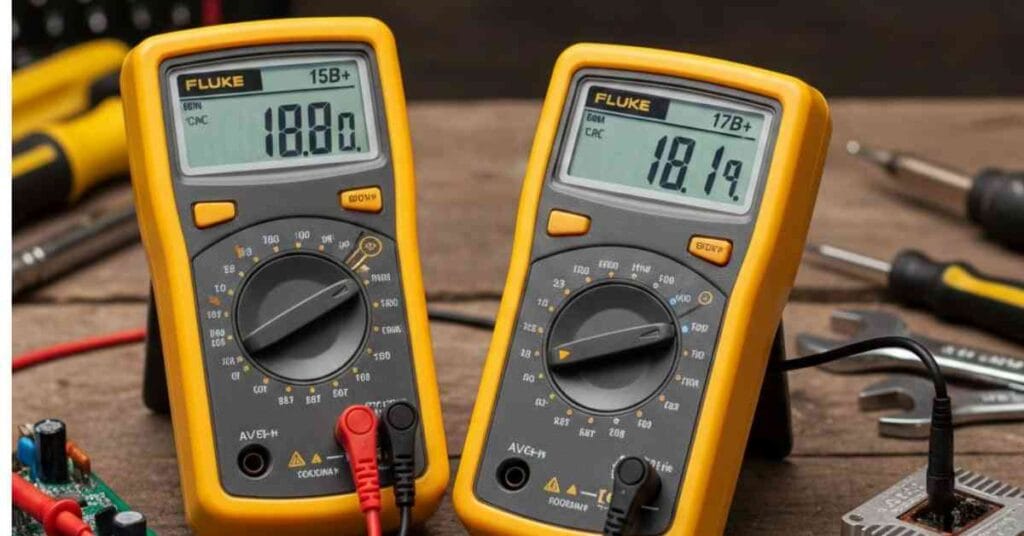
I spent weeks testing these two meters on my workbench to see which one actually earns a spot in my tool bag. Here is what I found while fixing household appliances and checking car electronics.
My Experience with the Fluke 15B+
I first grabbed the Fluke 15B+ when I needed to fix a dryer that stopped heating. It feels solid in the hand, like it can take a fall on a concrete garage floor. I used it to check continuity on the thermal fuse and it was instant—no lag or scratchy beep.
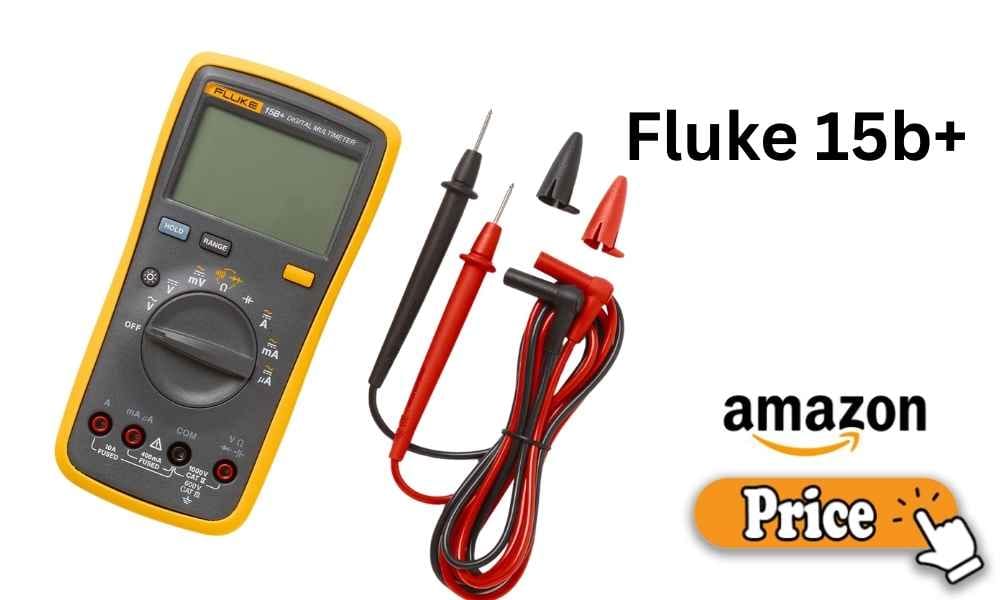
When I tested it against my high-end bench meter, the DC voltage readings were within 0.1%, which is plenty for my DIY projects. It is a simple, no-nonsense tool that just works every time I turn the dial.
| Pros | Cons |
| Very long battery life | No temperature sensor |
| High-quality test leads | No frequency mode |
| Sharp, clear screen | Lacks relative mode |
My Experience with the Fluke 17B+
The Fluke 17B+ became my go-to when I started working on my old truck. I needed to check if the alternator was charging properly and if the battery was draining overnight. The added “Relative” mode was a lifesaver; I could zero out the lead resistance to get a true reading on small wires.
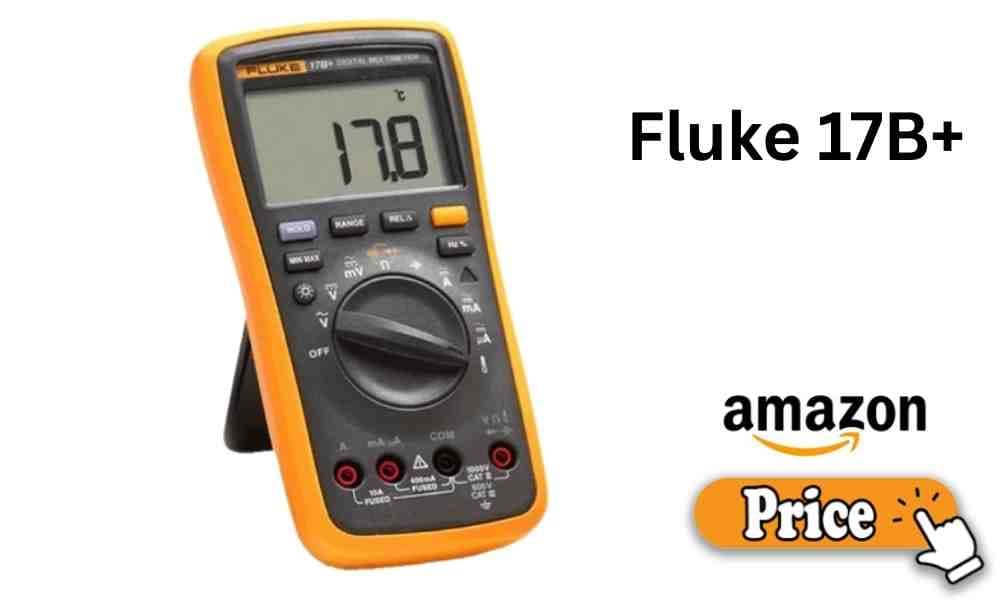
I also used the temperature probe to check the heat coming off a motor that felt too hot. It gave me a digital reading in seconds, saving me from a literal “trial by fire.”
| Pros | Cons |
| Includes temperature probe | More expensive |
| Measures frequency/duty cycle | No True RMS |
| Relative mode for accuracy | Same plastic build as 15B |
Details Comparison for Fluke 15B vs 17B
Let’s look at how these two stack up when you are actually using them in the field or at home.
Core Measurement Capabilities
Both meters handle the basics well, but the 17B+ offers more for electronics fans. I tested both on a standard 12V car battery and they gave identical results.
| Feature | Fluke 15B+ | Fluke 17B+ |
| DC Voltage | Up to 1000V | Up to 1000V |
| Temperature | Not available | -40°C to 400°C |
| Frequency | Not available | Up to 100 kHz |
Accuracy and Stability
Accuracy is where Fluke shines. I noticed the 17B+ felt a tiny bit more stable when reading small capacitors. Neither meter jumped around much, even when I was working near noisy power cables.
| Metric | Fluke 15B+ | Fluke 17B+ |
| Counts | 4000 Counts | 4000 Counts |
| DC Accuracy | 0.5% + 3 digits | 0.5% + 3 digits |
| Stability | High | High |
Display and Usability
The screens are large and easy to read even in a dim basement. The dial on both clicks into place with a firm, quality feel that cheaper meters just don’t have.
| Feature | Fluke 15B+ | Fluke 17B+ |
| Backlight | Bright White | Bright White |
| Dial Quality | Very Firm | Very Firm |
| One-hand Use | Easy | Easy |
Safety and Build Quality
I feel safe using these because they have proper internal fuses. The rubber holster is thick and protects the corners if you drop it while reaching behind a washing machine.
| Feature | Fluke 15B+ | Fluke 17B+ |
| CAT Rating | CAT III 600V | CAT III 600V |
| Protection | Rugged Holster | Rugged Holster |
| Leads | TL75 Probes | TL75 Probes |
Battery Life and Power
Both use two AA batteries. I have used the 15B+ for three months without a change. The auto-off feature is a bit aggressive, but it saves you from a dead battery when you forget it on the bench.
| Feature | Fluke 15B+ | Fluke 17B+ |
| Battery Type | 2 x AA | 2 x AA |
| Auto-Off | Yes | Yes |
| Run Time | 500+ Hours | 500+ Hours |
Conclusion
If you just need to fix things around the house, the Fluke 15B+ is a perfect choice. It is tough and accurate for a great price. However, if you like to tinker with electronics or HVAC, spend the extra money on the 17B+ for the temperature and frequency modes.