
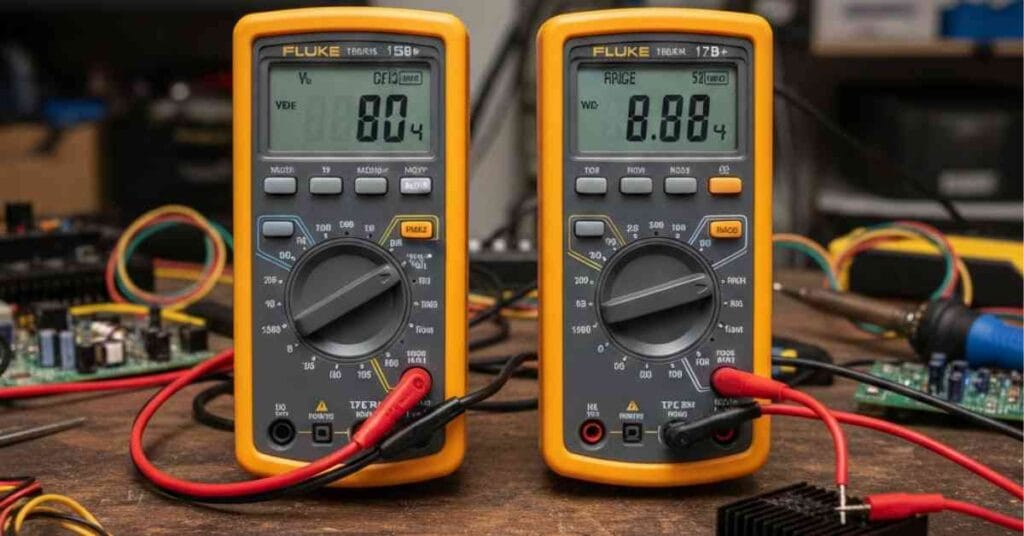
I spent several weeks testing the Fluke 15B+ and 17B+ on my workbench. Both meters feel solid, but they serve different needs. Here is what I found after using them for real repair jobs.
My Experience with the Fluke 15B+
I used the Fluke 15B+ while fixing an old dryer and checking a car battery. The first thing I noticed was the build. It feels like a Fluke. The plastic is thick, and the dial clicks firmly into place. When I tested a 12V car battery, the reading was instant and stable.
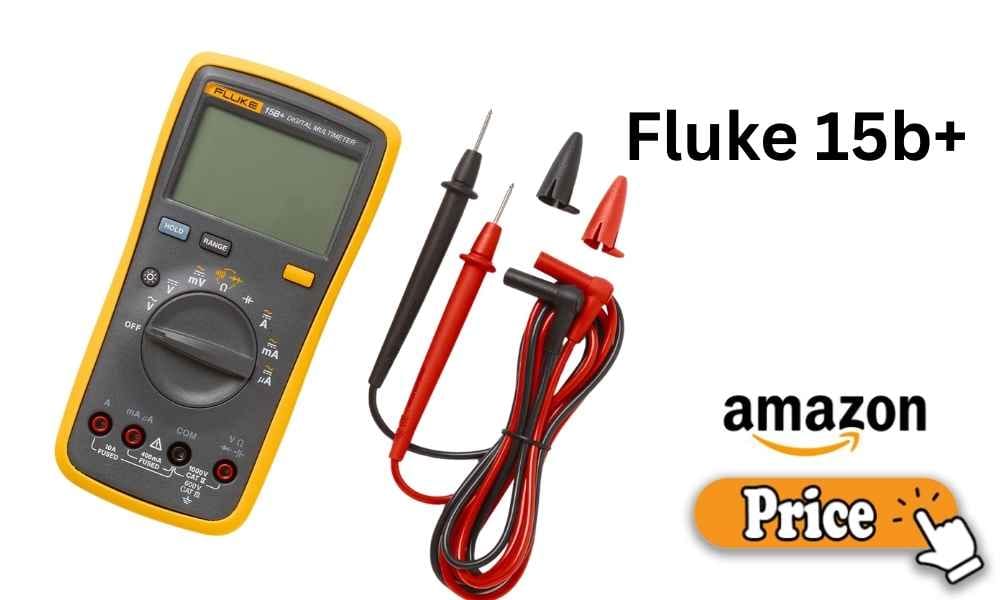
I also did a continuity test on some trailer wiring. The beep is a bit slow compared to high-end meters, but it gets the job done. It did not struggle with household AC voltage either. For basic electrical tasks, it is a very reliable tool that does not overcomplicate things.
| Pros | Cons |
| Very easy to use | No temperature setting |
| Great battery life | Slow continuity beep |
| Strong safety rating | No frequency mode |
My Experience with the Fluke 17B+
The Fluke 17B+ felt more like a complete kit for my electronics desk. I used it to check a small cooling fan motor. Being able to measure the frequency and duty cycle made it easy to see if the controller worked.
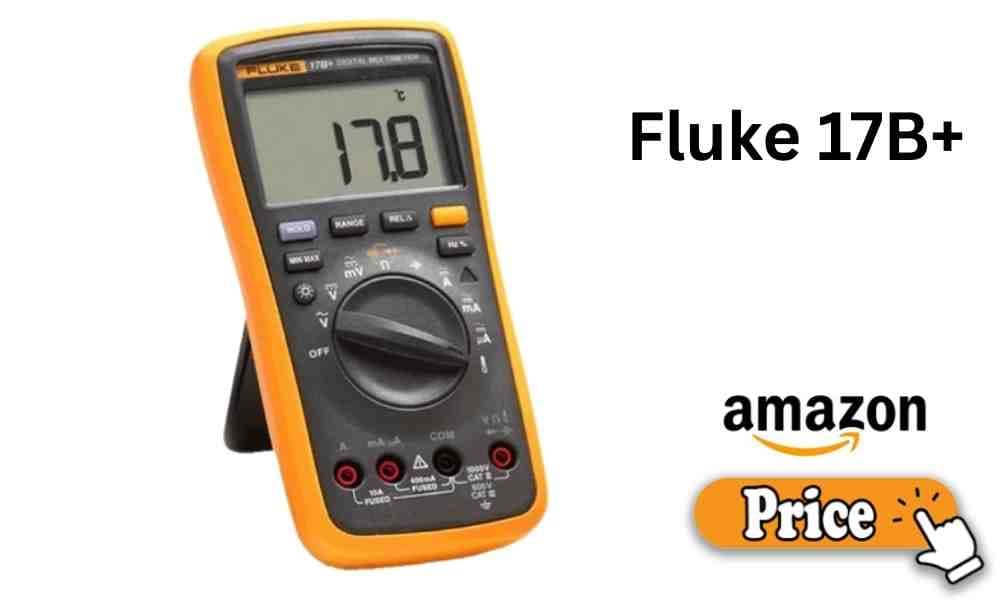
The temperature probe was a lifesaver when I was testing a heat sink on a power supply. I also love the Relative (REL) mode. I used it to zero out my lead resistance before measuring a low-ohm resistor. It gave me much more confidence in my numbers. This meter just does more for the money.
| Pros | Cons |
| Measures temperature | Higher price point |
| Has Relative mode | Leads are a bit stiff |
| Frequency testing | Slightly slower boot |
Details Comparison for Fluke 15B+ vs 17B+
Let’s look at how these two stack up when you are actually working in the field or at a desk.
Accuracy and Stability
I checked both meters against a calibrated voltage source. Both stayed within 0.5%. The 17B+ seemed a bit more stable when measuring small DC voltages. Neither meter drifted much as they warmed up.
| Feature | Fluke 15B+ | Fluke 17B+ |
| DC Accuracy | 0.5% + 3 | 0.5% + 3 |
| Reading Stability | High | Very High |
Display and Readability
Both screens are large and clear. I took them outside in bright sun, and I could still read the digits. The backlight is bright enough for dark corners under a sink. The 4000-count display is plenty for most DIY and pro tasks.
| Feature | Fluke 15B+ | Fluke 17B+ |
| Backlight | Yes | Yes |
| Digit Size | Large | Large |
Safety and Build Quality
Fluke does not skimp on safety. Both have a CAT III 600V rating. This means they are safe for home panels. The rubber holster is thick and handles drops well. I accidentally knocked the 15B+ off my bench, and it didn’t even scuff.
| Feature | Fluke 15B+ | Fluke 17B+ |
| Safety Rating | CAT III 600V | CAT III 600V |
| Drop Protection | Excellent | Excellent |
Advanced Testing Modes
This is where the 17B+ wins. It can measure temperature and frequency. If you fix HVAC units or circuit boards, you need these. The 15B+ is strictly for the basics like volts, ohms, and amps.
| Feature | Fluke 15B+ | Fluke 17B+ |
| Temp Probe | No | Yes |
| Frequency | No | Yes |
Battery Life and Power
Both use two AA batteries. This is great because AA batteries are cheap and easy to find. I have used the 15B+ for a month, and the low battery light hasn’t come on. The auto-off feature works well to save power.
| Feature | Fluke 15B+ | Fluke 17B+ |
| Battery Type | 2 x AA | 2 x AA |
| Auto-Off | Yes | Yes |
Conclusion
If you only need to check outlets and car batteries, the Fluke 15B+ is a perfect choice. It is tough and simple. However, if you do any electronics repair or HVAC work, the 17B+ is worth the extra cost for the temperature and frequency modes. I keep the 17B+ on my main bench because it handles every job I throw at it.