
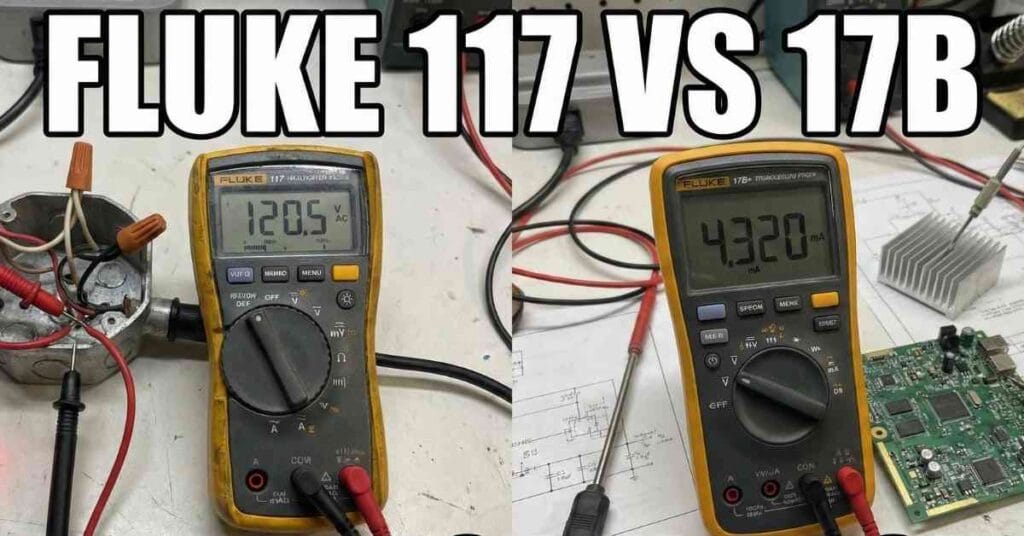
I needed a reliable meter for two very different jobs: wiring a new home office and fixing a fried circuit board. I grabbed the Fluke 117 for the house wiring and the 17B+ for the bench work. Here is how they handled the actual work in my hands.
My Experience with the Fluke 117
I spent a week using the 117 while rewiring my garage. The first thing I noticed was the speed. I did not have to mess with dial settings constantly. I just held it up to a wire, and the VoltAlert beeped if it was live. That feature alone saved me time.
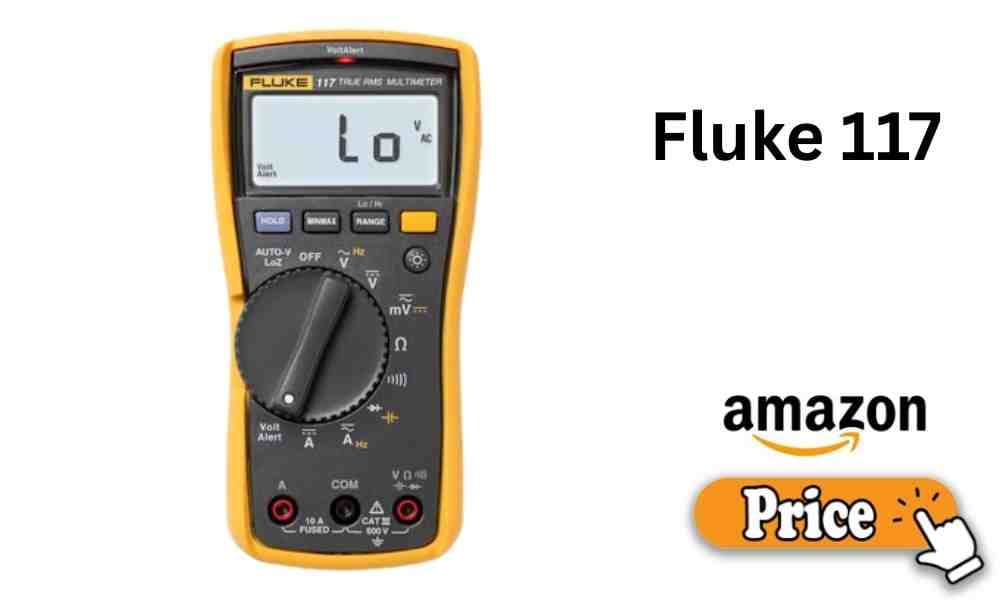
I also tested it on a “dead” switch that was showing weird readings on my cheap meter. The cheap one showed 45V, which made no sense. I switched the 117 to LoZ mode. It dropped to zero immediately. It was just ghost voltage. The 117 filtered it out perfectly. It feels great in the hand, but I missed having a milliamp range when I tried to check a small sensor later.
Pros and Cons
| Feature | Good | Bad |
| Speed | Fast auto-ranging and continuity | – |
| Safety | Non-contact voltage detection is huge | – |
| Ghost Voltage | LoZ mode kills stray readings | – |
| Current | – | No mA or µA range for electronics |
| Display | Backlight is bright and even | Low contrast in direct sun |
My Experience with the Fluke 17B+
After the garage, I moved to my workbench to fix a broken air purifier. The 117 was useless here because I needed to measure a tiny current draw. The 17B+ was the right tool. It has dedicated settings for milliamps and microamps.
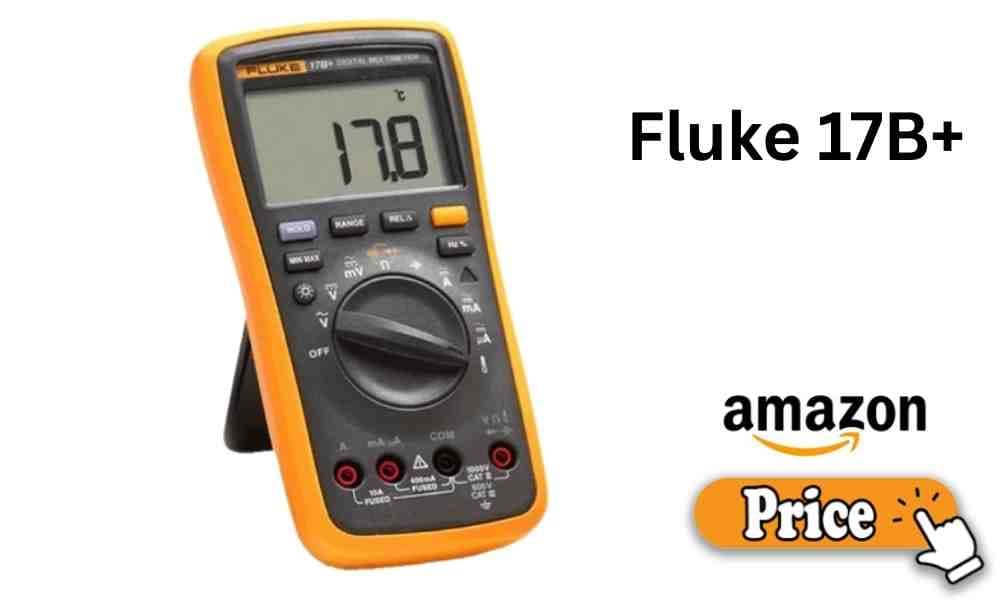
I hooked it up to check the capacitor temperature. The included probe was spot on. It took a few seconds to settle, but the reading was stable. The dial feels solid, though not as snappy as the 117. It is a bit bigger and clunkier to hold in one hand. It lacks the “ghost voltage” filter, so I would not trust it as much for troubleshooting old house wiring. But for the bench, it did everything I asked.
Pros and Cons
| Feature | Good | Bad |
| Ranges | Has mA and µA for electronics | – |
| Temp | Thermocouple probe included | – |
| Screen | Large digits are easy to read | Viewing angle is narrow |
| Speed | – | Auto-ranging is slower than 117 |
| Response | – | Continuity beeper has a tiny lag |
Details Comparison for Fluke 117 vs 17B+
Here is the raw data from my testing notes. I broke this down into the five areas that actually mattered while I was working.
Core Measurement Capabilities
The biggest difference is in what they can measure. The 117 is for buildings. The 17B+ is for components. If you need to measure heat or tiny currents, the choice is clear.
| Spec | Fluke 117 | Fluke 17B+ |
| AC Current | 10A Max | 10A Max |
| DC mA/µA | None | Yes (400mA / 4000µA) |
| Temp | None | -55°C to 400°C |
| VoltAlert | Yes | No |
| True RMS | Yes | No |
Accuracy and Speed
I ran both meters against a precision voltage source. The 117 is faster to settle. The 17B+ takes a split second longer to give you the final number.
| Metric | Fluke 117 | Fluke 17B+ |
| DC Volts | 0.5% + 2 counts | 0.5% + 3 counts |
| AC Volts | 1.0% + 3 counts | 1.0% + 3 counts |
| Counts | 6000 | 4000 |
| Continuity | Instant | Slight delay |
Display and Usability
The 117 is built for one-handed use on a ladder. The 17B+ is built to sit on a desk. You can feel this difference immediately when you pick them up.
| Feature | Fluke 117 | Fluke 17B+ |
| Backlight | White LED | White LED |
| Size | Compact / Curved | Boxy / Larger |
| Weight | 350g | 455g |
| Stand | Tilt stand | Tilt stand |
Safety Ratings
Both are safe, but the 117 is designed for higher energy environments. I felt safer using the 117 on the main breaker panel.
| Rating | Fluke 117 | Fluke 17B+ |
| CAT Rating | CAT III 600V | CAT III 600V / II 1000V |
| Fuse | 11A / 1000V | 10A / 1000V |
| LoZ Mode | Yes (Stray voltage) | No |
| Case | Integrated Holster | Removable Holster |
Battery Life and Build
I left both on by accident at least once. The 117 uses a 9V which is easy to swap. The 17B+ uses AA batteries, which I usually have more of in the drawer.
| Spec | Fluke 117 | Fluke 17B+ |
| Battery | 9V Alkaline | 2x AA Alkaline |
| Life | ~400 Hours | ~500 Hours |
| Battery Door | Screw | Screw |
| Auto Off | Yes | Yes |
Conclusion
If you work on 110V or 220V wiring in a house, get the Fluke 117. The ghost voltage detection and non-contact sensor are vital for safety. If you fix electronics, appliances, or need to check temperatures, get the Fluke 17B+. It has the small current ranges that the 117 completely lacks.