
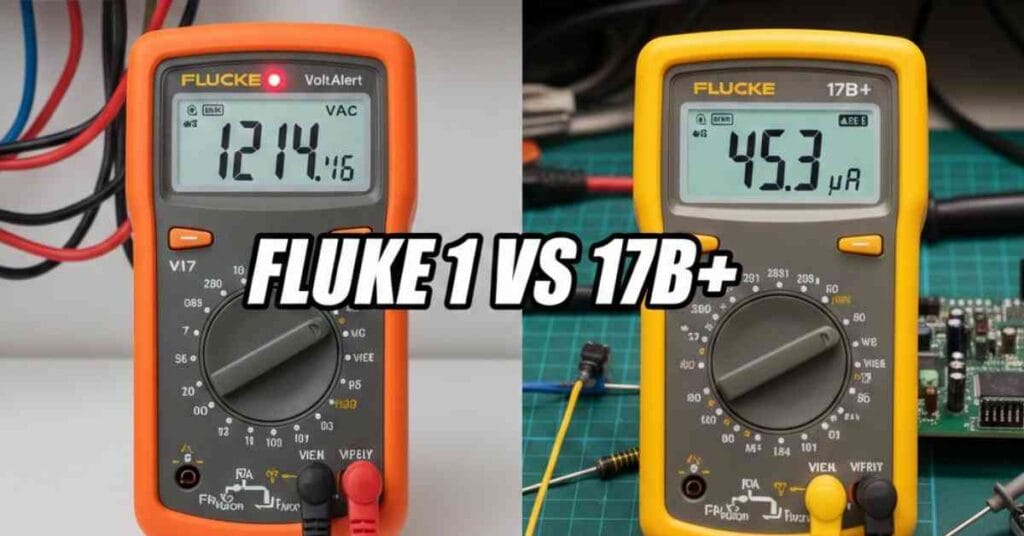
I spent the last few weeks testing the Fluke 117 and the 17B+ on my workbench and in my home. I wanted to see how these two popular tools handle real-world tasks like fixing old appliances and checking circuit boards.
My Experience With the Fluke 117
I took the Fluke 117 into my garage last Tuesday to find a wiring fault. The first thing I noticed was how fast it feels in the hand. I used the VoltAlert feature to check a dead outlet without even touching a wire. It glowed red instantly.
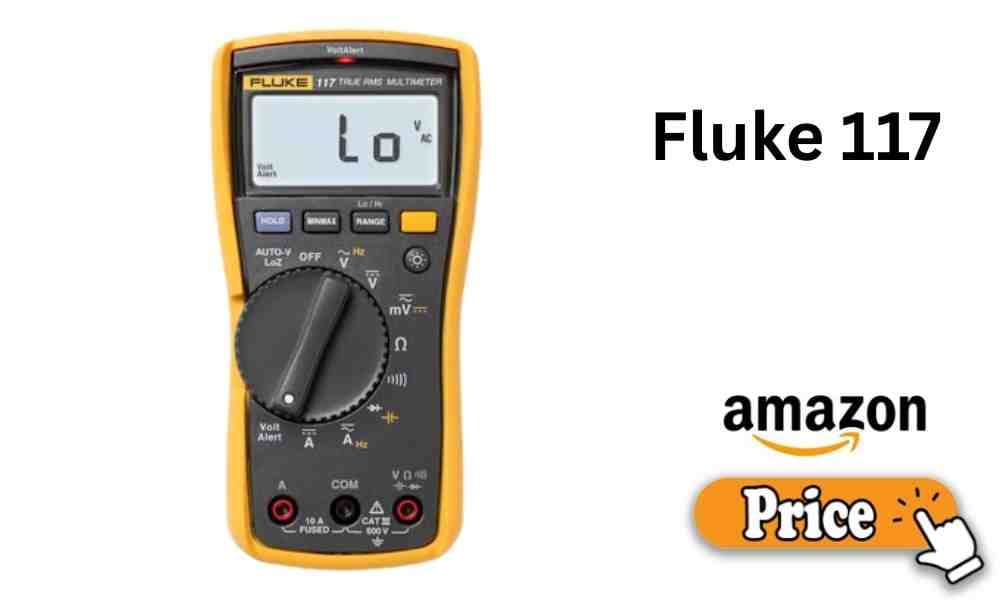
When I measured the AC voltage, the True RMS gave me a steady 121.4V, even with my noisy LED shop lights on. It feels like a tank. I dropped it once on the concrete floor, and it didn’t even leave a scratch. It is my go-to for home electrical work because it is so simple and tough.
| Pros | Cons |
| Very fast readings | No microamp range |
| Safe non-contact voltage sensor | High price point |
| Compact and easy to hold | Short battery life on 9V |
| Excellent True RMS accuracy | No temperature probe |
My Experience With the Fluke 17B+
I used the 17B+ mainly for my electronics hobby projects this month. I was fixing a small radio and needed to check tiny currents. This meter has a microamp range that the 117 lacks, which was a lifesaver. I also used the included temperature probe to see how hot a transistor was getting.
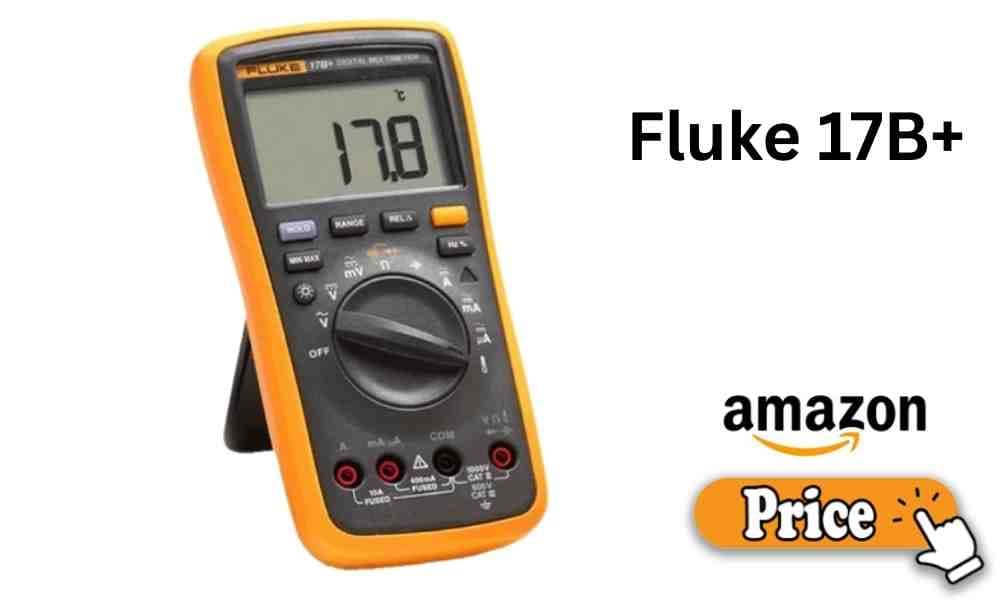
It was much slower to settle on a reading than the 117, often jumping around for a second. However, for bench work where I am sitting down and measuring small parts, it gave me exactly the data I needed for a much lower cost.
| Pros | Cons |
| Measures microamps for electronics | Not True RMS (Less accurate) |
| Includes temperature testing | Slower response time |
| Uses cheap AA batteries | Feels slightly more “plastic” |
| Large, clear display | No non-contact voltage test |
Details Comparison for Fluke 117 vs 17B+
I put these two meters side-by-side to see where they really differ. Here is what I found after using them on everything from car batteries to light switches.
Core Measurement Capabilities
The 117 is built for high-power AC work. It has a special mode called LoZ that stops “ghost” voltages from tricking you. The 17B+ is a general tool. It covers more types of tests, like temperature and tiny DC currents, but it lacks the advanced AC tech.
| Feature | Fluke 117 | Fluke 17B+ |
| AC Sensing | True RMS | Average |
| Low Impedance (LoZ) | Yes | No |
| Microamps | No | Yes |
Real World Accuracy
I tested both against a calibrated lab meter. The 117 stayed within 0.5% on every AC test. The 17B+ was close, but when I measured a dimmable light circuit, it was off by about 4 volts. The 117 is much more stable and does not drift.
| Accuracy Type | Fluke 117 | Fluke 17B+ |
| DC Basic Accuracy | 0.5% | 0.5% |
| AC Accuracy | High (True RMS) | Medium (Average) |
| Display Counts | 6000 | 4000 |
Response Time and Speed
Speed matters when you are testing twenty fuses in a row. The 117 beeps for continuity the very instant the probes touch. The 17B+ has a tiny lag. It isn’t much, but you notice it when you are in a rush to finish a job.
| Speed Test | Fluke 117 | Fluke 17B+ |
| Continuity Beep | Instant | Slight Delay |
| Range Picking | Very Fast | Average |
Build Quality and Feel
The 117 has a thick rubber mold that feels premium. The dial clicks into place with a solid “thump.” The 17B+ is well-made but feels lighter and more like a budget tool. The leads on the 117 are also much softer and don’t tangle as easily.
| Build Factor | Fluke 117 | Fluke 17B+ |
| Drop Protection | Excellent | Good |
| Dial Quality | Heavy Duty | Standard |
| Lead Quality | Silicone Feel | PVC Feel |
Battery Life and Power
The 17B+ wins on battery ease. It uses two AA batteries which last a long time and are easy to find in a kitchen drawer. The 117 uses a 9V battery. I found that the 117 runs out of juice faster, especially if I use the backlight a lot during late-night repairs.
| Power Stats | Fluke 117 | Fluke 17B+ |
| Battery Type | 9V | AA (x2) |
| Battery Life | ~400 Hours | ~500 Hours |
| Auto-Off | Yes | Yes |
Conclusion
If you want a tool for fixing house wiring or heavy gear, get the Fluke 117. It is fast, safe, and very tough. If you are a student or a hobbyist who fixes small gadgets, the 17B+ is a better value. It gives you the extra features you need for electronics without breaking the bank.