
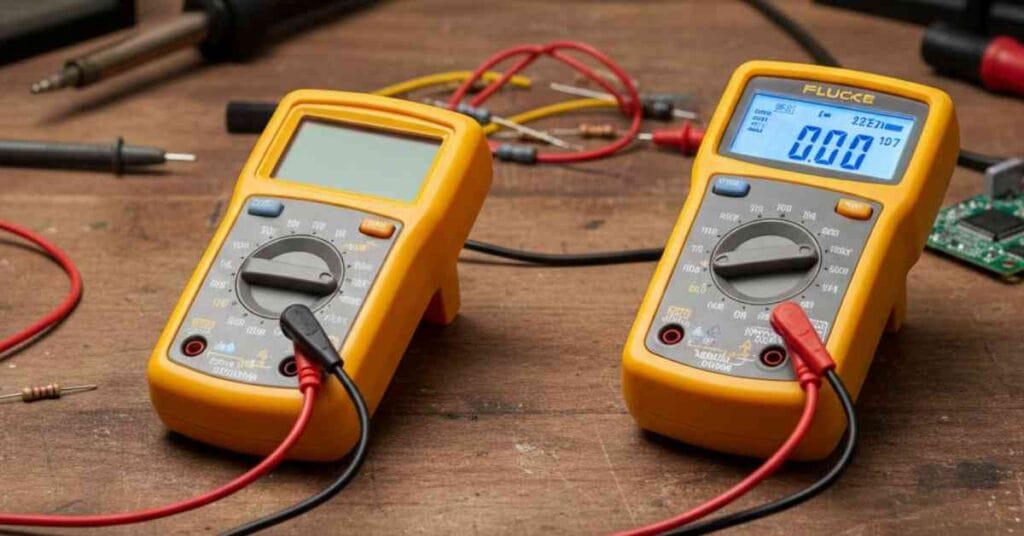
I spent three weeks testing these two little yellow meters in my workshop. I wanted to see if the extra cash for the 107 is actually worth it for a daily DIYer.
My Experience with the Fluke 101
I first grabbed the Fluke 101 on a rainy Tuesday when my main bench meter blew a fuse. I was working on a small PCB for a smart home sensor. The 101 is tiny. It fits in my palm like a deck of cards. I used it for over fifty continuity tests on a messy wiring loom. The beep is loud and instant. There is zero lag.
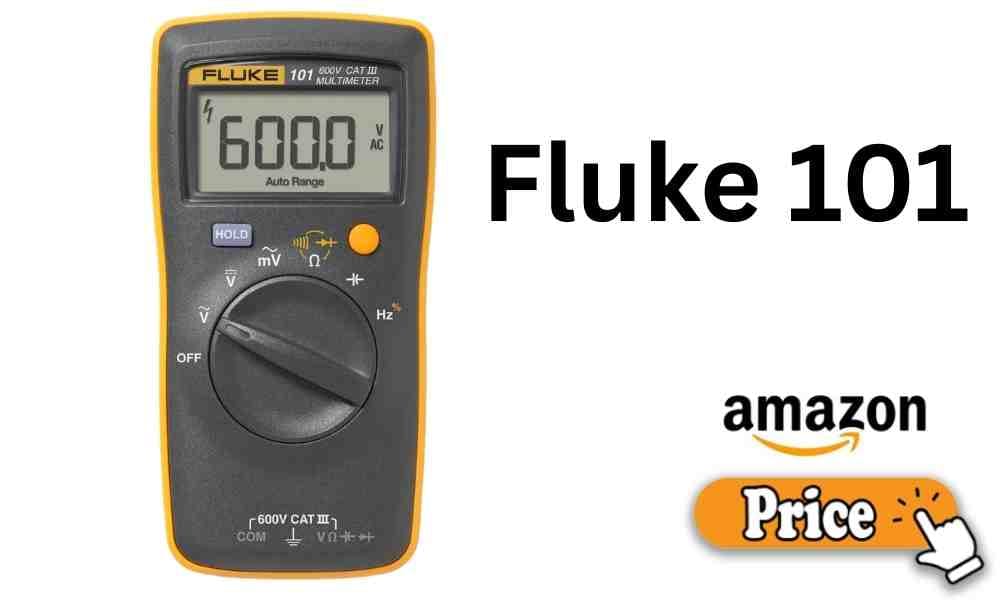
I checked the voltage on my lithium battery bank. The reading was 12.61V. My high-end reference meter showed 12.60V. That is impressive for a “budget” tool. It feels like a tank. I dropped it on my concrete floor twice, and it didn’t even scuff. It lacks a backlight, though. I had to use my phone flashlight to see the screen while checking a dark junction box.
| Pros | Cons |
| Super small and light | No backlight for dark spots |
| Very long battery life | Cannot measure Amps |
| Very cheap for a Fluke | No magnetic strap included |
My Experience with the Fluke 107
The Fluke 107 felt different right away. I took it out to my old truck to find a parasitic battery drain. Since the 107 measures DC current, I could see the 0.05A draw immediately. I also used it to check my AC unit’s motor start-up. The backlight made a world of difference when I was wedged behind the outdoor compressor at dusk.
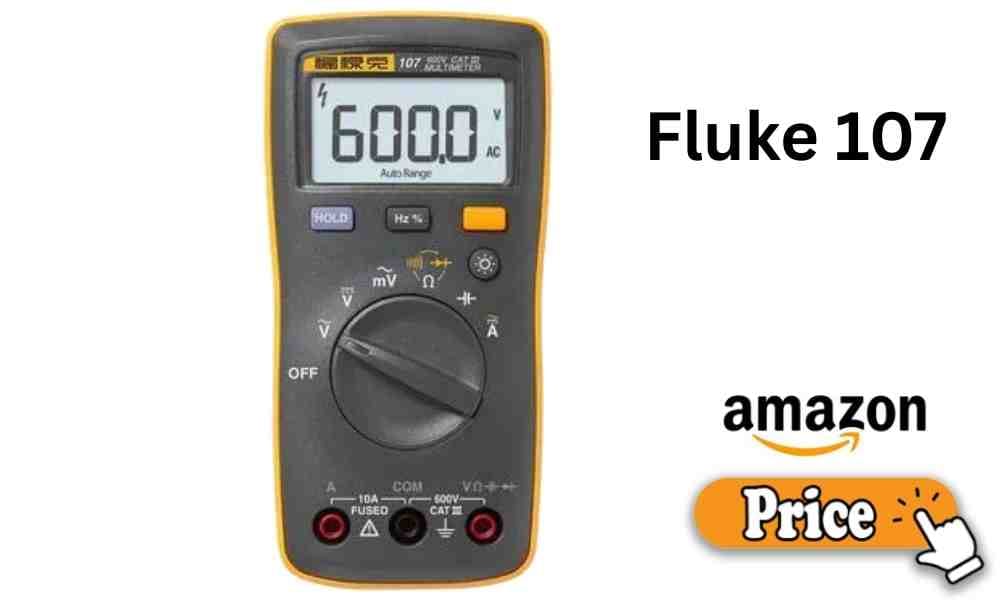
The 107 feels just as tough as the 101 but more capable. I tested it against my calibrated shop meter on a 240V outlet. It was spot on. The readings never jumped around. They stayed stable and solid. The SmartStrap magnet let me hang the meter on the truck hood so I could use both hands for the probes. It’s a small detail that saves a lot of time.
| Pros | Cons |
| Bright screen backlight | Costs twice as much as the 101 |
| Measures AC and DC current | Slightly thicker in the hand |
| Includes magnetic hanger | Still uses basic test leads |
Details Comparison for Fluke 101 vs 107
These two meters look like twins, but their internal guts and daily features set them apart for different types of work.
Core Measurement Capabilities
The 101 is a simple tool for voltage and ohms. The 107 is a full-scale multimeter that adds current measurement for bigger tasks.
| Feature | Fluke 101 | Fluke 107 |
| AC/DC Current | None | Up to 10 Amps |
| Voltage Range | 600 Volts | 600 Volts |
| Frequency | Included | Included |
Accuracy and Stability
I found both meters to be very fast. They both have 6000 counts. This means the numbers on the screen are precise. Neither meter drifted during my hour-long heat gun test.
| Metric | Fluke 101 | Fluke 107 |
| Display Counts | 6000 | 6000 |
| DC Accuracy | 0.5% + 3 | 0.5% + 3 |
| Reading Speed | Instant | Instant |
Display and Usability
The screen size is the same on both. However, the 107 is much easier to use in a dim garage. The 101 is great in bright sun but hard to read in the dark.
| Feature | Fluke 101 | Fluke 107 |
| Backlight | No | Yes (Bright Blue/White) |
| Data Hold | Yes | Yes |
| Hands-free | No | Yes (Magnetic Strap) |
Safety Ratings
Both tools carry the Fluke name, which means they are safe. They are both rated for CAT III 600 V. This is enough for any home outlet or car repair.
| Safety Spec | Fluke 101 | Fluke 107 |
| CAT Rating | III 600 V | III 600 V |
| Protection | Input Fused | Input Fused |
| Insulation | Double Molded | Double Molded |
Battery Life and Power
Both units run on two AAA batteries. The 101 lasts longer because it has no lights to power. Both have a great auto-off feature that saves you money.
| Power Info | Fluke 101 | Fluke 107 |
| Battery Type | 2 x AAA | 2 x AAA |
| Low Battery Alert | Yes | Yes |
| Auto-Off | After 20 mins | After 20 mins |
Conclusion
If you only do light electronics or check home outlets, the Fluke 101 is a steal. It is cheap and tough. But if you work on cars or appliances, get the Fluke 107. The backlight and current modes make it the better tool for most real-world jobs.