
I still remember a very hot summer day last year. My yard grass was getting way too tall. I hopped on my riding mower and turned the key. All I heard was a sad clicking noise.
The battery was completely dead and useless. I charged it up, but it died again fast. This made me ask a really big question. Do lawn mowers have alternators like our cars do?
I always thought mowers were just small cars. They have wheels, an engine, and a gas tank. So, it makes sense they would have an alternator. I was very surprised to learn the real truth.
I talked to my smart neighbor Bob. He knows a lot about small engines and parts. He came over to look at my broken mower. Bob smiled and started to explain how things work.
The Big Answer: Do Lawn Mowers Have Alternators?
Bob told me the short answer is usually no. Most lawn mowers do not have real alternators. This was a huge shock to my brain. I wondered how the battery stays full of juice.
Push mowers do not need a charging system at all. You just pull a cord to start the engine. They do not have a battery to charge up. So, they definitely lack any kind of alternator.
Riding mowers are a very different story. They need a battery to start the big engine. They also need power for lights and extra parts. But they still do not use a car alternator.
Instead of an alternator, they use a cool part. This part is called a stator. It does the same job but looks very different. Let us look at how these mowers compare.
Mower Types and Power Systems
| Mower Type | Needs Battery | Has Alternator | Uses Stator |
| Push Mower | No | No | No |
| Riding Mower | Yes | No | Yes |
| Zero Turn Mower | Yes | No | Yes |
Meet the Stator: The Mower Charging System
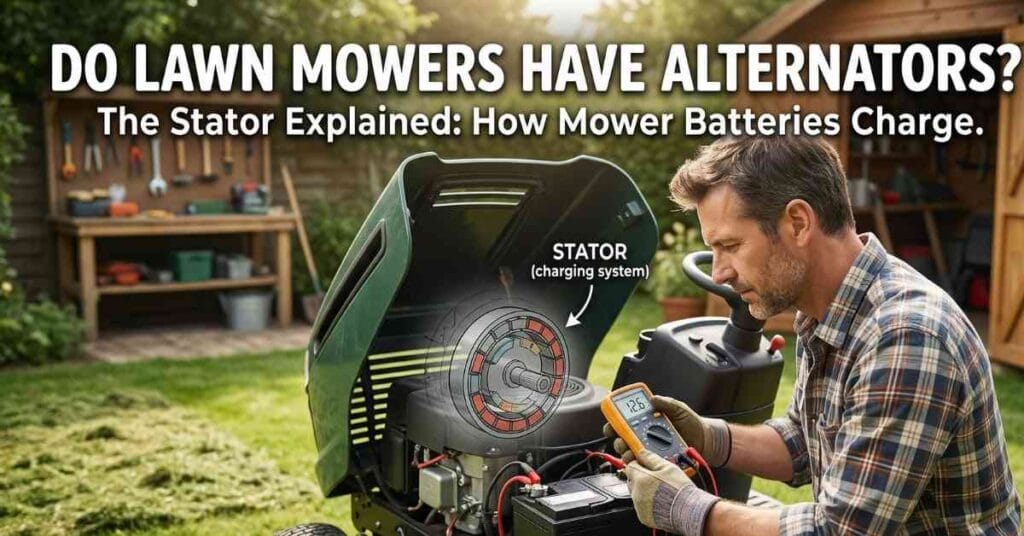
So, what exactly is a stator anyway? Bob showed me a picture on his smart phone. A stator looks like a metal ring with wires. It hides under the spinning flywheel on top of the engine.
The flywheel has strong magnets built inside it. When the engine runs, the flywheel spins really fast. The magnets spin right around the metal stator ring. This fast spinning makes an electric charge.
This charge creates alternating current or AC power. But a mower battery needs direct current or DC power. So, the power must go through a voltage regulator. This part changes the power to feed the battery.
It is a very simple and smart system. It has fewer moving parts than a car alternator. This means it is less likely to break down. But sometimes, things still go wrong and stop working.
Car Parts Versus Mower Parts
| Feature | Car Alternator | Mower Stator |
| Moving Parts | Yes, spins inside | No, stays still |
| Size | Large and heavy | Small and light |
| Location | Outside the engine block | Under the engine flywheel |
Signs Your Mower Is Not Charging
I asked Bob how I could know for sure. How do I know if my stator is bad? He told me there are a few clear signs. The first sign is exactly what I had happened.
Your mower battery keeps dying over and over. You charge it up, and it runs for an hour. Then you turn it off and it will not start. The stator is not putting power back into the battery.
Another sign is if your mower headlights look dim. When the engine is running fast, lights should be bright. If they look weak, the system is lacking power. The engine is using all the juice from the battery.
Sometimes, your mower might even stop running while cutting grass. The engine needs a spark to keep burning gas. If the battery dies completely, the spark plug fails. Then you are stuck in the middle of your yard.
Bad Charging Signs to Watch For
| Warning Sign | What It Means | What To Do |
| Dead Battery | System is not charging | Test the battery fully |
| Dim Headlights | Low power output limit | Check the stator wiring |
| Engine Stalls | Battery is totally empty | Test voltage regulator part |
How I Test My Mower Stator
I wanted to fix my mower all by myself. Bob let me borrow his handy digital multimeter. This is a small tool that checks electric flow. Testing the charging system is actually quite easy.
First, I made sure the battery was fully charged. I used a plug-in wall charger overnight. A dead battery can give you a false test result. Then I put the battery back into my mower.
Next, I set the multimeter to read DC volts. I touched the red probe to the red battery post. I touched the black probe to the black battery post. The meter showed twelve point six volts before starting.
Then I started the mower engine and ran it fast. I checked the meter screen one more time. The numbers should jump up past thirteen or fourteen volts. My meter stayed stuck right at twelve point six.
This proved my stator or regulator was bad. The system was not sending any fresh power back. I felt proud that I found the real problem. Now I just needed to fix it up.
Things You Need to Test Power
| Tool Name | What It Does | Is It Hard To Use? |
| Multimeter | Checks power and voltage | Very easy |
| Wall Charger | Fills up the empty battery | Very easy |
| Work Gloves | Keeps your hands safely clean | Very easy |
Fixing the Charging System Issue
Fixing a bad stator takes a bit of hard work. You have to take the top of the engine off. You have to remove the heavy metal flywheel. This requires a special pulling tool to do right.
I decided to check the voltage regulator first. It sits right on the outside of the engine block. It is very easy to reach and take off. Sometimes the wires just get loose or very dirty.
I found a wire that looked burnt and bad. I cleaned it up and put on a new plug. I started the engine and checked the battery again. The meter jumped right up to fourteen volts!
I was so happy I did not need a new stator. A simple wire fix saved me time and money. It felt great to fix my own riding mower. Now my grass looks neat and perfect again.
Why Push Mowers Never Need Them
We talked about riding mowers having a stator system. But let us look closer at simple push mowers. These little machines are wonderful for small green yards. They keep things very basic and easy to use.
A push mower only needs a spark to run right. It uses a very tiny coil near the spinning flywheel. As the magnets pass by, the coil makes a quick spark. This spark fires the gas and keeps the blade spinning.
There are no headlights or electric parts to run. You do not turn a key to start the motor. You use your own arm power to pull the rope. Because of this, they never need a heavy battery.
If there is no battery, there is no need for charge. So, a push mower will never have an alternator. It will never have a stator ring either. This makes them much cheaper and easier to fix.
Keeping Your Mower Battery Happy
A good battery helps your stator last a long time. If the battery is weak, the stator works too hard. This extra heat can burn the stator wires up. So, taking care of your battery is a smart move.
I always take my battery out in the cold winter. Freezing temperatures can ruin a good battery very fast. I keep it in my warm garage on a wooden shelf. This simple trick adds years to its total life.
I also use a smart trickle charger every month. This keeps the power topped off when not in use. A full battery makes the first spring start super easy. The stator does not have to struggle to catch up.
You should also check the battery posts for green rust. This gross stuff blocks the power from flowing well. You can clean it off with baking soda and water. A clean connection makes the whole system run better.
These small steps make a very big difference. My current battery has lasted for four long years. My stator has not given me any more trouble either. A little care saves a lot of major headaches.
Final Thoughts on Mower Power
So, let us go back to our main big question. Do lawn mowers have alternators inside of them? We now know the answer is a big no. But they do have a great system to charge batteries.
The stator does a fantastic job of making power. It is hidden away and works very hard for us. It keeps our riding mowers starting up every single time. It keeps our headlights shining bright in the dark.
I learned a lot from my dead battery scare. I learned how to check my power output safely. I learned that simple wire fixes can save the day. I hope my little story helps you out too.
Always keep an eye on your battery health. Test your system if the engine starts to drag. Do not be afraid to look under the engine hood. You might just fix it yourself and save some cash.
As an Amazon Associate, We earn from qualifying purchases