
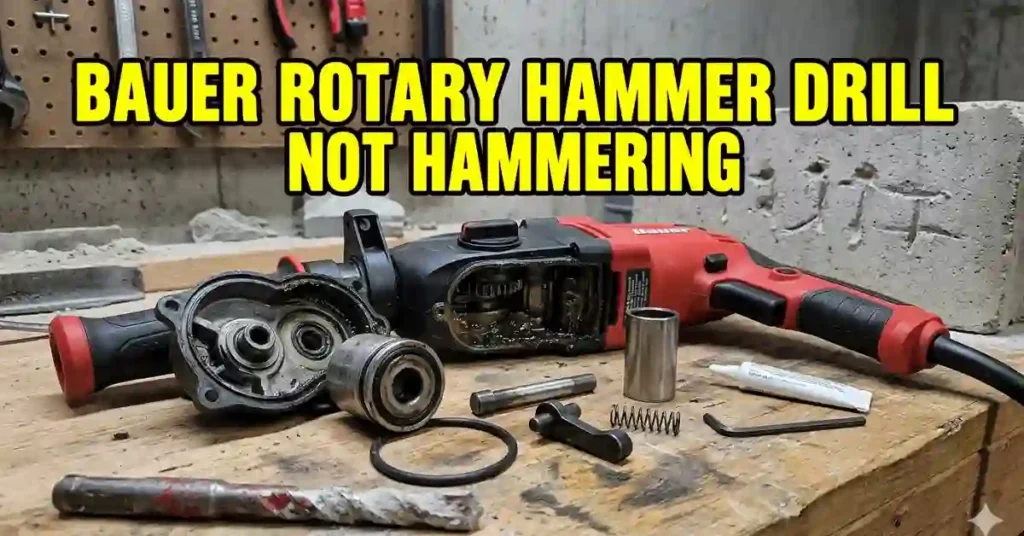
I remember the exact moment my Bauer rotary hammer gave up on me. It was a cold Tuesday morning in my garage. I had a line of holes to drill into a concrete slab for some new shelves. I pulled the trigger and the motor roared. The bit spun fast, but when I pushed it against the stone, nothing happened. There was no impact and no dust, just a loud spinning sound.
It felt like the tool had lost its punch. If you are dealing with a Bauer rotary hammer drill not hammering, I feel your pain. It is a very common issue with these tools. After some trial and error, I found out why it happens. I also learned how to get that hitting power back.
Why the Hammer Action Fails When You Need It Most
A rotary hammer is not like a standard drill. It does not use gears to click and clack. It uses air pressure. Inside the tool, a piston moves back and forth. This creates a pocket of air that flings a heavy metal striker against the bit.
When your Bauer rotary hammer drill not hammering starts acting up, the air seal is usually the cause. If air leaks out, the striker stays still. You get the spin, but you do not get the hit. I spent a few hours digging into the “why” to see if I could save my project.
The Common Culprits for Loss of Impact
I wanted to know if I had a bad tool or if I just needed to maintain it. I found that most issues come down to a few simple parts. Here is a quick look at what usually goes wrong based on my experience.
| Issue | What It Feels Like | The Likely Cause |
| Cold Start | Motor runs, bit spins, but zero vibration. | Thick grease is sticking to the striker. |
| Air Leak | Weak hammering that stops under pressure. | Worn out rubber O-ring on the piston. |
| Mode Slip | Tool feels “gritty” and does not hammer. | The selector dial is not fully locked. |
| Dry Shank | High heat and noise but slow progress. | Lack of grease on the SDS bit end. |
The “Wake-Up” Trick for Cold Mornings
Back to that Tuesday in my garage. It was quite cold outside. That is a huge factor for these tools. The grease inside the Bauer gear case is very thick. When it gets cold, it turns into something like cold honey. The striker gets “glued” to the back of the chamber.
I tried a trick called the “Jumpstart” method. I set the dial to the hammer-only icon. I put the bit against the concrete floor. I pulled the trigger and gave the tool a firm shove downward. I did this a few times until I heard a change in the sound.
Suddenly, I heard a loud thud. The grease broke free. The tool started hitting like new again. If your tool has been sitting in a cold shed or truck, try this first. Warm it up by running it for a minute without a load. Then give it a good bump against the work surface to free the parts.
Checking the Mode Selector Dial
This sounds simple, but I have messed this up more than once. The red button on the side of the Bauer drill is there for a reason. You have to press it fully to turn the dial. If you do not, the dial might stop between two modes.
Sometimes, the dial feels like it is in place, but it is not. If it is 95% of the way there, the gears inside won’t engage the piston. I always give the bit a little twist by hand while I turn the dial. I wait for that loud click. If you don’t hear the click, your Bauer rotary hammer drill not hammering will stay that way.
My Secret Weapon: SDS Bit Grease
I used to be lazy about my tools. I would grab a bit and jam it into the chuck without a thought. I did not think about the friction. One day, the tool smelled like burning rubber. The bit was stuck and would not move.
Now, I keep a small tube of SDS grease in my tool bag. Before I start a job, I wipe the end of the bit clean. I add a pea-sized drop of grease to the grooves. This small step makes a huge difference in how the tool feels.
- It helps the bit slide back and forth much better.
- It creates a seal so the air stays behind the striker.
- It keeps the chuck from wearing out too fast.
If your bit is bone dry, the tool has to work twice as hard. That leads to a lot of heat. Heat leads to the internal rubber rings failing. A little bit of grease keeps everything cool and moving.
Taking It Apart: The Deep Fix
If the “bump” trick does not work, the problem is inside. I decided to open mine up after six months of heavy use. I found that the grease had turned into a black, gritty mess. This grit was stopping the air from building up pressure.
Inside the Bauer 1-1/8 inch model, there is a piston with a rubber O-ring. This ring is the heart of the tool. If it has a tiny tear, you lose all your hitting power. I had to clean out the old grease to see what was wrong.
Steps for a Basic Teardown
I am not a pro mechanic, but I can turn a screwdriver. I took my time to make sure I did not lose any small parts. Here is how I handled the internal check on my own workbench.
- Remove the top screws on the gear case.
- Clean out the old, nasty grease with a clean rag.
- Look at the rubber ring on the piston for any damage.
- Apply fresh, high-quality lithium grease to the chamber.
- Put it back together and test it on a scrap block.
Doing this made my drill feel brand new. It was a messy job, but it saved me from buying a new tool. It also taught me exactly how the tool works.
Comparing the Bauer to Other SDS Drills
I also own a DeWalt and have used a Bosch. The Bauer is a beast for the price, but it needs more love. The seals are not as tight as the high-end brands. You have to be willing to do some maintenance.
| Feature | Bauer SDS Plus | High-End Brands |
| Price | Around $100 | $250 – $400 |
| Durability | Good for DIY | Built for daily use |
| Maintenance | Needs frequent grease | Better dust seals |
| Power | High (5 Joules) | Very Consistent |
The Bauer wins on value every time. But you have to be ready to troubleshoot. If my Bauer rotary hammer drill not hammering happens again, I know what to do. It is likely just a cry for fresh grease or a new ring.
Don’t Forget the Carbon Brushes
After about a year, I noticed sparks coming from the motor vents. The hammer action was weak because the motor was not spinning fast. If the motor is slow, it cannot build the air pressure needed to hit.
I checked the brushes. These are the small blocks of carbon that give power to the motor. Bauer usually includes an extra set in the box. I swapped them out in five minutes. The motor speed went up, and the hammer power came back right away.
Final Thoughts from the Job Site
If you are staring at a hole that won’t get deeper, do not panic. Start with the basics. Is it cold? Is the dial clicked in? Is the bit greased? Most of the time, these tools just need a little care.
Most of the time, these tools just need a little “tough love” to work. My Bauer has drilled many holes since that cold Tuesday. It just needed me to understand how it worked. I keep it clean and greased now.
Keep your bits clean. Keep your grease fresh. And do not be afraid to give it a little bump when it acts lazy. Concrete is tough, but your tool can be tougher if you treat it right.
As an Amazon Associate, We earn from qualifying purchases