
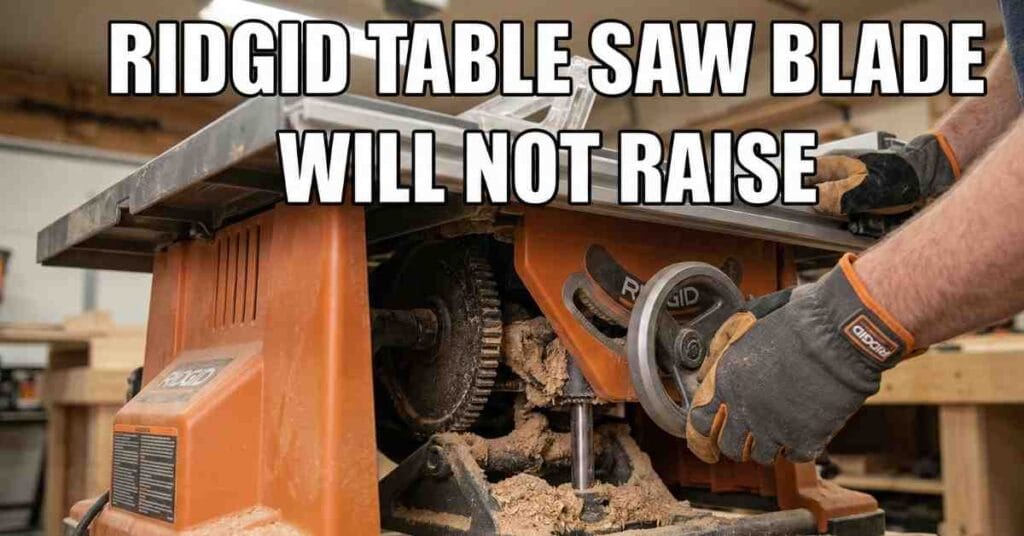
I was in my Florida workshop last Tuesday. I had a big project to finish for my niece. I tried to raise the blade on my Ridgid saw, but the handle would not move. It felt like the gears were stuck in thick glue.
If your Ridgid table saw blade will not raise, do not panic. You do not need a new saw. I found that most of the time, the fix is very simple. I spent the morning getting my hands dirty to find the best solution for you.
Why the Blade Gets Stuck
Dust is the main enemy in any wood shop. It gets into every small crack. On a Ridgid saw, the gears are open to the air. This means they catch all the fine dust from your cuts.
When dust mixes with old grease, it gets hard. I call this “shop cement.” It fills the threads of the lift screw. This stops the gears from turning. Here is a quick look at what usually goes wrong.
Common Lift Problems
| Problem Area | What Happens | How it Feels |
| Elevation Screw | Dust fills the threads | Gritty or stiff |
| Miter Gears | Wood chips get stuck | Hard stop or jumpy |
| Locking Knob | Vibrations tighten it | Will not budge |
| Dry Tracks | No lube on the slides | Heavy and slow |
Step 1: The Deep Clean
The first thing I did was unplug my saw. I never work on the gears with the power on. I tilted the saw to a 45-degree angle. This let me see the inner parts clearly.
I used a can of compressed air to blow out the big chunks. Then, I took an old toothbrush. I scrubbed the long metal screw that moves the blade up and down.
You must get all the old, black gunk out of the threads. If the threads are not clean, no amount of force will help. I spent ten minutes just brushing and wiping. It made a huge difference right away.
Step 2: Check the Gears and Teeth
Next, I looked at the small gears near the handwheel. These are called miter gears. They have small teeth that must fit together perfectly. Even a tiny sliver of wood can jam them.
I found a small piece of pine wedged between two teeth. I used a thin wire to poke it out. Once that bit of wood was gone, the wheel started to turn again. Always look closely at these teeth with a bright light.
Step 3: Use the Right Lubricant
This is where many people make a mistake. I used to use thick grease, but that was wrong. Grease attracts more dust. This makes the problem come back even faster.
Now, I only use a dry spray. Look for a spray with PTFE or graphite. It goes on wet but dries very fast. It leaves a slick film that dust will not stick to.
I sprayed the lift screw and the gears. Then, I turned the handwheel up and down a few times. This spread the lube evenly. The handle now turns with just one finger. It feels like a brand new machine.
Step 4: Check for Broken Parts
If cleaning does not work, you might have a broken part. On some Ridgid models, a small washer can snap. This is called a thrust washer. If it breaks, the screw will just spin in place.
Look at the shaft while you turn the handle. If the shaft moves in and out but the blade stays down, the washer is likely the issue. This is a cheap part to buy, but it takes a little time to install.
How to Prevent This Problem
I learned my lesson that Tuesday morning. Now, I have a new routine to keep my saw happy. I want to spend my time building, not fixing tools.
I use my shop vac every time I make a cut. This keeps the inside of the saw much cleaner. I also blow out the gears with air once a week. It only takes a minute, but it saves a lot of stress.
Keeping your saw clean is the best way to avoid a stuck blade. It keeps your cuts accurate and your motor cool. Plus, it makes woodworking much more fun when your tools work well.
Read More: DeWalt Table Saw Not Turning On
Final Tips for Your Shop
A stuck blade is annoying, but you can fix it. Just take your time and do not force the wheel. If you push too hard, you might break a gear tooth. That would be a much bigger job to fix.
Start with a good cleaning and the right dry lube. In most cases, that is all you need. My saw has been running great for months now. I hope these steps help you get back to your project quickly.
As an Amazon Associate, We earn from qualifying purchases