
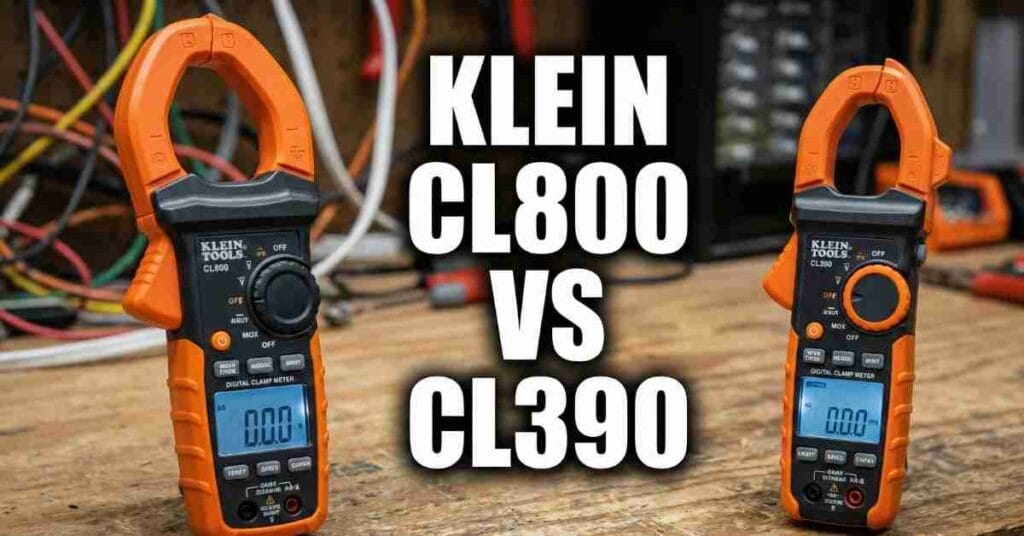
I used both meters for months. I kept them in my truck. I wanted to see which one is best. They look alike. But they work very differently. Here is what I found on the job.
Klein CL800 Digital Clamp Meter Review
I took the CL800 to a shop job first. It feels big in my hand. It is heavy and thick. I dropped it twice. It fell six feet onto hard floor. It did not break. The rubber is thick. I do not worry about it.
I tested it on old wires. I used the Low Z mode. This is a great feature. Stray voltage can trick you. The CL800 clears that up. It showed zero volts. That is the truth. This saved me time. I did not need my other tester.
| Pros | Cons |
| Kills ghost voltage fast | Big and heavy to carry |
| Very tough build | Screen is hard to see in dim light |
| Safe for big power lines | No DC amps for heaters |
| True readings every time | Wires are stiff in the cold |
The battery lasts a long time. I used it for a month. It still works fine. The screen is okay. It is fine in the sun. But in a dark room, it is hard to see. I had to squint.
The tool is accurate. I checked it against my bench tool. My bench tool said 120.4 volts. The CL800 said 120.3 volts. That is close enough. It does not drift. It finds the number fast. It feels like a tank. You can trust it.
Klein CL390 HVAC Clamp Meter Review
I used the CL390 next. I did home heating jobs. This meter is small. It is light. It fits in my back pocket. This helps in tight attics. The grip is thin. I can use it with one hand.
I fixed a furnace with it. The fire would not stay on. I checked the flame sensor. The CL390 has a special mode for this. The big CL800 does not have it. I hooked it up. It showed a low number. The sensor was dirty. I cleaned it. The number went up. The heat stayed on.
| Pros | Cons |
| Screen glows in the dark | Not as safe for big lines |
| Has DC amps for HVAC | Not built for factory work |
| Light and easy to hold | Feels a bit cheap |
| Magnet holds it well | Slow to find the number |
The screen is great. The numbers are bright. The background is black. It looks like a scoreboard. I did not need a light. I could see it in the dark.
It is a bit slow though. I checked a breaker. The numbers jumped around. It took a second to stop. The big CL800 is faster. But the magnet is strong. It stuck to the furnace. I like this tool for home work.
Details Comparison for Klein CL800 vs CL390
Both tools work. But they feel different. I will compare them now. I will look at what matters. Here is how they did on the job.
1. Display and Visibility
The screen is key. The CL800 has a grey screen. It has black numbers. It is good outside. But it is dim inside. You need the light button. It can be hard to read.
The CL390 is the opposite. It has a black screen. The numbers glow. It is easy to read in the dark. I loved it in crawl spaces. But the sun washes it out. If you work inside, the 390 is best.
| Feature | Klein CL800 | Klein CL390 |
| Screen Type | Grey Screen | Black Screen |
| Dark Room | Hard to see | Very easy to see |
| Sunlight | Good | Hard to see |
| Angles | Okay | Good |
2. Core Capability and Functions
The CL800 missed one thing. It has no DC amps mode. I could not fix a heater with it. I had to get another tool. This is bad for HVAC work.
But the CL800 has Low Z. I tested a wire bundle. My stick tester beeped at all of them. The CL390 showed 24 volts on a dead wire. The CL800 showed zero. It was right. This keeps you safe.
| Feature | Klein CL800 | Klein CL390 |
| DC Amps | No | Yes |
| Ghost Volt Mode | Yes | No |
| Max Amps | 600 | 400 |
| Max Volts | 1000 | 600 |
3. Build Quality and Durability
I am hard on tools. The CL800 feels strong. The plastic is thick. The dial is stiff. It clicks loud. You know when you turn it. It does not switch by mistake. The wires feel strong too.
The CL390 feels cheaper. It is light. The dial is loose. I dropped it once. The battery door popped open. It did not break. But the CL800 is tougher. If you work hard, get the 800.
| Feature | Klein CL800 | Klein CL390 |
| Weight | Heavy | Light |
| Dial Feel | Stiff | Loose |
| Drop Test | Very Strong | Okay |
| Feel | Tough Rubber | Hard Plastic |
4. Accuracy and Speed
I checked both tools. They are both right. On a wall plug, they show the same volts. They were very close. But the CL800 is faster. I touch the wire. The number is there.
The CL390 hunts a bit. The numbers scroll. It takes a second. This is annoying if you are fast. The beep is faster on the 800 too. It beeps right away. The 390 waits a tiny bit.
| Feature | Klein CL800 | Klein CL390 |
| Speed | Fast | Slow |
| Right Value | Yes | Yes |
| Beep Speed | Fast | A bit slow |
| Steady | Very Steady | Good |
5. Safety Ratings
This matters for pros. The CL800 is rated high. It is CAT IV. I can use it on main lines. It can take a big surge. It is safe for big power.
The CL390 is rated lower. It is CAT III. It is safe for outlets. It is safe for home panels. But do not use it on big factory lines. The 800 is built safer. Use the 390 for home work only.
| Feature | Klein CL800 | Klein CL390 |
| CAT Rating | High (IV) | Medium (III) |
| Main Lines | Safe | No |
| Factory Work | Good | Limited |
| Probes | Strong | Okay |
Conclusion
If you fix heaters, buy the CL390. The screen is great in the dark. You need the DC amps mode. But if you do big electric work, buy the CL800. It is tougher. It is faster. It is safer for big jobs.
As an Amazon Associate, We earn from qualifying purchases