
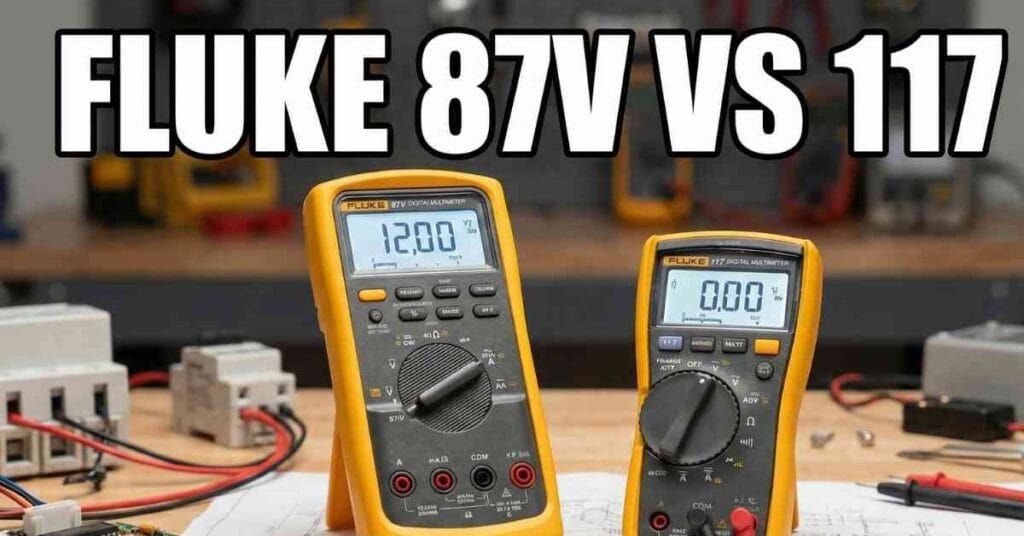
I have spent years trusting my safety to Fluke meters. I keep the 87V on my main workbench for precision electronics and the 117 in my grab-bag for quick facility checks. Here is how these two distinct tools stacked up when I put them to work side-by-side.
Fluke 87V Industrial Multimeter
The 87V is the meter I grab when I cannot afford to be wrong. It is built like a tank and feels substantial in the hand. I tested this unit extensively on a faulty HVAC blower motor that was giving me intermittent trouble. The “Low Pass Filter” function was a lifesaver here; it allowed me to ignore the noise from the variable frequency drive (VFD) and get a steady voltage reading.
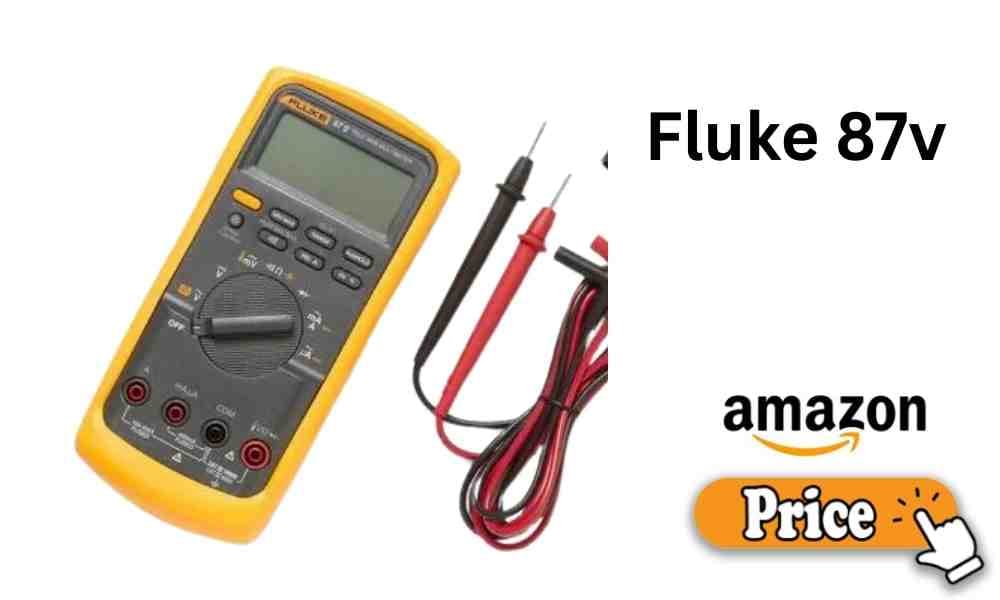
In real situations, the speed of the bar graph is noticeable. When I was checking a car battery for a voltage drop during cranking, the 87V caught the dip instantly. The display is crisp, and the backlight is bright enough for the darkest mechanical rooms. It is overkill for checking a simple outlet, but for diagnosing complex signal issues or measuring very low current (micro-amps) in flame sensors, it is the only tool for the job.
| Pros | Cons |
| Incredible accuracy (0.05% DC) | Heavy and bulky to carry all day |
| Handles VFD signals perfectly | Expensive for basic tasks |
| Measures micro-amps for HVAC | No non-contact voltage detector |
| Lifetime warranty peace of mind | Overkill for simple house wiring |
Fluke 117 Electrician’s Multimeter
I use the 117 for daily “is it live?” checks. It is compact, light, and fits perfectly in my hand. I tested this while troubleshooting a mess of ghost wires in an old office renovation. The “VoltAlert” feature is great—I could just hold the meter up to a wire to see if it was live without messing with leads.
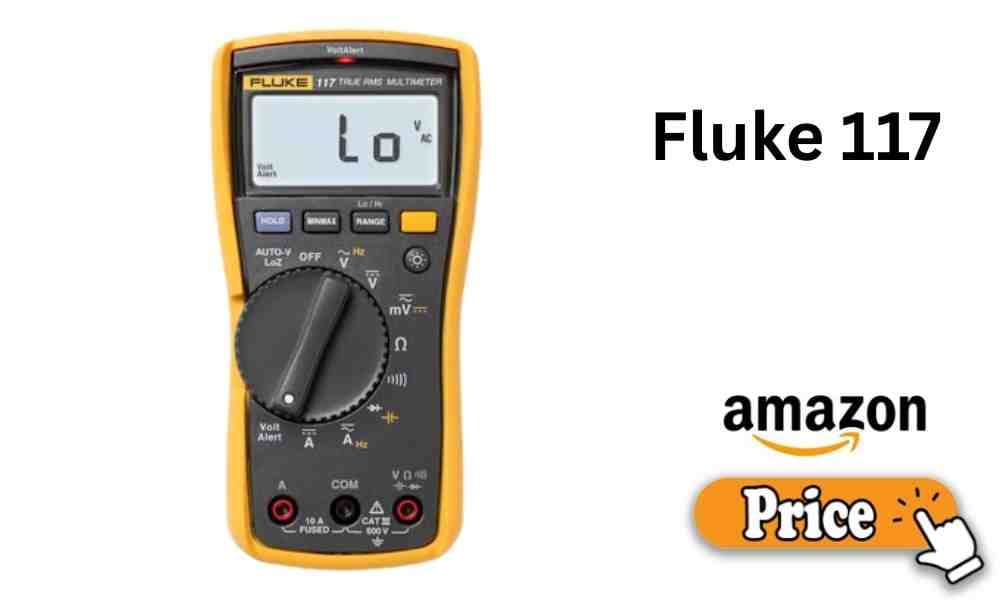
The real star here is the “LoZ” (Low Impedance) mode. I had a wire reading 40 volts that should have been dead. My other meters were confused, but the 117’s LoZ mode drained that ghost voltage instantly and showed me it was actually zero. It lacks the extreme precision of the 87V, but for 90% of building maintenance, it is faster and easier to use.
| Pros | Cons |
| Compact and one-handed use | Lower accuracy (0.5% DC) |
| Built-in non-contact voltage sensor | Cannot measure micro-amps |
| LoZ mode ignores ghost voltage | Not rated for industrial 1000V |
| Backlight is very evenly lit | No low-pass filter for VFDs |
Detailed Comparison for Fluke 87V vs 117
Here is a closer look at how these two meters compare in specific categories that matter on the job.
Core Measurement Capabilities
The 87V is a true powerhouse. It measures up to 1000V AC/DC and can handle 20A for short bursts. I found its resistance range particularly useful when testing high-value resistors on circuit boards. The 117 is limited to 600V. This is fine for residential and commercial panels, but I would not take it into a heavy industrial plant. The 87V also wins on bandwidth, meaning it measures high-frequency AC signals accurately where the 117 might struggle.
| Feature | Fluke 87V | Fluke 117 |
| Max Voltage | 1000V AC / DC | 600V AC / DC |
| AC Bandwidth | 20 kHz | 1 kHz |
| Temp Probe | Included | Not Available |
Accuracy and Resolution
This is the biggest technical difference I noticed. The 87V has a 20,000-count high-resolution mode. When I needed to see a tiny drift in a 5-volt sensor signal, the 87V showed it clearly. The 117 is a 6,000-count meter. It is plenty accurate for checking if a 120V outlet is working (119.5V vs 120.2V does not matter there), but it lacks the fine detail for sensitive electronics work.
| Spec | Fluke 87V | Fluke 117 |
| DC Accuracy | 0.05% | 0.5% |
| Counts | 20,000 | 6,000 |
| True RMS | Yes | Yes |
Display and Usability
The 117 wins on ergonomics. I can hold it and turn the dial with just my thumb. The screen has a high contrast that I found easy to read even from an angle while on a ladder. The 87V is larger and requires two hands to operate comfortably. However, the 87V display is more informative. It has a dual-level backlight and an analog bar graph that updates incredibly fast, which I prefer for tuning adjustments.
| Feature | Fluke 87V | Fluke 117 |
| Backlight | Two-stage, White | Single-stage, White |
| Bar Graph | Fast update (40/sec) | Standard (32/sec) |
| Weight | Heavy (624g) | Light (550g) |
Safety Ratings
Safety is non-negotiable for me. The 87V is rated CAT IV 600V and CAT III 1000V. This means it can withstand higher energy spikes, like those you might see on the utility side of a building. The 117 is rated CAT III 600V. It is perfectly safe for breaker panels and outlets inside a building, but I would not use it on the main service entrance of a factory.
| Rating | Fluke 87V | Fluke 117 |
| Safety Class | CAT IV 600V | CAT III 600V |
| Fuse Protection | High energy fuses | High energy fuses |
| Max Surge | 8 kV peak | 6 kV peak |
Build Quality and Durability
Both meters feel solid, but the 87V is in a league of its own. It has a removable rubber holster that absorbs shocks. I have dropped my 87V from a bench onto concrete, and it did not even blink. The 117 has the rubber molding built directly into the case. It is sleek and durable, but the 87V feels like it could survive a war zone. The dial on the 87V also has a crisper “click” that feels very precise.
| Feature | Fluke 87V | Fluke 117 |
| Case Style | Removable Holster | Integrated Overmold |
| Drop Test | Tested to 3 meters | Tested to 1 meter |
| Water/Dust | IP30 Rated | IP42 Rated |
Conclusion
If you work in industrial settings or repair electronics, you need the Fluke 87V. Its accuracy and filters are essential for motor drives. But for most electricians working in buildings, the Fluke 117 is the smarter buy. It is lighter, cheaper, and the non-contact voltage feature saves time every single day.
As an Amazon Associate, We earn from qualifying purchases