
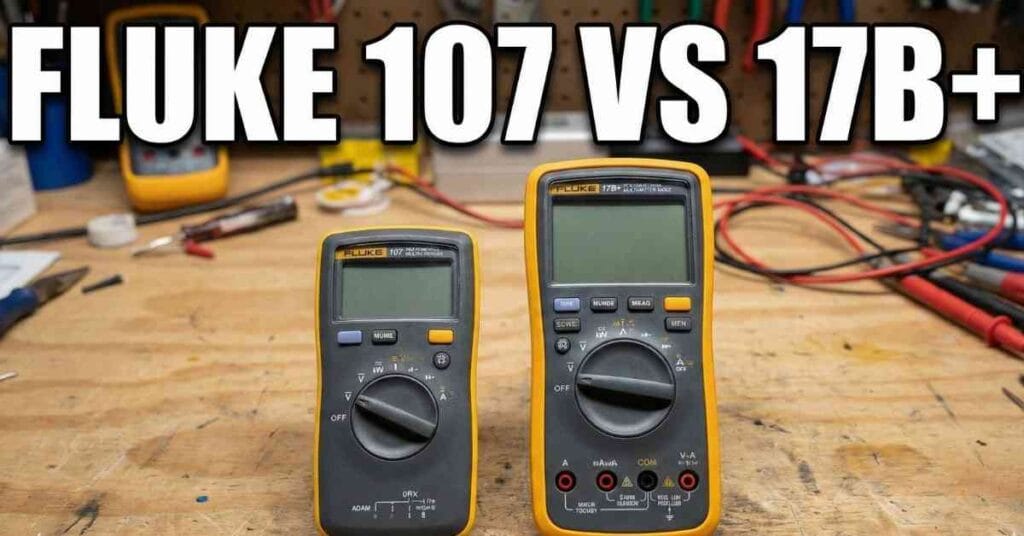
I bought both the Fluke 107 and the 17B+ to see which one belonged in my tool bag. I needed one for quick checks and one for deeper repair work. After testing them for weeks on real jobs, I found they serve very different needs. Here is what I learned.
My Experience With The Fluke 107
I call this my “ladder buddy.” I grabbed the 107 because I was tired of lugging a heavy bag up to checking ceiling fans. The first time I used it, I was on a step ladder fixing a light fixture. I slapped the magnetic strap against the metal junction box. It held firm. This feature alone saved me so much hassle.
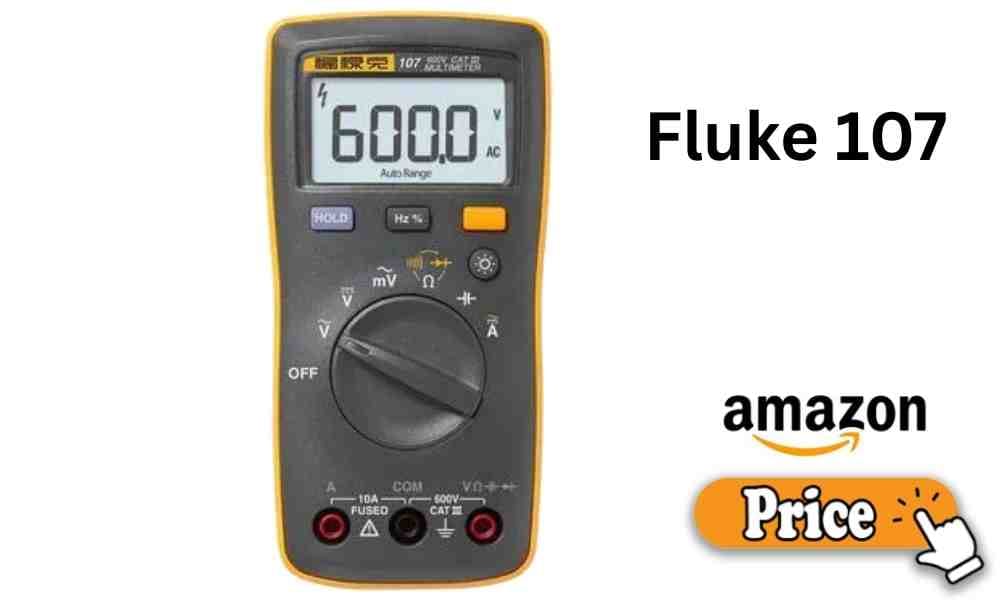
I tested it on standard 120V household outlets. The readings were fast. I also checked continuity on a bundle of old automotive wires in my garage. The beep is loud and instant. I did notice it lacks a few heavy-duty modes. I tried to record a voltage dip on a generator, but without a Min/Max button, I could not do it. It is great for grab-and-go tasks, but it has limits. It fits in my back pocket like a phone, which I love.
| Pros | Cons |
| Fits in a shirt pocket | No Min/Max recording |
| Magnetic strap is included | Flimsy kickstand leg |
| Very fast continuity beep | Leads are not silicone |
| Backlit screen is bright | No temperature mode |
My Experience With The Fluke 17B+
The 17B+ feels like a tank compared to the 107. I keep this one on my workbench. I used it to diagnose a bad capacitor in my air conditioner. The capacitance mode took a second to settle, but it gave me a solid reading of 45 microfarads. The 107 could not have done the temperature check I needed next. I plugged in the thermocouple and checked the vent air temp. It worked perfectly.
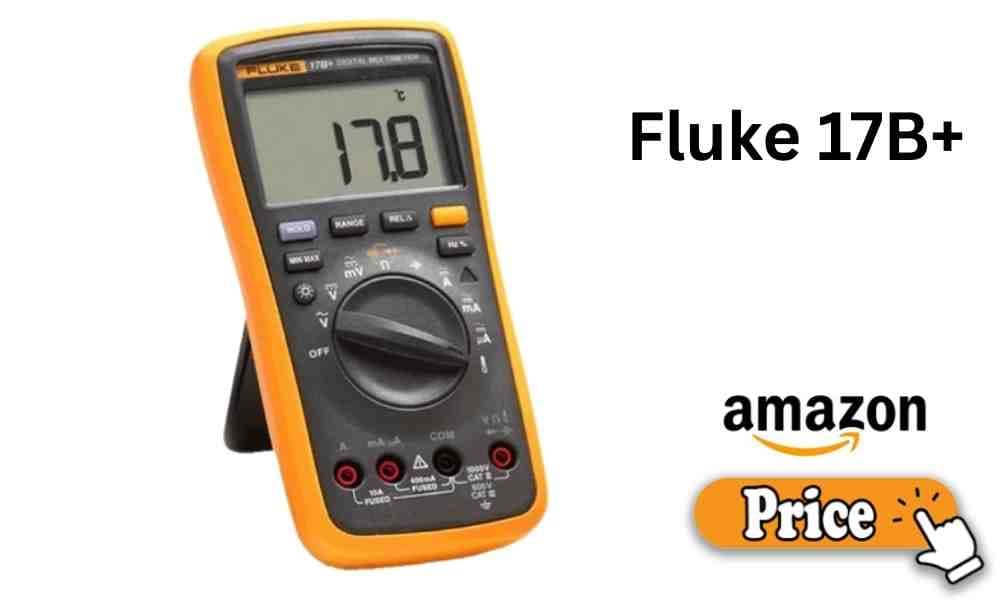
I also used the “Relative” mode to zero out my test leads before measuring a low-ohm resistor. You cannot do that on the 107. The dial feels stiff and clicks into place with authority. It is heavy, though. I dropped it once from my bench onto concrete. It bounced and worked fine. It is too big for a pocket, but it feels safer for high-voltage work.
| Pros | Cons |
| Has Min/Max and Relative modes | Big and heavy to carry |
| Includes temperature probe | Slower auto-ranging |
| 1000V safety rating | Screen viewing angle is average |
| sturdy tilt stand | Uses AA batteries (adds weight) |
Detailed Comparison for Fluke 107 vs 17B+
Here is how these two meters stack up against each other in the key areas that matter most for daily use.
Core Measurement Capabilities
I looked at what each meter can actually catch. The 107 is limited. It tops out at 600V. This is fine for home use. The 17B+ goes up to 1000V. This matters if you work on industrial panels. I also missed the Min/Max button on the 107. If you need to catch a motor startup spike, the 107 cannot do it. The 17B+ handles those tricky transient tasks much better.
| Feature | Fluke 107 | Fluke 17B+ |
| Max Voltage | 600V AC/DC | 1000V AC/DC |
| Temperature | No | Yes (Probe included) |
| Min/Max Mode | No | Yes |
Accuracy and Speed
I ran a side-by-side test on a 12V car battery. The 107 read 12.64V. The 17B+ read 12.63V. Both are very close. But here is the surprise. The 107 has a 6000-count display. The 17B+ only has 4000 counts. This means the tiny 107 actually gives you finer detail on some readings. However, the 17B+ felt a split second faster to settle on the final number when resistance testing.
| Metric | Fluke 107 | Fluke 17B+ |
| Display Counts | 6000 | 4000 |
| DC Accuracy | 0.5% | 0.5% |
| Reading Stability | Good | Excellent |
Design and Handling
This is the biggest difference. The 107 is the size of a smartphone. I can hold it and the probes in one hand. The magnetic SmartStrap is genius. You can hang it anywhere. The 17B+ is a brick. It needs two hands or a flat surface. But, the 17B+ has a real kickstand. The 107 uses the magnetic strap as a prop, and it tips over easily if you pull the leads.
| Feature | Fluke 107 | Fluke 17B+ |
| Weight | Light (200g) | Heavy (455g) |
| Stand Type | Magnetic Flap | Solid Kickstand |
| One-Handed Use | Easy | Difficult |
Safety Ratings
Safety is key when you touch live wires. Both meters are rated CAT III 600V. This covers almost all residential and commercial office work. But the 17B+ is also rated CAT II 1000V. The internal fuses on the 17B+ are massive. They look like they can handle a serious mistake. The 107 is safe, but I would not use it on a main service entrance. The 17B+ just inspires more confidence for high energy jobs.
| Rating | Fluke 107 | Fluke 17B+ |
| Safety Class | CAT III 600V | CAT III 600V / CAT II 1000V |
| Build Feel | Solid Plastic | Thick Rubber Armor |
| Fuse Access | Requires screw removal | Requires screw removal |
Battery Life and Power
I left the 107 in my truck for a week in the cold. It turned right on. It uses two AAA batteries. They are cheap and light. The 17B+ uses two AA batteries. It seems to last forever. I have not changed them in three months. Both have an auto-off feature. This saves you when you forget to turn the dial to “OFF.” The 107 backlight turns off faster to save power, which can be annoying in a dark attic.
| Spec | Fluke 107 | Fluke 17B+ |
| Battery Type | 2x AAA | 2x AA |
| Est. Life | 200 hours | 500 hours |
| Auto-off | Yes (rigid) | Yes |
Conclusion
If you need a meter for your pocket to check outlets and basic wiring, get the Fluke 107. The magnet is worth the price alone. But if you want to learn electronics or fix appliances with heat issues, buy the Fluke 17B+. It is a complete lab tool that will not limit you as you grow.
As an Amazon Associate, We earn from qualifying purchases