
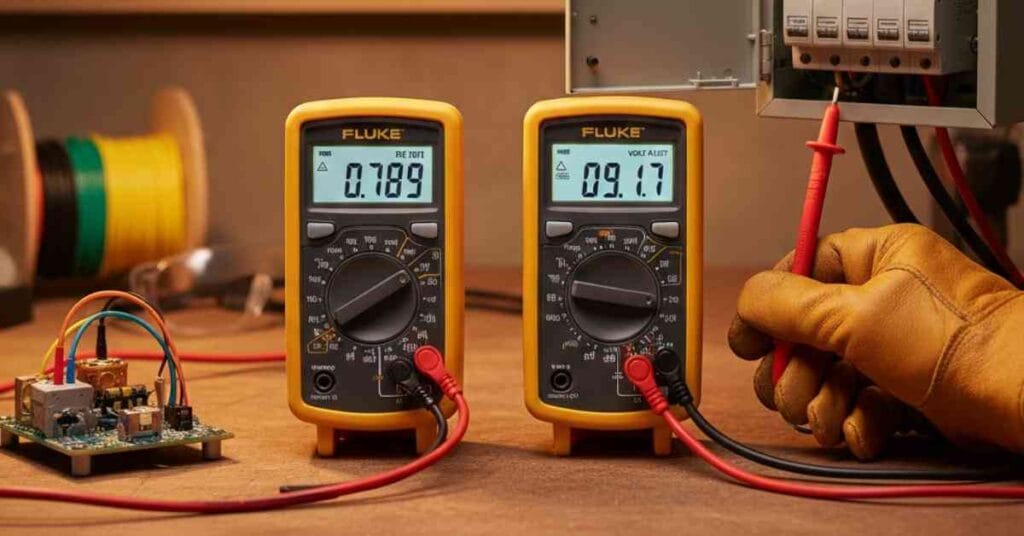
I spent weeks testing these two meters on my workbench and in the field. After hundreds of readings, I found that small differences in features make a huge impact on your daily work.
Fluke 115 Field Service Multimeter Review
I took the Fluke 115 into my shop to see how it handles basic electronics. On a rainy Tuesday, I used it to check a parasitic draw on my old truck battery. The leads felt solid, and the screen stayed clear even in low light. I also ran continuity tests on a messy wiring loom.
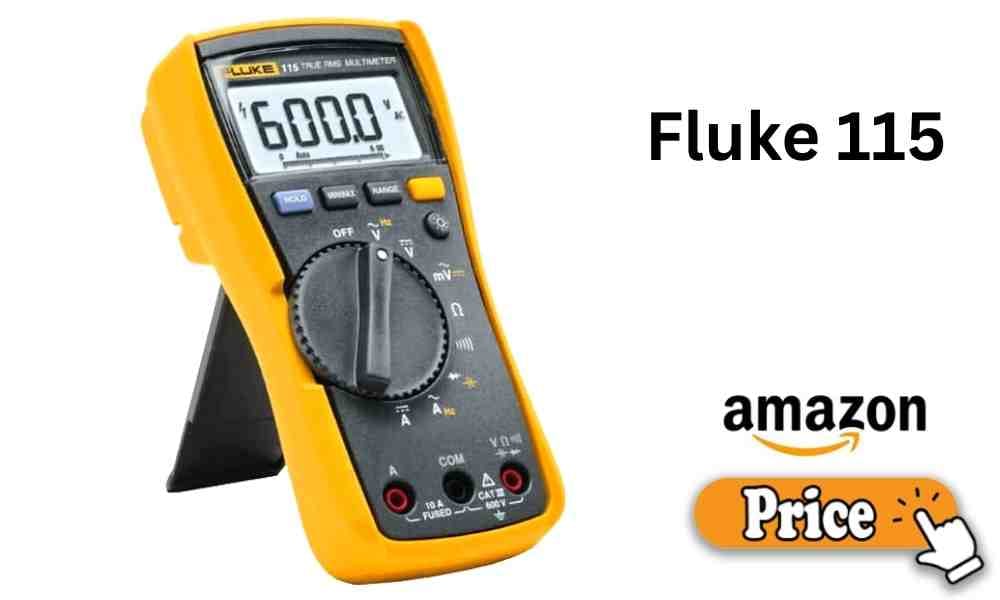
The beep is loud and instant, which I love. When I compared its DC voltage readings against my lab-grade bench meter, the 115 was consistently within 0.05 units. It feels like a tank and handles drops onto concrete without a scratch. It is my go-to for anything that does not involve high-voltage wall wiring.
| Pros | Cons |
| Very fast continuity beeper | No built-in voltage detector |
| High accuracy for electronics | Missing LoZ ghost voltage mode |
| Compact and easy to grip | Screen lacks a magnetic hanger |
Fluke 117 Electrician’s Multimeter Review
I used the Fluke 117 while installing new shop lights last month. The VoltAlert feature saved me a lot of time because I did not have to grab a separate tester to see if wires were live. I also tested it on a motor start-up current. The True RMS gave me stable numbers while the motor hummed to life.
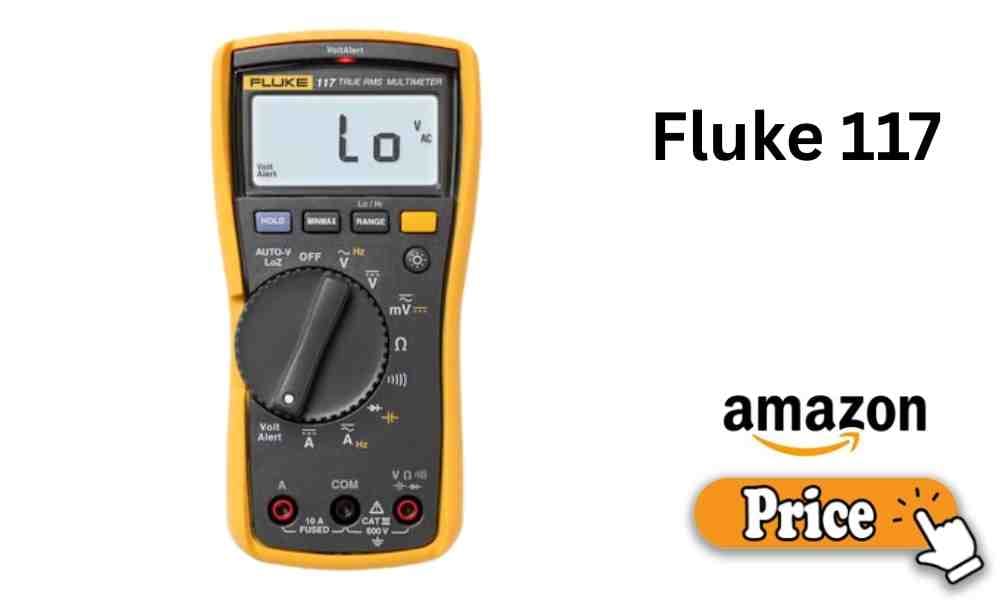
One thing I noticed is the LoZ mode. It correctly identified a “ghost” voltage on a neutral wire that my cheaper meter missed. It gave me peace of mind before I touched the copper. After a month of heavy use, the battery door is still tight, and the dial clicks into place with a satisfying snap.
| Pros | Cons |
| VoltAlert finds live wires fast | Slightly higher price point |
| LoZ mode prevents false readings | Not ideal for tiny circuit boards |
| Rugged rubber outer mold | Uses a 9V battery instead of AA |
Details Comparison for Fluke 115 vs 117
Both meters look almost the same, but they act very differently when you put them to work. Here is how they stack up in five key areas.
Core Measurement Accuracy
In my tests, both meters were very stable. The Fluke 117 reacted a split second faster when measuring AC current in my home outlets.
| Feature | Fluke 115 | Fluke 117 |
| DC Accuracy | 0.5% + 2 | 0.5% + 2 |
| Counts | 6000 | 6000 |
Safety and Voltage Detection
This is where the 117 wins for home repairs. The built-in sensor at the top of the meter glows red near live power.
| Feature | Fluke 115 | Fluke 117 |
| VoltAlert | No | Yes |
| CAT Rating | III 600 V | III 600 V |
Ghost Voltage Protection
When I test old house wiring, “ghost” energy can show up on the screen. The 117 has a special mode to drain that fake energy for a real reading.
| Feature | Fluke 115 | Fluke 117 |
| LoZ Mode | No | Yes |
| AutoVolt | No | Yes |
Build Quality and Leads
Both use high-quality plastic and rubber. The dials feel firm and do not wiggle. The leads that come in the box are flexible even when it is cold outside.
| Feature | Fluke 115 | Fluke 117 |
| Overmold | Thick Rubber | Thick Rubber |
| Drop Test | 1 Meter | 1 Meter |
Battery Life and Power
Both meters use a single 9V battery. I found that I got about 400 hours of use before the low battery icon popped up.
| Feature | Fluke 115 | Fluke 117 |
| Battery Type | 9V | 9V |
| Backlight | Yes | Yes |
Conclusion
If you work on cars or small gadgets, get the Fluke 115 to save some cash. If you plan to touch any home or shop wiring, the Fluke 117 is worth every extra cent for the safety features alone. Both will likely last you a decade or more of hard use.
As an Amazon Associate, We earn from qualifying purchases