
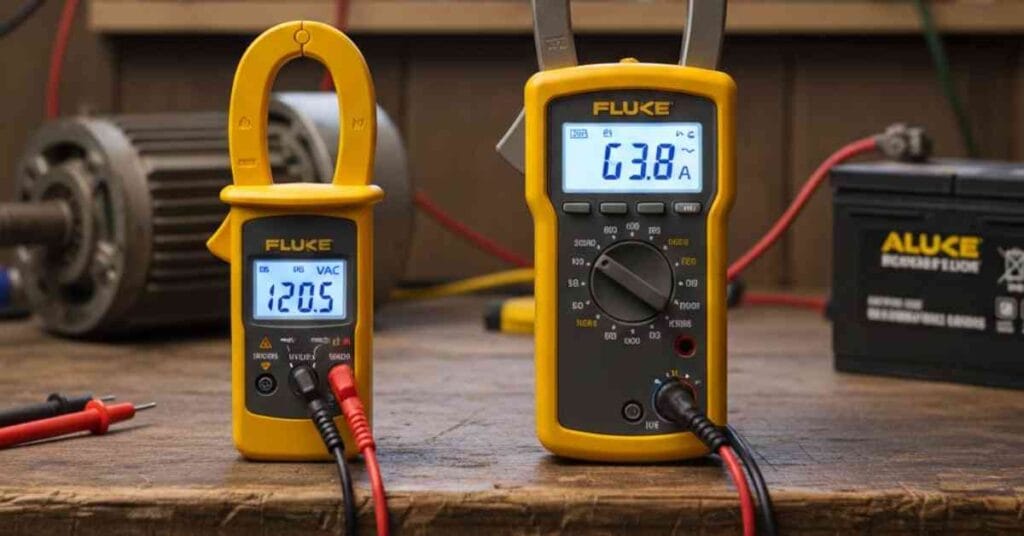
I spent the last month putting these two Fluke meters through their paces in my workshop and on actual job sites. If you are torn between the Fluke 373 vs 323, here is what I learned from real-world use.

My Experience with the Fluke 323
I carried the Fluke 323 in my pocket for two weeks while doing residential electrical work. It is remarkably light. When I was checking household AC current on a kitchen circuit, the slim design made it easy to reach into a crowded breaker box. It feels like a tool that won’t break if you toss it into a bag.
The readings were very consistent. I checked it against my bench meter, and the Fluke 323 was always within a few tenths of a volt. However, I did miss having a backlight. One evening, I was tracing a circuit in a dark basement. I had to hold my phone in one hand for light and the meter in the other. It was a bit of a struggle. It is a great, simple tool, but it has limits.
| Pros | Cons |
| Very thin and light | No screen backlight |
| Fast continuity beeper | No capacitance mode |
| Fits in tight panels | Lower current range |
My Experience with the Fluke 373
The Fluke 373 felt like a step up the moment I gripped it. I used this meter to troubleshoot a faulty HVAC fan motor. This is where the 373 shines because it has a capacitance setting. I was able to test the motor start-up capacitor quickly. The 323 simply cannot do that.
I also noticed the display is much easier to read. The numbers are larger, and the backlight is bright. When I tested a car battery draw, the 6000-count display gave me a bit more detail than the 323. It is slightly bulkier, but the extra features saved me from carrying a second meter for HVAC tasks. After dropping it once on a concrete floor, it didn’t even have a scratch.
| Pros | Cons |
| Bright backlit screen | Slightly larger in hand |
| Measures capacitance | More expensive |
| Higher 600A AC range | Uses more battery |
Detailed Comparison for Fluke 373 vs 323
Both meters are high-quality tools, but they serve different needs. Here is how they stack up in five key areas.
Accuracy and Stability
In my tests, the Fluke 373 offered better stability. The 6000-count display means it can show more precise increments. When measuring a steady 120V outlet, the 373 stayed locked on the number, while the 323 flickered slightly more.
| Feature | Fluke 323 | Fluke 373 |
| Display Counts | 4000 | 6000 |
| True RMS | Yes | Yes |
| Stability | Good | Excellent |
Jaw Size and Design
The jaw on the 373 is slightly larger. I noticed this when I had to clamp around a thick bundle of wires in a generator transfer switch. The 323 jaw is 30mm, while the 373 is 34mm. That small gap makes a big difference when wires are stiff.
| Feature | Fluke 323 | Fluke 373 |
| Jaw Opening | 30 mm | 34 mm |
| One-hand Use | Excellent | Good |
Measurement Capabilities
The 373 is the clear winner for versatility. It includes capacitance and a higher AC current ceiling. If you only do basic wiring, the 323 is fine. If you touch motors or HVAC systems, you need the 373.
| Feature | Fluke 323 | Fluke 373 |
| Max AC Amps | 400 A | 600 A |
| Capacitance | No | Yes |
Usability and Display
I found the 373 much better for aging eyes or dark workspaces. The backlight is a game-changer. The 323 is purely for well-lit areas. The buttons on both feel clicky and solid, even when I wore work gloves.
| Feature | Fluke 323 | Fluke 373 |
| Backlight | No | Yes |
| Ease of Reading | Moderate | High |
Safety and Build Quality
Both meters carry a CAT IV 300V / CAT III 600V rating. This means they are safe for professional use. The rubber overmolding on both feels premium. Fluke did not cut corners on the safety of either model.
| Feature | Fluke 323 | Fluke 373 |
| CAT Rating | III 600V / IV 300V | III 600V / IV 300V |
| Insulation | Double | Double |
Conclusion
If you want a small, tough tool for simple home electrical work, get the Fluke 323. It is a “set it and forget it” meter that fits anywhere. However, if you are a pro or a serious DIYer who works on motors or in dark spots, the Fluke 373 is worth the extra cost. The backlight and capacitance testing make it the more capable companion for my daily tasks.
As an Amazon Associate, We earn from qualifying purchases