
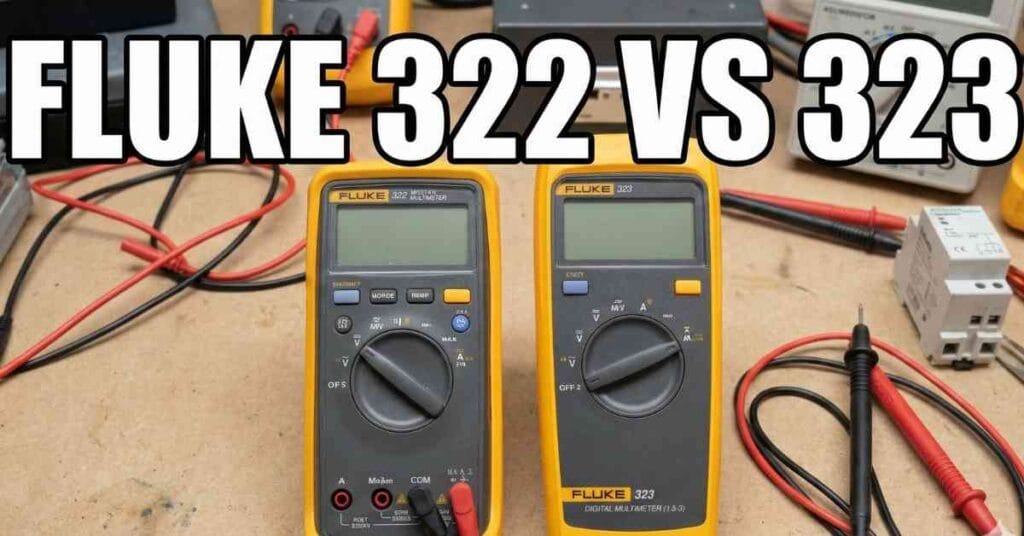
I used the Fluke 322 for years before upgrading to the 323. While the 323 is the modern replacement, the older 322 had one specific feature I actually miss. Here is exactly how they compare after weeks of field use.
Fluke 322 Review (The Discontinued Classic)
I carried the Fluke 322 in my secondary tool bag for a long time. It was my go-to meter for quick residential calls where I did not need advanced diagnostics. It is small, light, and fits into a shirt pocket easier than almost any other clamp meter I have owned.
I primarily used it for checking load on breaker panels and simple continuity tests. The best thing about this meter is the 40A range. It gives you 0.01A resolution. This is fantastic for seeing small current draws that other basic meters miss. However, it shows its age when you work on modern electronics. It is an “average sensing” meter. That means if I measured a circuit with LED drivers or variable speed motors, the reading was often off by 10% or more. The resistance range is also very limited. It stops at 400 ohms. This was a pain when I needed to test heating elements or sensors that went above that limit.
Pros and Cons: Fluke 322
| Pros | Cons |
| Precise 0.01A resolution on 40A range | No True RMS (inaccurate on non-linear loads) |
| Very compact and lightweight (230g) | Low resistance limit (Max 400 Ω) |
| Fast continuity response | No CAT IV safety rating |
| Great battery life (100+ hours) | Smaller 25mm jaw opening |
Fluke 323 Review (The Modern Workhorse)
The Fluke 323 is what I use now for daily tasks. It feels more substantial in the hand than the 322. The plastic feels thicker and the jaw spring is stronger. The biggest upgrade here is True RMS. I can now trust the current readings on HVAC units with variable frequency drives.
I tested the continuity beeper extensively. It is loud and instant. One thing to note is the threshold. It beeps at anything under 70 ohms. The older 322 only beeped under 30 ohms. This means the 323 might beep on a circuit that has a bit of resistance, which can be confusing if you are looking for a dead short. The jaw opening is larger at 30mm. This extra space helps when I try to hook it around 4/0 feeder cables in a tight panel. The resistance range goes up to 4000 ohms. This saves me a trip to the truck for a different meter. It does not have a backlight, which is a letdown, but the screen is high contrast and easy to read in daylight.
Pros and Cons: Fluke 323
| Pros | Cons |
| True RMS accuracy for modern electronics | No 0.01A low-current resolution |
| Higher resistance range (Max 4000 Ω) | No backlight on display |
| Larger 30mm jaw opening | Slightly heavier than the 322 |
| CAT IV 300V / CAT III 600V rated | Continuity threshold is higher (70 Ω) |
Details Comparison for Fluke 322 vs 323
The 323 is the clear winner for safety and versatility, but the 322 had a niche advantage in low-current precision. Below is a breakdown of the five most important differences I found during testing.
Core Measurement Accuracy
The most vital difference is how they measure AC current. The 322 uses average sensing. It assumes electricity flows in a perfect wave. In the real world, computers and LEDs distort this wave. When I measured a circuit with heavy electronic loads, the 322 read low. The 323 uses True RMS. It calculates the actual heat potential of the current. For any commercial work today, True RMS is mandatory.
| Feature | Fluke 322 | Fluke 323 |
| Measurement Type | Average Sensing | True RMS |
| Best Accuracy (AC) | 1.8% + 5 counts | 2.0% + 5 counts |
| AC Current Max | 400 A | 400 A |
Physical Design and Jaw Size
The 323 is slightly bigger but feels more durable. The jaw shape is the key change. The 322 has a 25mm opening. It struggles with thick service entrance cables. The 323 has a 30mm opening. That 5mm difference does not sound like much, but it makes hooking wires in a crowded breaker box much easier. The 323 also has a tactile barrier on the body to keep your fingers away from live voltage.
| Spec | Fluke 322 | Fluke 323 |
| Jaw Opening | 25 mm | 30 mm |
| Weight | 230 g | 265 g |
| Dimensions | 190 x 63 x 35 mm | 207 x 75 x 34 mm |
Resistance and Continuity
This is where the 323 is far more useful. The 322 stops measuring resistance at 400 ohms. If I test a coil that is 1000 ohms, the 322 just shows “OL” (Over Limit). The 323 measures up to 4000 ohms. I can test almost any standard component with it. However, the continuity beep is different. The 322 is stricter. It only beeps if resistance is under 30 ohms. The 323 beeps at anything under 70 ohms.
| Feature | Fluke 322 | Fluke 323 |
| Max Resistance | 400 Ω | 4000 Ω (4 kΩ) |
| Continuity Beeper | < 30 Ω | < 70 Ω |
| Resolution | 0.1 Ω | 0.1 Ω |
Low Current Resolution
The 322 actually wins here. It has a dedicated “40A” range. In this mode, it displays two decimal places (e.g., 5.43 A). The 323 only has one 400A range. It always displays one decimal place (e.g., 05.4 A). If you hunt for small battery drains or parasitic loads, the older 322 gives you more data. The 323 is not designed for that level of precision.
| Range Setting | Fluke 322 Resolution | Fluke 323 Resolution |
| 0 – 40 A | 0.01 A | 0.1 A |
| 40 – 400 A | 0.1 A | 0.1 A |
Safety and Durability
The 323 is built to a higher safety standard. It is rated CAT IV 300V and CAT III 600V. This means it can handle higher voltage spikes safely. The 322 is only CAT III 600V. If you work on the utility side of the service panel or outside on the meter base, you should use the 323. Both are tough, but the 323 feels like it can take a harder drop on concrete.
| Rating | Fluke 322 | Fluke 323 |
| Safety Category | CAT III 600V | CAT III 600V / CAT IV 300V |
| Warranty | Expired (Legacy) | 2 Years |
| Casing | Hard Plastic | Ergonomic Molded |
The Fluke 323 is the right choice for general electrical work today. It is safer and handles modern loads correctly. The only reason to stick with a 322 is if you specifically need that 0.01A resolution for low-current testing. For everyone else, the 323 is the reliable upgrade.
As an Amazon Associate, We earn from qualifying purchases