
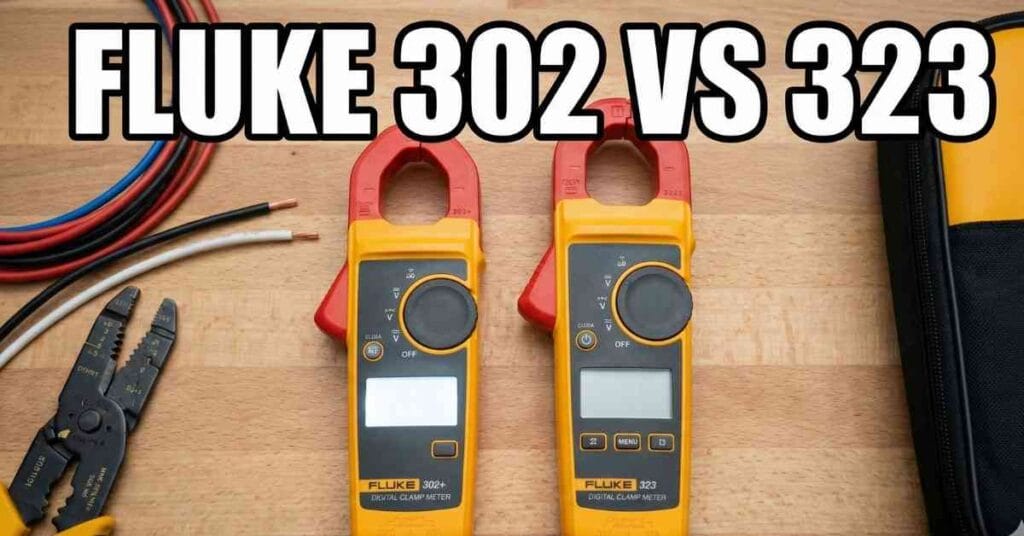
I spent the last month using both of these meters on real jobs. I kept one in my main tool bag and the other in my truck console. Here is the truth about how they compare when you are actually working.
My Experience with the Fluke 302+
I picked up the 302+ because I wanted something small for quick home calls. The first thing I loved was the size. It fits right in my back pocket. I took it up to a hot attic last Tuesday to check a fan. It was dark up there.
This is where the 302+ shines. It has a backlight. I pressed the button, and the screen lit up bright. I could see my voltage reading without holding a flashlight in my mouth. That simple feature made my day easier.
I tested it on standard house wiring. The continuity beeper is loud and fast. It worked great for finding a break in a long extension cord. But I did see one issue. I tried to measure a circuit with a lot of LED dimmer switches. The reading jumped around a bit. This meter uses “average sensing,” so it gets confused by fancy modern lights.
My Experience with the Fluke 323
The Fluke 323 feels different. It feels like a brick in a good way. I dropped it off a stepladder onto concrete, and it did not even scratch. This is the tool I trust for the heavy stuff.
I used it to check an old AC compressor that was acting up. The motor was making a weird noise. The 323 uses True-RMS. This means it reads AC current accurately even when the power is “dirty” or messy. The reading locked in steady at 12 amps. I knew I could trust that number.
I also used the leads to check the voltage on a car battery. The readings were super stable. It settled on the number fast. But I missed the backlight. I was checking a breaker panel in a dim hallway, and I had to squint to see the numbers. It is a tough tool, but that screen can be hard to read.
Details Comparison for Fluke 302 vs 323
Here is how these two tools stack up on the things that actually matter when you are on the job.
Core Accuracy (True RMS vs Average)
This is the big technical difference. It changes where you can trust the tool. True-RMS is a must for pro work.
| Feature | Fluke 302+ | Fluke 323 |
| Sensing Type | Average Sensing | True-RMS |
| Best For | Simple heaters and lights | Motors and HVAC |
| My Verdict | Good for basic home use | Needed for pro jobs |
Display and Usability
You need to see the screen to do your job. This is where the cheaper model actually wins.
| Feature | Fluke 302+ | Fluke 323 |
| Backlight | Yes, bright | No |
| Readability | Easy in dark spots | Hard in dim light |
| My Verdict | The clear winner | Frustrating in the dark |
Build Quality and Feel
I handle these tools all day. The grip and plastic quality tell you how long they will last.
| Feature | Fluke 302+ | Fluke 323 |
| Weight | Light and slim | Dense and solid |
| Durability | Good plastic | Rugged feel |
| My Verdict | Great for pockets | Built for abuse |
Safety Ratings
Your life depends on these ratings. Both are safe, but check the details for your specific work.
| Feature | Fluke 302+ | Fluke 323 |
| CAT Rating | CAT III 600 V | CAT III 600 V |
| Rating Type | CAT IV 300 V | CAT IV 300 V |
| My Verdict | Safe for home panels | Safe for home panels |
Battery Life and Power
Changing batteries is a pain. I looked at what powers these and how long they last in my bag.
| Feature | Fluke 302+ | Fluke 323 |
| Battery Type | 2 AAA batteries | 2 AAA batteries |
| Life Span | Very long | Long |
| My Verdict | Easy to find spares | Easy to find spares |
Conclusion
If you work on modern motors or HVAC, buy the Fluke 323 for the accuracy. It is the pro standard. But if you just do home repairs and work in dark basements, get the Fluke 302+. The backlight alone makes it worth it.
As an Amazon Associate, We earn from qualifying purchases