
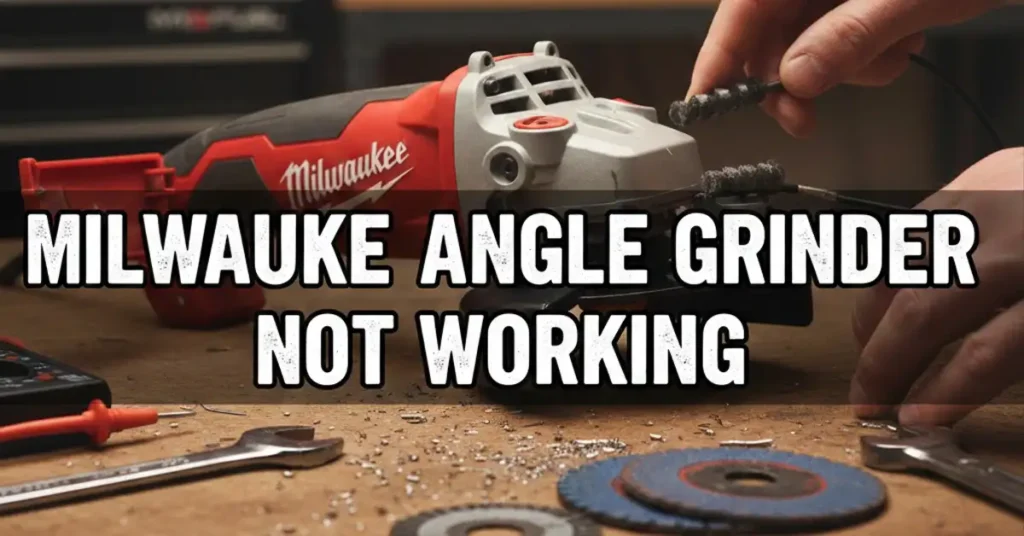
It was a Tuesday afternoon in my garage. I was right in the middle of smoothing down a rusty weld on an old truck frame. My Milwaukee angle grinder was humming along just fine. Then, total silence. No pops, no smoke—it just died.

I’ve spent years working with these “Red” tools. They are usually tough as nails. But when your Milwaukee angle grinder is not working, it feels like your whole day has hit a wall. I didn’t want to buy a new one. I wanted to fix mine.
I sat down on my stool and grabbed a cold drink. I started poking around to see what went wrong. If your grinder just quit on you, do not panic. Most of the time, the fix is simpler than you think. Here is exactly what I found and how I got back to work.

Checking the Basics First
Before I took out a single screw, I checked the obvious stuff. We often look for a big disaster when the fix is right in front of us. I once spent an hour trying to “fix” a saw that was not even plugged in. I was not going to make that mistake again.
The Battery or the Cord
If you use the M18 cordless line, the battery is the first thing to check. I swapped my 5.0Ah pack for a fresh High Output battery. Sometimes a battery looks full but has a bad cell. It happens to the best of us after years of hard use.

For those of you with a corded model, check the “stress point.” This is where the wire enters the handle. I’ve seen wires fray inside the rubber sleeve from being bent too much. Give the cord a gentle wiggle while you hold the trigger to see if it sparks.
The Reset Table
| Component | What I Look For | The “Quick Fix” |
| Battery Pack | Dust on the metal tabs | Wipe with a dry cloth |
| Power Cord | Nicks, cuts, or flat spots | Replace the cord |
| GFCIs | Tripped buttons on the wall | Press the “Reset” button |
Why My Milwaukee Angle Grinder Stopped Working
After I knew the power was good, I had to dig deeper. I’ve noticed that Milwaukee tools are very smart. They have brains that protect the motor. Sometimes, they stop working just to save their own lives from burning out.
The Overload Protection
I was leaning pretty hard on that truck frame when it cut out. These grinders have a system called Redlink Plus. If the tool gets too hot or the disc pinches, it shuts down. It is like a circuit breaker for your hand to keep things safe.
I felt the motor housing to see if it was hot. It was warm, but not burning. I pulled the battery out for about thirty seconds. This clears the “memory” of the tool. I put the battery back in, pulled the trigger, and it still did not start.
The Dust Factor
Grinders live in a cloud of metal dust. That dust is magnetic and loves to get inside the switch. I noticed my trigger felt a bit “crunchy” when I pushed it. This is a big sign that dirt is blocking the signal.
I grabbed my air compressor and went to work. I blew air into every vent and around the switch. A cloud of black grit flew out. If your Milwaukee angle grinder is not working, a dirty switch is a huge suspect. The dust blocks the metal tabs from touching each other.
The Most Common Fix: Carbon Brushes
If you have a corded Milwaukee grinder, you have carbon brushes. These are small blocks that rub against the motor to give it power. They are meant to wear out over time. It is like the brake pads on your car.
How to Spot Worn Brushes
I’ve fixed many grinders for friends by just changing these. You can usually tell they are going bad if you see sparks through the vents. Sometimes the tool will run for a second and then stop for no reason.
I used a flathead screwdriver to pop off the two plastic caps on the sides. If the brush is shorter than a pencil eraser, it is done. I keep a spare set in my toolbox now. They cost very little and take five minutes to swap.
Diving Into the Gearbox
Sometimes the motor is fine, but the “business end” of the tool is stuck. I disconnected the power and tried to spin the disc by hand. It would not budge an inch. This tells me the issue is mechanical, not electrical.
The Spindle Lock Trap
On the top of the grinder, there is a button you press to lock the disc. Mine was stuck in the “down” position. A small piece of metal grit had jammed it tight. This keeps the gears from turning at all.
I used a pair of pliers to gently pull the button back up. Once it popped back out, the disc spun freely. If your motor hums but the disc does not move, your spindle lock is probably the culprit. Give it a good wiggle to see if it clears.
Grease and Gears
Inside the head of the grinder are heavy-duty gears. Over time, the grease can get hard or leak out. This causes a lot of heat and can even lock the tool up. I like to check the grease once a year to keep things smooth.
| Part | Sign of Trouble | Solution |
| Gears | Screaming noise | Add high-temp grease |
| Bearings | Disc wobbles | Replace the bearing |
| Spindle | Button is stuck | Clean with WD-40 |
I always wipe out the old, black grease when I open it. I put in a fresh dab of red gear grease. It makes the tool run much quieter and cooler. This simple step can add years to the life of your grinder.
When the “Brain” Goes Bad
If you have checked the brushes and the switch, it might be the control board. In the cordless FUEL models, there is a small circuit board in the handle. These are sealed in hard plastic to protect them from dust and drops.
Sadly, if these go bad, you cannot really fix them with a screwdriver. I look for “the smell” of burnt wires. If the tool smells like ozone, the board is likely toast. This is a more serious issue that usually needs a pro.
I check the date code on the tool at this point. Milwaukee has a great five-year warranty on most tools. If it is under warranty, I send it in for a free fix. If not, I start looking for a sale on a new bare tool.
My Checklist for a Dead Grinder
When my tools break, I follow a simple path. It keeps me from getting frustrated or throwing things. I start with the easiest fix and work my way up to the hard stuff.
- Check Power: Try a new battery or a different outlet first.
- Clean it Out: Use air to blow out the dust and grit.
- Check the Brushes: Look at the wear on the carbon blocks.
- Test the Spin: Make sure the gears are not jammed up.
- Reset the Brain: Let it cool down and remove the power.
Keeping Your Grinder Alive Longer
After getting mine running again, I realized I had been mean to it. I was using it for two hours straight without a break. That much heat is bad for any motor, no matter how tough it is.
Now, I try to follow a few simple rules. I do not “lug” the motor by pushing too hard. If I hear the RPMs drop, I back off the pressure. I also blow it out with air every Friday before I close up the shop.
A Milwaukee angle grinder not working is a pain, but it is usually a sign that the tool needs a quick tune-up. Most of the time, you can be back to grinding in under ten minutes. My truck frame is finally smooth, and my grinder is back in its spot.
FAQs: Milwaukee angle grinder is not working
Why did my Milwaukee angle grinder stop mid-cut?
Your tool likely hit the Redlink Plus safety limit. This happens when the motor gets too hot or the disc pinches. Pull the battery for ten seconds to reset the brain.
How do I know if my carbon brushes are worn out?
Look for sparks or a loss of power in corded tools. Open the side caps to check the carbon length. If they are shorter than a pencil eraser, you need a new set.
Can dust cause my Milwaukee grinder to fail?
Yes, metal grit is magnetic and can jam your trigger switch. Use a can of compressed air to blow out the vents. This simple fix often brings a “dead” tool back to life.
Is it safe to use a grinder that smells like it is burning?
No, a burning smell means the motor or wires are overheating. Stop work and unplug the tool right away. This scent usually points to a bad circuit board or worn gears.
As an Amazon Associate, We earn from qualifying purchases