
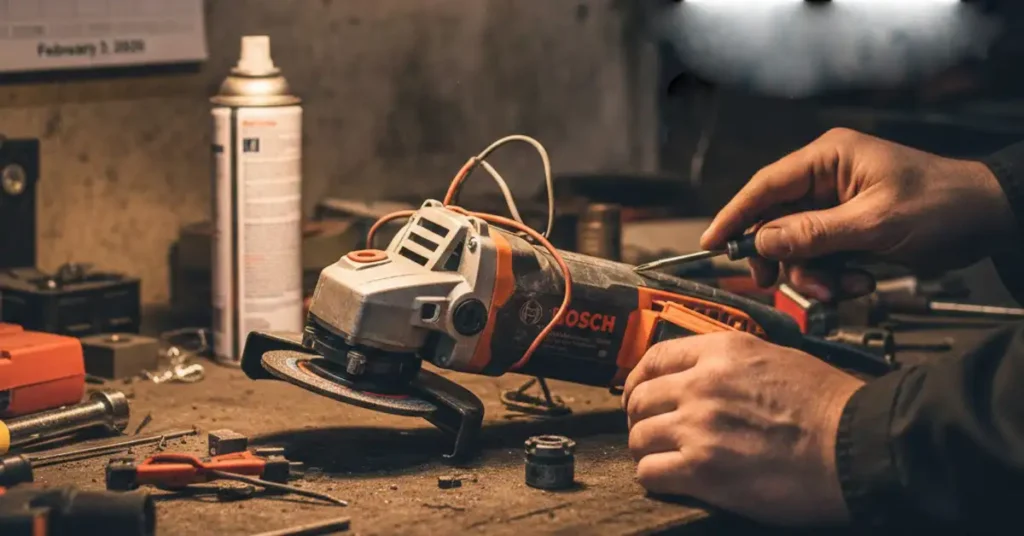
It was a hot Tuesday afternoon in my garage. I was right in the middle of smoothing down a rusty weld on a gate frame. Then, it happened. My Bosch angle grinder stopped working. No pops. No smoke. Just dead silence.

I stood there like a fool, clicking the switch back and forth. I even shook the tool as if that would wake it up. If you have been there, you know that mix of anger and defeat. You have work to do, and your tool just quit on you.
The First Check: Simple Power Issues
Before I grabbed my screwdriver set, I had to rule out the silly stuff. I once spent an hour fixing a tool only to find out the plug was loose. Do not be that person. I checked the wall outlet first to be sure it had juice.
Is the Outlet Alive?
I plugged my shop fan into the same outlet. The fan did not spin. It turns out I had tripped a breaker when I started the grind. If your tool dies, check your power box first. It sounds basic, but it happens to the best of us.
The Restart Protection Feature
Bosch builds their tools to be very safe. Many models have a feature called “Restart Protection.” If the power cuts out while the switch is “on,” the tool will not start when power comes back. I had to flip the switch to “off” and then “on” again to reset it.

Why Bosch Tools Quit: Common Causes
Once I knew I had power, I sat down at my bench. I needed to see why my Bosch angle grinder stopped working. I made a quick list of what usually goes wrong with these machines.
The Troubleshooting Table
| Common Problem | What It Feels Like | The Quick Fix |
| Worn Brushes | Tool stops or sparks | Replace carbon brushes |
| Broken Cord | Works when you wiggle it | Cut and rewire cord |
| Dusty Switch | Switch feels stuck or gritty | Blow out with air |
| Hot Motor | Tool feels very warm | Let it cool 20 mins |
The Main Culprit: Worn Carbon Brushes
I have fixed many tools, and most of the time, it is the brushes. These are small blocks of carbon. They pass power to the spinning part of the motor. Because they rub against moving parts, they wear down over time.
The Auto-Stop Secret
Bosch is smart. They put a tiny spring inside the brush. When the carbon gets too short, the spring pops out. This breaks the circuit. It stops the tool before the metal parts touch and ruin the motor.
I opened the side hatch on my grinder. Sure enough, the brushes were tiny. They looked like little stubs. I could smell a bit of that “burnt toast” scent that comes from old carbon. This is a very common reason a Bosch angle grinder stopped working.
How to Swap Brushes
First, unplug the tool. This is the most important step! Find the brush caps on the side or back. Use a flat-head driver to unscrew them. Pull out the old brush and spring. Slide the new one in and screw the cap back on.
The Hidden Break: Dealing with Power Cords
If your brushes look long and healthy, the cord is next. Grinders live a hard life. We bend the cords and wrap them tight. We pull on them to reach that last inch of a metal sheet.
The Wiggle Test
I plugged the tool in and held the switch on. I wiggled the cord where it enters the handle. This is the main stress point. If the tool blips to life for a split second, you have a broken wire inside the rubber.
To fix this, I had to open the handle. I cut off the bad two inches of wire and reconnected the fresh ends to the switch. It made the cord a bit shorter, but the tool worked perfectly again.
When Dust Wins: Cleaning the Switch
Metal dust is the enemy of any Bosch angle grinder stopped working. When you grind steel, the tiny sparks are actually hot bits of metal. These get sucked into the vents and settle on the parts.
The Gritty Switch
My switch felt very “crunchy.” It did not have that nice “click” it had when it was new. I used a can of compressed air. I blew air into every vent and around the trigger. A huge cloud of black dust came out.
After a few blasts, the switch moved freely again. If you work with stone or metal, do this once a week. It keeps the grit from eating the plastic parts inside. It also keeps the motor cool.
Advanced Motor Issues: When to Give Up
Sometimes, the fix is not so easy. If you smell a strong chemical odor or see melted plastic, the motor might be toast. This happens if you push the tool too hard for too long.
Checking the Armature
I look through the vents with a flashlight. If the copper coils look black instead of shiny, the motor is burnt. In that case, the cost of the part is often as much as a new tool. It might be time to go shopping for a new Bosch.
Bearing Failures
If the motor hums but will not spin, the bearings might be seized. I try to spin the wheel by hand while the tool is unplugged. If it feels stuck or makes a grinding sound, the internal bearings are gone.
Preventing Future Tool Failures
Fixing a tool is great, but not breaking it is better. I have learned a few tricks to keep my gear running. These tips will save you money and time on your next big project.
Maintenance Schedule
| Task | How Often | Benefit |
| Blow out dust | After every use | Cooler motor |
| Check brushes | Every 6 months | Prevents motor damage |
| Inspect cord | Before each use | Safety and reliability |
I always keep a spare set of brushes in my toolbox now. They cost less than five dollars. Having them on hand means I don’t have to stop working to go to the store. It makes life much easier.
I hope this helps you get back to work. Most of the time, a Bosch angle grinder stopped working is just a minor bump in the road. Take your time, stay safe, and check the easy stuff first!
FAQs: Bosch Angle Grinder Stopped Working
Why did my Bosch angle grinder stop working all of a sudden?
It often happens because the carbon brushes wore out. These small parts cut the power to protect your motor from damage. Replacing them usually fixes the tool in minutes.
Can I fix a grinder that smells like it is burning?
A burning smell usually means the motor is too hot or the coils are shorted. Stop using it right away to stay safe. Check the brushes or let it cool down before you try it again.
How do I know if my power cord is broken inside?
Plug the tool in and gently wiggle the cord near the handle. If the motor sparks to life for a second, the wire is snapped. You can cut the bad part off and rewire it easily.
As an Amazon Associate, We earn from qualifying purchases