
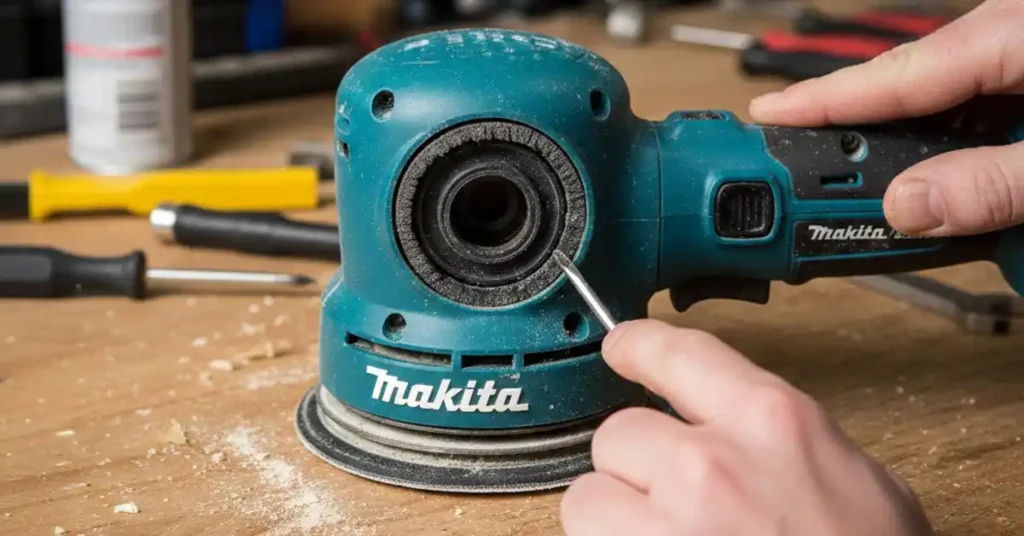
It was a hot Tuesday in my dusty garage. I was working on a large pine bench. My Makita sander was humming along just fine. Then, I noticed the pad was barely moving. The motor sounded strong, but the disc just sat there. I knew right then that I had a problem.
If your Makita orbital sander is not spinning, do not toss it in the trash. This is a common issue for many woodworkers. I have fixed my own sander many times over the years. Usually, it is a quick fix that costs less than a lunch. You just need a few tools and a little bit of time.

Quick Diagnosis for Your Makita Sander
To fix the tool, we must see what broke. A sander needs to spin and vibrate at the same time. This is called random orbit motion. When it stops spinning, it leaves deep marks on your wood. I have listed the main causes in the table below to help you out.
| What I See | What Is Wrong | How I Fix It |
| Pad spins too fast by hand | Worn Friction Ring | Replace the rubber ring |
| Pad feels stuck or gritty | Dust buildup or bad bearing | Clean or replace bearing |
| Motor runs but no pad movement | Stripped drive hub | Replace the sanding pad |
| Strange grinding noises | Failed internal bearing | Install new bearing box |
The Main Culprit: The Rubber Friction Ring
The most common reason for a sander not spinning is the friction ring. This is a thin rubber ring inside the tool. It acts like a brake to control the speed. In my experience, these rings wear out every year or two if you sand a lot. I once found my ring had turned into a gummy mess from the heat.
To check this, unplug your tool and turn it over. Try to spin the pad with your finger. If it spins like a toy top, the ring is gone. The rubber should provide a small amount of drag. If there is no drag, the pad will not rotate properly when you touch the wood.
How I Replaced My Friction Ring
Replacing this part is very simple. I used a Phillips head screwdriver to remove the three screws on the pad. Once the pad was off, I saw the black rubber ring. It sits in a small groove on the plastic body. I popped the old one off with a flat tool and wiped the area clean.
I stretched the new ring into the groove. It is a tight fit, so you have to pull hard. Once it was in place, I put the pad back on. I tested it on a scrap of oak, and it spun perfectly. This simple fix saved me from buying a whole new tool for my project.
When Dust Chokes the Machine
Wood dust is a silent killer for power tools. I remember a day when I forgot to hook up my shop vac. Within an hour, my sander was struggling to move. The fine dust gets into every crack and crevice. It can pack down so tight that the pad physically cannot turn anymore.
I took the pad off and found a thick layer of wood flour. It was jammed between the pad and the motor housing. I used a stiff brush to get the big chunks out. Then I used a vacuum to suck out the rest. Keeping the tool clean is the best way to make it last for years.
Dealing with a Dead Bearing
If your sander makes a loud, high scream, the bearing is likely dead. This is a bigger job than the rubber ring. Bearings fail when they get too hot or too dirty. My old sander started to smell like burning metal before it finally quit on me.
Replacing a bearing takes about thirty minutes. You have to open the bottom of the sander to reach the bearing box. If you are not comfortable with that, you can buy the whole bearing unit as one part. It costs more, but it is much easier to install for a quick repair.
Tips to Keep Your Sander Spinning
I have learned that how I use the tool matters most. Never press down hard on the sander while you work. Let the weight of the tool do the job. Pushing down creates heat that melts the rubber parts and kills the bearings. I always use a vacuum now to keep the tool cool and clean.
Checking your gear once a month is a great habit. I always look at my sanding pad to see if the teeth are still sharp. If the center hub of the pad is smooth, the motor cannot turn it. A new pad is cheap and keeps the tool running like new. Fixing your own tools is a great way to save money and stay productive.
FAQs: Makita Orbital Sander Stopped Spinning
Why does my Makita orbital sander spin too fast when I lift it?
This usually means your rubber friction ring is worn out or broken. This part acts as a brake to keep the speed safe and steady. Replacing it will fix the issue quickly.
Can I use my Makita sander without the dust bag attached?
You can, but fine dust will quickly clog the internal parts and bearings. This buildup often causes the pad to stop spinning. Using a vacuum is much better for the tool’s life.
Why is my Makita sander making a loud grinding noise?
A grinding sound is a classic sign that a ball bearing has failed. Heat or dust likely dried out the grease inside. You should replace the bearing box before the motor gets damaged.
Will pressing down harder help my Makita sander work faster?
No, extra pressure creates too much heat and can melt your friction ring. It also wears out the motor and bearings. Let the grit of the paper do the work for you.
As an Amazon Associate, We earn from qualifying purchases