
Over the years, I have put dozens of different mowing configurations through their paces on everything from manicured estate lawns to bumpy, overgrown horse pastures. In this hands-on comparison, we are going to dive deep into the real-world performance of front/mid-mounted hydraulic setups versus traditional rear-mounted PTO implements. By looking at two highly popular, heavy-duty representatives of these categories, you will easily figure out which design fits your machine and your land.
mid mount vs rear finish mower: At a Glance
| Mid-Mount Finish Mower | Rear Finish Mower | |
|---|---|---|
| Mounting Position | Mounted underneath the tractor chassis between front and rear axles | Attached to the rear three-point hitch of the tractor |
| Operator Visibility | Excellent forward visibility, easy to monitor without looking backward | Requires operator to constantly look backward to monitor performance |
| Maneuverability | Highly maneuverable with a tight turning radius, ideal for obstacles | Longer overall footprint, prone to swinging wide on tight turns |
| Ease of Installation | Can be difficult and time-consuming to align and mount underneath | Quick and simple to hook up using standard three-point linkage |
| Ground Clearance | Reduces tractor ground clearance, must be removed for rough terrain | Can be lifted high off the ground using the hydraulic hitch |
| Storage and Maintenance | Harder to access blades and underside for cleaning or maintenance | Easy to tilt or lift for quick blade access and cleaning |
| Tractor Versatility | Often semi-permanently mounted, limiting quick use of other implements | Easily swapped out, leaving the tractor ready for other attachments |
Complete Comparison: Mid-Mount Finish Mower vs Rear Finish Mower
| Titan Attachments 60″ Skid Steer Finish | BILT HARD 48 inch 3 Point | |
|---|---|---|
| Product Image | 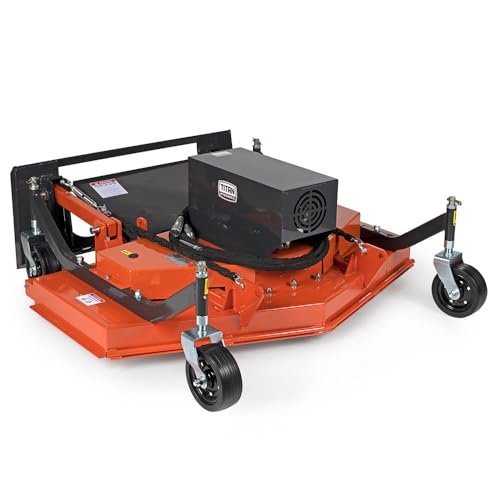 | 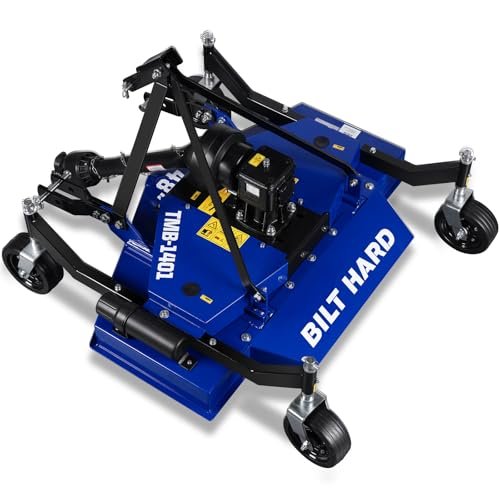 |
| Price | View On Amazon | View On Amazon |
| Category | Premium | Mid-Range |
| Mower Type & Mounting | Front-Mounted Skid Steer Finish Mower (Universal Quick Tach) | Rear-Mounted 3-Point PTO Finish Mower (Category 1 Hitch) |
| Cutting Width | 60 inches | 48 inches |
| Power Source | Hydraulic motor (hoses & flat-face couplers included) | Tractor PTO shaft (rated for 15-45 HP tractors) |
| Cutting Height Range | 0.4″ to 3.2″ (adjustable wheel brackets) | 0.4″ to 4.0″ (adjustable height) |
| Blades | 3 overlapping heat-treated blades | 3 heavy-duty heat-treated steel blades |
| Terrain Following | Floating hitch mount plate | Advanced Floating System with 4-wheel design |
| Discharge Style | Rear discharge (reduces grass buildup) | Wide rear discharge (spreads clippings evenly) |
| Gearbox Rating & Build | 40HP cast iron gearbox, high-grade steel, powder-coated | Cast iron gearbox, heavy-duty one-piece steel deck |
| Best For | Skid steer owners needing high visibility for tight, precise mowing around obstacles | Compact tractor owners needing an economical, durable rear-mount mower for lawns |
| Amazon Link | View On Amazon | View On Amazon |
| Overall Winner | Winner | Runner-up |
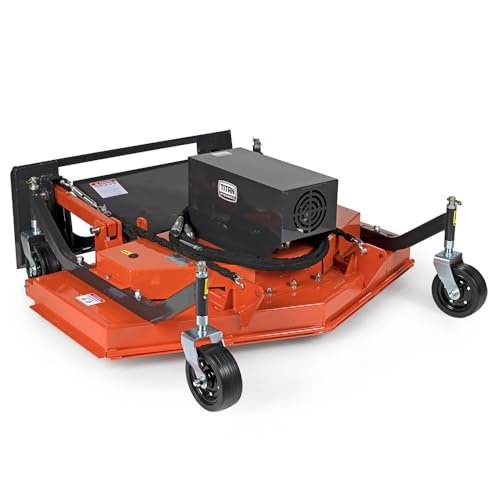
Product 1: Titan Attachments 60″ Skid Steer Finish Mower
The Titan Attachments 60″ Skid Steer Finish Mower completely changes how you approach large-scale turf maintenance if you own a skid steer or compact track loader. By placing the mower deck directly in front of the operator, this unit provides unmatched visibility that traditional pull-behind mowers simply cannot match. I found that the universal quick tach coupled with the heavy-duty hydraulic motor made hookups fast, though you do need to ensure your machine’s hydraulic flow matches the motor requirements. The floating hitch does a fantastic job of tracing ground contours independently of the loader arms. Because it uses a rear discharge design, you do not have to worry about throwing dangerous debris toward nearby buildings or vehicles. The structural integrity is highly impressive, featuring high-grade steel construction and a 40HP cast iron gearbox designed to handle thick grass without bogging down.
- Universal Quick Tach Connection: Instantly mounts to any standard skid steer or compact track loader plate with included flat-face couplers.
- Front-Mounted Visibility: Allows you to mow directly up to fences, trees, and structures without straining your neck.
- Floating Hitch System: Prevents gouging and scalping by allowing the deck to rise and fall naturally over dips and ridges.
- Adjustable Wheel Brackets: Hardened steel pins let you adjust the cutting height from 0.4 inches up to 3.2 inches.
- Three Overlapping Blades: Heat-treated steel blades rotate at high speeds to eliminate uncut strips of grass.
Pros
- Exceptional operator visibility prevents collisions with low-hanging branches and obstacles.
- Pushing the mower forward means you do not flatten the grass with your machine’s tires before cutting it.
- Highly maneuverable in tight corners and dead-ends where a tractor could never fit.
- Thick steel plating and a heavy-duty gearbox withstand significant abuse.
Cons
- Requires a skid steer with auxiliary hydraulics, limiting its use for traditional tractor owners.
- May feel front-heavy on smaller skid steer models without proper counterweights.
- Cutting height adjustments require manual pin-pulling on all four caster wheels.
Best for:
Landscapers, estate owners, and contractors who already own a skid steer and need to maintain large lawns with complex landscaping, tight corners, and numerous obstacles.
Expert Opinion: This front-mounted powerhouse turns a utility loader into a precision mowing machine, saving your neck from strain and offering control that pull-behind decks cannot equal.
Product 2: BILT HARD 48″ 3-Point PTO Finish Mower
The BILT HARD 48″ 3-Point PTO Finish Mower represents the classic, highly dependable approach to pasture and large lawn maintenance. This implement hooks up to your tractor’s Category 1 3-point hitch and draws its cutting power directly from the PTO shaft. It is optimized for smaller utility and compact tractors rated between 15 to 45 horsepower. During my testing on rolling fields, the advanced floating system allowed the deck to glide smoothly over ridges without scalping the high spots. The three heat-treated steel blades slice cleanly through thick, fibrous weeds and turf grass alike. I appreciate the rear discharge design on this unit because it spreads the clippings evenly across the entire width of the cut instead of leaving thick, unsightly windrows of wet grass to rot on your lawn.
- Category 1 3-point Hitch: Standardized design fits seamlessly onto a wide range of compact and sub-compact tractors.
- PTO Powered System: Directly transfers engine horsepower to the blades via a durable, shielded drive shaft.
- Advanced Floating System: The lower hitch pins slide within vertical slots, letting the deck follow land contours independently.
- Wide Cutting Height Range: Easily adjust the four caster wheels to set your cut anywhere from 0.4 inches to 4.0 inches.
- Cast Iron Gearbox: Provides continuous, reliable power transfer with minimal heat buildup during long hot afternoons.
Pros
- Very affordable compared to hydraulic front-mount systems, making it highly accessible for homeowners.
- Simple mechanical design with fewer hoses, fittings, or hydraulic pumps to maintain or leak.
- Four-wheel support system distributes weight evenly to minimize soil compaction.
- The 4-inch maximum cutting height is excellent for managing rougher, taller field grasses.
Cons
- Constantly looking backward to monitor the mower can cause neck fatigue over long hours.
- Backing into tight corners or around delicate landscaping requires careful tractor maneuvering.
- PTO shafts must be sized and sometimes cut to match your specific tractor length.
Best for:
Hobby farmers, homesteaders, and homeowners with small to mid-sized tractors who need an affordable, mechanically simple tool to groom acres of open grass and light pasture.
Expert Opinion: You cannot beat the reliability and simplicity of a classic 3-point rear mower, making this unit an outstanding budget-friendly workhorse for rural property owners.
Mid Mount vs Rear Finish Mower: Key Differences That Matter
Performance Comparison
A front or mid-mount mower cuts grass before your machine’s tires have a chance to pack it down. This results in a more uniform cut across the entire width of the deck. With a rear finish mower, the tractor tires roll over the grass first. This sometimes leaves faint, uncut streaks where the flattened grass fails to stand up before the blades pass over it. However, the rear-mounted mower handles taller, rougher field growth slightly better because of its higher clearance capabilities.
Price/Value Analysis
The financial investment required for these two designs differs significantly. The Titan hydraulic front-mount mower requires a larger initial investment because of its heavy-duty hydraulic motor, hoses, and quick-attach plate construction. The BILT HARD rear mower is much friendlier on the wallet. It relies on simple mechanical gearboxes and belts, offering excellent cutting performance at a fraction of the cost.
Build Quality Comparison
Both machines feature high-grade steel decks and cast iron gearboxes, but they distribute stress differently. The front-mount mower takes the brunt of impacts directly on its frame, meaning its quick-tach plate and front caster brackets must be exceptionally thick. The rear mower suffers less impact stress because it trailing behind the tractor, allowing its frame to be slightly lighter while still maintaining great durability.
User Experience Differences
Operating a front-mounted mower is incredibly intuitive. You simply look straight ahead and steer the deck exactly where you want to cut. This layout makes trimming around garden beds and trees remarkably easy. A rear mower requires you to turn your head constantly to check your clearance. It also swings wide when you make sharp turns, requiring a different style of driving to avoid hitting fence posts or trees.
Which Should You Choose?
If your property is filled with ornamental trees, tight fence lines, garden beds, and buildings, the front-mounted hydraulic mower is your best option. This setup allows you to nose directly into tight spaces and finish the job without pulling out a string trimmer later. You will need a compatible skid steer or loader with auxiliary hydraulics to run it, but the visibility and agility are worth the premium.
If you own a compact tractor and have open acreage, long driveways, or flat pastures to maintain, the rear finish mower is the smarter choice. It is highly economical, easy to hook up to a standard 3-point hitch, and requires very little maintenance over its lifetime.
For sheer maneuverability and pristine cut quality on complex lawns, the front-mounted system wins. For reliable, budget-friendly acreage grooming behind a standard tractor, the rear-mounted system remains the undisputed king of the homestead.
Frequently Asked Questions
Q: Is a mid mount vs rear finish mower better for cutting wet grass?
A: Both styles can handle damp grass, but rear discharge models are far superior to side discharge units because they distribute the heavy, wet clippings evenly behind the mower without clogging.
Q: Do I need high-flow hydraulics to run the front-mounted finish mower?
A: No, standard auxiliary hydraulic flow on most modern skid steers is sufficient, but you must check that your machine’s gallons-per-minute rate falls within the manufacturer’s recommended operating range.
Q: Can a rear finish mower handle brush and thick woody saplings?
A: No. Finish mowers are designed for turf grass and soft weeds. Attempting to cut thick brush, saplings, or heavy rocks will damage the high-speed finish blades and spindles. You would need a rotary cutter, often called a brush hog, for those tasks.
Q: How difficult is it to adjust the cutting height on these mowers?
A: Both units require you to manually adjust the spacers or pins on the caster wheels. This process takes about five minutes. You lift the deck slightly, adjust the spacers on all four wheels to your desired height, and lock them back in place.
Q: What is the main maintenance difference when comparing a mid mount vs rear finish mower?
A: Front-mounted hydraulic mowers require you to monitor hydraulic hose wear and coupler seals to prevent fluid leaks. Rear-mounted PTO mowers require you to grease the PTO shaft u-joints regularly and monitor the gear lube levels inside the cast iron gearbox.
As an Amazon Associate, We earn from qualifying purchases