
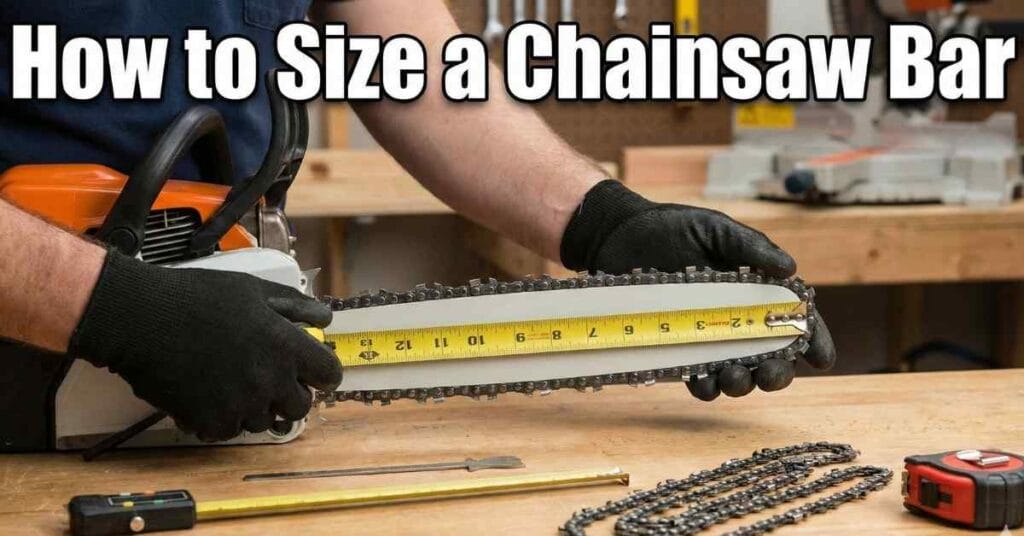
I remember the first time I tried to replace a chainsaw bar. It was a crisp Saturday morning. I had a pile of oak logs waiting in the driveway and a saw that had seen better days.
I walked into the local hardware store, confident I knew what I needed. I had measured the old metal bar from end to end with a tape measure. I bought a “20-inch” bar. I drove home. I tried to fit it.
It didn’t fit. Not even close.
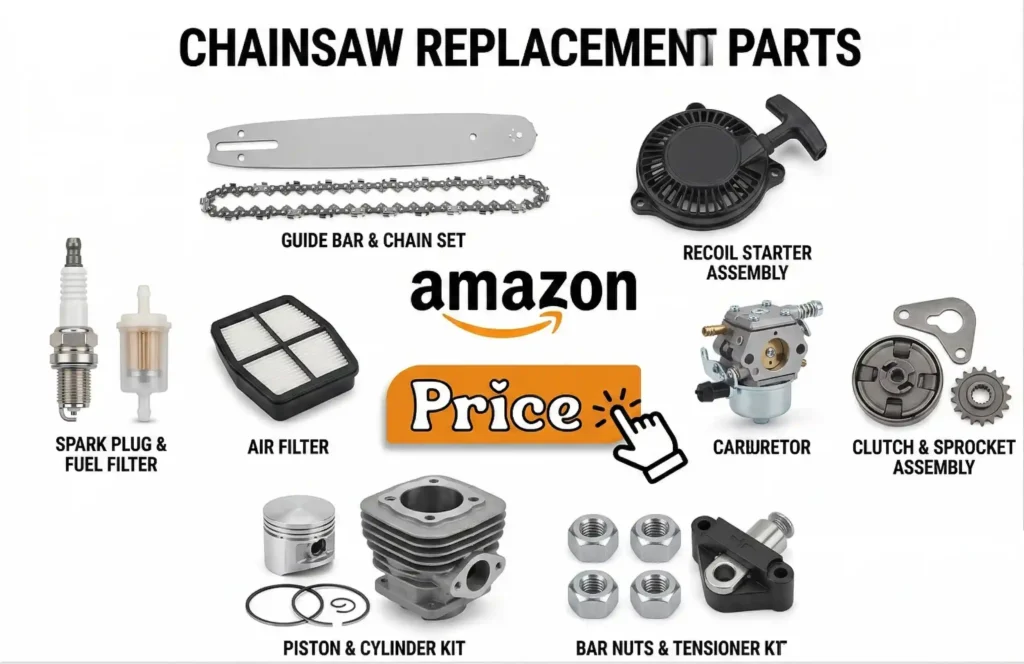
I learned the hard way that sizing a chainsaw bar is not just about length. It is a mix of knowing your “called length” and finding three tiny, hidden numbers.
If you are standing in your garage with a tape measure right now, let me save you a trip. Here is how I learned to size a chainsaw bar the right way.
It Starts With “Called Length”
There is a big difference between the total length and the cutting length. This was my first big error.
I took the bar off the saw and measured it from tail to tip. It was about 22 inches. So, I thought I had a 22-inch bar. Wrong.
Here is the trick:
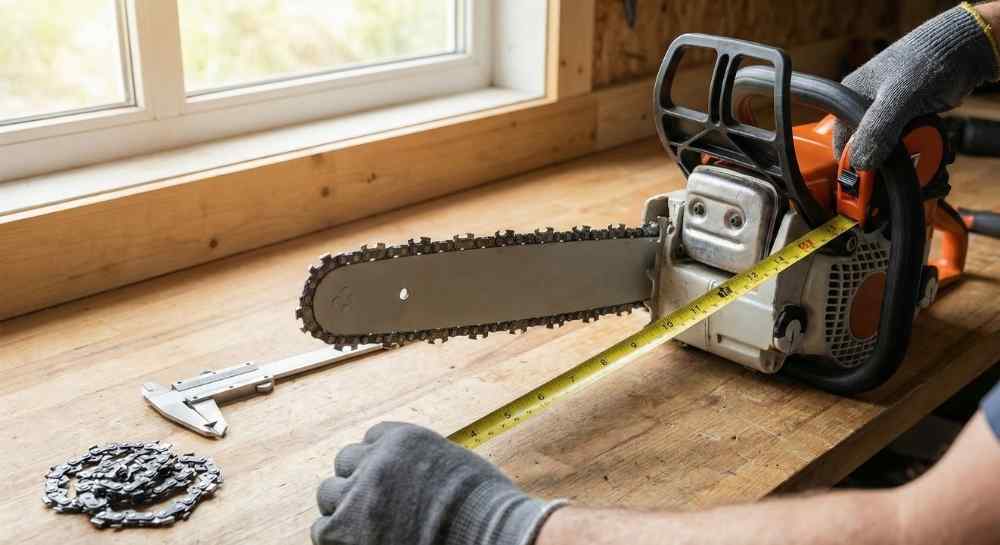
Leave the bar on the saw. Grab your tape measure.
- Place the tape at the front face of the saw body (right where the bar comes out).
- Measure to the very tip of the nose.
- Round that number up to the nearest even inch.
If you measure 17 inches, you have an 18-inch bar. That is your “called length.” It is the only part that matters for cutting wood.
The Hidden Data: Pitch, Gauge, and Links
Getting the length right is only step one. The next part feels a bit like detective work. You need to match the chain to the bar, and the bar to the saw.
I used to ignore the numbers stamped on the side of the bar. I thought they were just serial codes. They are actually the vital specs you need.
You need to find these three “golden numbers”:
1. Pitch
This is the space between the rivets.
- My experience: I once tried to force the wrong chain onto a sprocket. It sounded terrible and ruined the chain instantly.
- How to check: Measure the distance between any three rivets on your chain. Divide that number by two. That is your pitch.
2. Gauge
This is how thick the drive link is. Think of it as the “fin” that rides inside the bar groove.
- The test: It is hard to see the difference with your eyes. A .050″ gauge looks just like a .058″ gauge.
- My trick: I use a dime. If a dime fits snugly into the bar groove, it is usually a .050″ gauge. If a penny fits, it is likely the larger .058″ or .063″.
3. Drive Link Count (DL)
This is the total number of links in the chain.
- The only way: You have to count them. I know, it is boring. I usually mark the first one with a permanent marker so I don’t lose my place. This number must be exact. If you are off by one link, the chain won’t fit.
The Mount Pattern Matters
I cannot stress this enough. Even if you get the length, pitch, and gauge right, the bar might not bolt on.
Different brands use different “mounts.” A Stihl mount usually won’t fit a Husqvarna saw. The bolt holes won’t line up.
Worse, the oil holes won’t match.
I always check the oiler hole now. If that hole is blocked, your bar gets no oil. It will smoke, overheat, and die in minutes. I ruined a good bar this way once. It was an expensive lesson.
Quick Cheat Sheet
To make this easier, I made a simple table for you. Before you buy anything, fill this out.
| Spec | What it Means | How to Find It |
| Called Length | The cutting area | Measure from saw body to tip. |
| Pitch | Space between rivets | Measure 3 rivets, divide by 2. |
| Gauge | Thickness of the link | Use the “dime test” or check the stamp. |
| Drive Links | Total length of chain | Count the drive teeth manually. |
| Mount | Bolt & Oil pattern | Check your owner’s manual. |
Final Thoughts
Sizing a chainsaw bar feels hard at first. But once you know where to look, it is easy.
Most of the time, you can find all these numbers stamped on the tail of your old bar. You just have to scrub off the sawdust and oil to see them.
Take the time to check the numbers. It feels much better to cut wood with a saw that fits perfectly than to drive back to the store in frustration.
FAQs – How to Size a Chainsaw Bar
How do I measure my chainsaw bar size?
To size a bar, measure from the saw body to the tip. Do not measure the whole metal piece. Round that number up to the next even inch to find the true cutting length.
Can I put a longer bar on my chainsaw?
You can use a longer bar if your motor is strong. A small saw cannot run a big bar well. It may stall or get hot. Check your manual to find the max size allowed.
What do pitch and gauge mean for a saw?
Pitch is the space between rivets. Gauge is how thick the link is. You must match these numbers to your saw. If you do not, the new chain will not cut wood at all.
How do I count the drive links on a chain?
To count drive links, take the chain off the saw. Count each tooth that rides in the groove. You need the exact count for the chain to fit safe and tight on the bar.
Why does my new bar not fit my saw?
Brands use different mounts. A bar for one brand may not fit another. Check the oil holes and bolt slots on the tail of the bar. They must line up for the saw to work.
As an Amazon Associate, We earn from qualifying purchases